


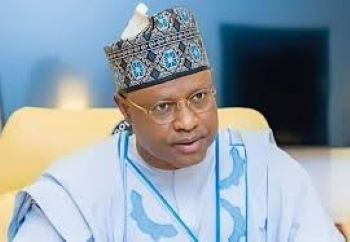
Gov. Uba Sani of Kaduna State says the state has made significant improvements in security, infrastructure, and human development since he assumed office in 2023.
He made the remarks at a workshop for senior government officials organised by the Nigerian Institute of Public Relations (NIPR) during Nigeria Public Relations Week, Croc City 2026, in Kaduna.
The workshop, themed “From Policy to Public Trust: Strategic Communication for Vision Alignment and Governance Delivery for Renewed Hope,” was attended by commissioners, special advisers, counsellors, permanent secretaries, and other top officials.
Sani said he inherited a state with immense potential but burdened by insecurity, infrastructure deficits, and poor social indicators.
“Kaduna is not where it was. Kaduna is by far a better place today and is on the path to greater heights,” he said.
He explained that his administration adopted a results-driven governance model anchored on Key Performance Indicators (KPIs) to ensure accountability and measurable impact across ministries, departments, and agencies.
The government’s agenda is structured around seven strategic pillars: security, infrastructure, institutional strengthening, trade and investment, agriculture, human capital development, and citizen engagement.
On security, Sani said his administration collaborated with the Office of the National Security Adviser and military authorities to establish bases in high-risk areas, deployed over 150 vehicles and 500 motorcycles, and created a Joint Task Force to reduce urban crime.
He added that over 20,000 hectares of farmland were reclaimed, more than 1,000 displaced persons resettled, and over 117,000 internally displaced persons are receiving support. The administration also established a forensic laboratory and the Kaduna Incident Report Centre (KAD-IR).
In education, 736 classrooms were constructed, over 1,200 renovated, 10,000 teachers recruited, and more than 33,000 personnel trained. Out-of-school children dropped from about 550,000 to 187,720. Skills development initiatives include an Institute of Vocational Training and Skills Development.
On healthcare, 255 primary healthcare centres were upgraded, 23 centres of excellence created, and a 300-bed specialist hospital established.
The state initiated 150 road projects covering over 1,300 kilometres. Agricultural funding rose from ₦1.48 billion in 2023 to over ₦74 billion in 2026, with over 900 trucks of fertiliser distributed and more than 100,000 farmers enrolled in insurance schemes.
Sani said 23 investments worth $743 million were actualised between 2023 and 2025, with a $2.77 billion pipeline. Over 2.5 million bank accounts were opened, and ₦18 billion disbursed to support households and businesses. The free CNG mass transit scheme has served over 1.4 million passengers.
He reaffirmed his administration’s commitment to inclusive development, highlighting “Project 255,” which ensures ₦100 million investment in each ward across the state.
