


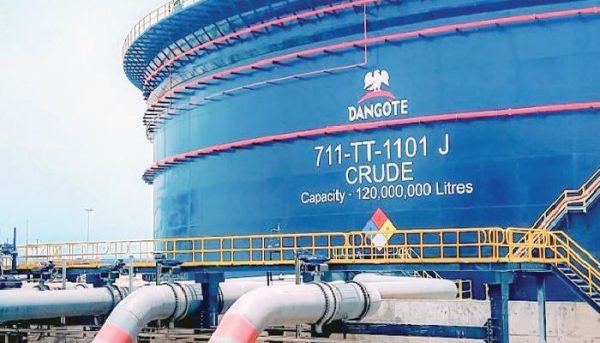
Dangote Petroleum Refinery & Petrochemicals has increased its crude oil processing capacity to 700,000 barrels per day (bpd), exceeding its official nameplate capacity of 650,000 bpd.
This achievement was confirmed during a performance test conducted by the refinery’s process licensors and marks a major milestone in its operational growth. It also cements the refinery’s status as the world’s largest single-train petroleum refinery.
In a statement issued Thursday in Lagos, Anthony Chiejina, Head of Corporate Communications, highlighted that the capacity increase reflects the refinery’s strong engineering design and operational efficiency.
Vice President of Oil and Gas at Dangote Industries Limited, Devakumar Edwin, announced plans to expand capacity to 1.4 million bpd within the next 30 months, aiming to position the facility among the largest refineries globally.
Edwin explained that the expansion would boost Nigeria’s energy security, reduce reliance on imports, and enhance the country’s position as a major exporter of refined products. He also emphasized the refinery’s long-term vision of becoming a leading refining hub for Africa and the world.
Owned by Nigerian industrialist Aliko Dangote, the refinery began fuel production in 2024 and has steadily increased output of petrol, diesel, aviation fuel, and other petroleum products. It currently supplies both local and international markets, exporting to several African countries, Europe—including the UK, France, Spain, Italy, and the Netherlands—and even the United States and Saudi Arabia.
The refinery has become a stabilizing force in the energy sector, especially amid global supply disruptions caused by tensions in the Middle East. As a result, many African countries now rely on it for energy security.
In April, S&P Global Commodities named Dangote Petroleum Refinery the world’s largest exporter of jet fuel, highlighting its influence in global energy markets. It has also improved fuel availability in Nigeria, reducing reliance on imports and easing pressure on foreign exchange reserves.
The expansion supports Nigeria’s efforts to boost local refining capacity and maximize crude oil resources. Increasing production has drawn interest from international crude oil suppliers and traders, sourcing feedstock locally and abroad.
Looking ahead, Dangote plans to reach 1.4 million bpd by 2028, with economic benefits including job creation, industrial growth, and improved trade balances. The refinery will also supply downstream industries with LPG, polypropylene, and other feedstocks for manufacturing packaging and consumer goods. Future projects include producing Linear Alkylbenzene (LAB) for detergent manufacturing.
