


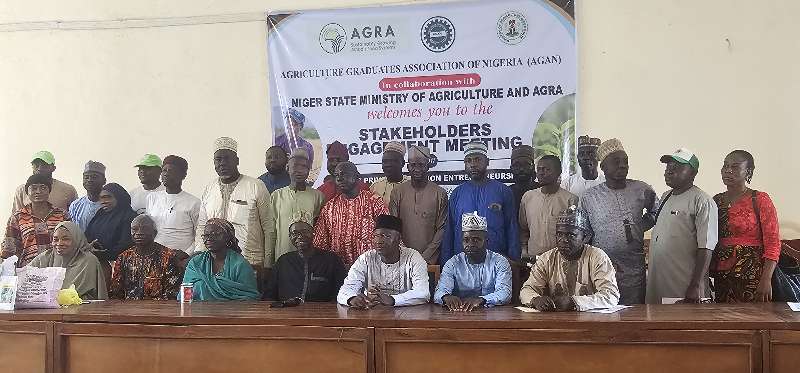
In a bid to combat the severe shortage of agricultural extension personnel, the Agriculture Graduates Association of Nigeria (AGAN) and the Niger State Ministry of Agriculture is engaging stakeholders across the agricultural sectors and value chain.
The crux of the meetings is focused on public private extension entrepreneurship to address the severe shortage of public extension workers and the rising complexity of modern farming.
The stakeholders meeting which took place at the Conference Hall of the Niger State Ministry of Agriculture looked at developing sustainable, private sector-led solutions to the mounting challenges facing extension services in the state.
The Permanent Secretary of the Ministry of Agriculture, Dr Mathew Ahmed acknowledged that traditional public extension services can no longer bear the burden of a growing farmer population, climate change, and strict resource constraints.
Ahmed, who was represented by the Director, Agricultural Services and Linkages, Malam Adamu Garba said that to achieve sustainable food security and economic growth, the government is actively supporting a shift toward private extension service providers adding that this collaboration is set to address critical issues such as capacity building, digital extension solutions, and the inclusion of youth in agriculture.
The Technical Coordinator of AGAN, Mallam Abdulsalam Mohammed highlighted that the farmer to extension worker ratio has skyrocketed to outrageous numbers emphasizing that the government cannot tackle this enormous responsibility alone due to competing demands for limited resources.
He noted that by combining public resources with private sector efficiency, the initiative aims to make smallholder farmers more productive, making collaboration between the public and private sectors essential to keep smallholder farmers productive and ultimately boost the national economy.
The Niger state AGRA Programme Officer, Dr Godswill Aguiyi challenged stakeholders to view extension services through a commercial lens explaining that rather than relying entirely on free government programs, the AGAN proposed model treats agricultural extension as a specialized, demand-driven consultancy.
He explained that in this system, the extension agents operate similarly to medical professionals as farmers facing specific crop diseases or soil issues request diagnostic services and pay for the resulting advisory and solutions, creating a profitable enterprise for private practitioners.
To support this new ecosystem, the Chief Executive Officer of AGAN, Alhaji Hussaini Iliyasu announced the creation of a One Stop Shop marketplace saying this central contact point connects farmers directly with agro-dealers, mechanization providers, and financial institutions.
He further said that AGAN is collaborating with the National Agricultural Seed Council and the National Cereals Research Institute to train Community Based Advisors as certified seed producers pointing that this strategy ensures farmers have immediate access to improved, climate-resilient crop varieties while generating independent income for the extension workers
