

• Home
  • Agric
  • Sci & Tech
  • Health
  • Environment
  • Hausa News
  • More
    • Business/Banking & Finance
    • Politics/Elections
    • Entertainments & Sports
    • International
    • Investigation
    • Law & Human Rights
    • Africa
    • ACCOUNTABILITY/CORRUPTION
    • Hassan Gimba
    • Column
    • Prof. Jibrin Ibrahim
    • Prof. M.K. Othman
    • Defense/Security
    • Education
    • Energy/Electricity
    • Entertainment/Arts & Sports
    • Society and Lifestyle
    • Food & Agriculture
    • Health & Healthy Living
    • International News
    • Interviews
    • Investigation/Fact-Check
    • Judiciary/Legislature/Law & Human Rights
    • Oil & Gas/Mineral Resources
    • Press Freedom/Media/PR/Journalism
    • General News
    • Presidency
  • About Us
    • Contact Us
    • Board Of Advisory
    • Privacy Policy
    • Ethics Policy
    • Teamwork And Collaboration Policy
    • Fact-Checking Policy
    • Advertising
  • Media OutReach Newswire
    • Wire News
  • The Stories
Facebook Twitter Instagram
Trending
  • VAT to states surges 30% to N551.8bn in February
  • Sanusi blasts Nigeria’s borrowing spree despite subsidy gains, demands fiscal accountability
  • CBN, NEXIM meet to align strategies to boost non-oil exports, FX earnings
  • Condom prices set to rise 30%
  • Nigerian overnight financing rate: What it means for banks, markets and SMEs, By Kalu Aja
  • Global hunger to stay critical in 2026
  • Naira slides to N1,355/$ as external reserves dip to $48.48bn
  • Power transmission in Nigeria set to improve
Facebook Twitter Instagram YouTube
AsheNewsAsheNews
  • Home
  • Agric

    Global hunger to stay critical in 2026

    April 24, 2026

    Building resilience locally–small-scale producers and fertilizer [FULL PAPER]

    April 24, 2026

    AFAN Enugu gets new leadership

    April 23, 2026

    Experts call for boost in local snail production

    April 23, 2026

    [EXPLAINER] Bottled water under the microscope: Why some brands stand out

    April 23, 2026
  • Sci & Tech

    Global fish growth declines over the last century

    April 24, 2026

    GIGM unveils integrated mobility platform

    April 23, 2026

    Airtel Africa launches DigiLeap tech drive for young women

    April 23, 2026

    CITAD urges more girls in tech

    April 23, 2026

    NCC to upgrade 12,000 towers, compensate users

    April 23, 2026
  • Health

    Condom prices set to rise 30%

    April 24, 2026

    HPV, malaria vaccines save lives across Africa

    April 24, 2026

    Group urges Nigerians to choose heart-healthy foods

    April 23, 2026

    Lagos trains officers to boost health surveillance

    April 23, 2026

    West Africa advances lassa fever vaccine readiness

    April 23, 2026
  • Environment

    Lagos cracks down on E-waste

    April 23, 2026

    Nigeria achieves 91% aviation safety rating

    April 23, 2026

    FG seeks $516m external financing for Sokoto–Badagry superhighway

    April 23, 2026

    NGE warns NBC over sanction threat

    April 22, 2026

    Don urges geographers to tackle forest crisis

    April 21, 2026
  • Hausa News

    Otti plans 250-room 5-star hotel in Umuahia

    April 11, 2026

    Anti-quackery task force seals 4 fake hospitals in Rivers

    August 29, 2025

    [BIDIYO] Yadda na lashe gasa ta duniya a fannin Ingilishi – Rukayya ‘yar shekara 17

    August 6, 2025

    A Saka Baki, A Sasanta Saɓani Tsakanin ‘Yanjarida Da Liman, Daga Muhammad Sajo

    May 21, 2025

    Dan majalisa ya raba kayan miliyoyi a Funtuwa da Dandume

    March 18, 2025
  • More
    1. Business/Banking & Finance
    2. Politics/Elections
    3. Entertainments & Sports
    4. International
    5. Investigation
    6. Law & Human Rights
    7. Africa
    8. ACCOUNTABILITY/CORRUPTION
    9. Hassan Gimba
    10. Column
    11. Prof. Jibrin Ibrahim
    12. Prof. M.K. Othman
    13. Defense/Security
    14. Education
    15. Energy/Electricity
    16. Entertainment/Arts & Sports
    17. Society and Lifestyle
    18. Food & Agriculture
    19. Health & Healthy Living
    20. International News
    21. Interviews
    22. Investigation/Fact-Check
    23. Judiciary/Legislature/Law & Human Rights
    24. Oil & Gas/Mineral Resources
    25. Press Freedom/Media/PR/Journalism
    26. General News
    27. Presidency
    Featured
    Recent

    VAT to states surges 30% to N551.8bn in February

    April 24, 2026

    Sanusi blasts Nigeria’s borrowing spree despite subsidy gains, demands fiscal accountability

    April 24, 2026

    CBN, NEXIM meet to align strategies to boost non-oil exports, FX earnings

    April 24, 2026
  • About Us
    1. Contact Us
    2. Board Of Advisory
    3. Privacy Policy
    4. Ethics Policy
    5. Teamwork And Collaboration Policy
    6. Fact-Checking Policy
    7. Advertising
    Featured
    Recent

    VAT to states surges 30% to N551.8bn in February

    April 24, 2026

    Sanusi blasts Nigeria’s borrowing spree despite subsidy gains, demands fiscal accountability

    April 24, 2026

    CBN, NEXIM meet to align strategies to boost non-oil exports, FX earnings

    April 24, 2026
  • Media OutReach Newswire
    • Wire News
  • The Stories
AsheNewsAsheNews
Home»Column»Prof. Jibrin Ibrahim»Tunani thinking on digital technology and addressing Nigeria’s education crisis, Prof. Jibrin Ibrahim
Prof. Jibrin Ibrahim

Tunani thinking on digital technology and addressing Nigeria’s education crisis, Prof. Jibrin Ibrahim

EditorBy EditorOctober 17, 2025Updated:October 17, 2025No Comments6 Mins Read
Prof. Jibrin Ibrahim
Share
Facebook Twitter LinkedIn Pinterest Email

Tunani Initiative, is a start-up of thinking young people seeking solutions to Nigeria’s numerous challenges. To celebrate the 2025 World Literacy Day last month, they organised an event to seek solutions to Nigeria’s shame of having the highest percentage of out of school children in the world. It was a good idea because I believe that the greatest challenge facing Nigeria today is that of rebuilding a high-quality educational system that could encourage the development of knowledge, skills, civic education and critical thinking for our young ones who are living in a society tearing at the seams. Quality education could be the pathway that would lead to the rebuilding of confidence in a future that could provide jobs, opportunities and progress for the majority. 
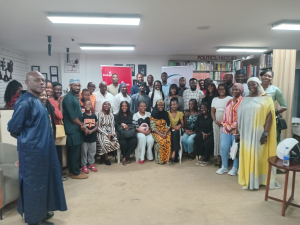
A group photograph of attendees!

It was the late statesman, Ahmed Joda, who drew our attention to the national pledge made by Nigeria in 1973. That year, the Head of State, General Yakubu Gowon, called a Government Retreat and asked for one policy recommendation that would ensure Nigeria would never again run the risk of another civil war. The outcome was the announcement of a  national pledge that every Nigerian child born from the end of the civil war, that is, January 1970, would be guaranteed free, compulsory, high-quality  and compulsory primary education. Subsequently, we extended the promise from primary to basic education, that is, nine years of free and high-quality education for all Nigerian children. All governments were to ensure that each year, sufficient resources are made available to ensure every child is in school. Nigerian governments abdicated this pledge and allowed the public education sector to collapse.

Each year, Nigeria graduates millions of children from the 65,000 public primary schools in the country. The assumption is that they have passed their exams so they are sent to junior secondary schools and the government appears pleased that it has met the constitutional provision of providing quality education to all Nigerians. Everybody knows it’s a lie because the entire elite class in the country send their own children to private, and not public schools. The reality is that Nigeria has abandoned any serious commitment to public primary schools for four decades and most of them are today factories for the reproduction of illiteracy and ignorance. We have been paying a heavy price for our irresponsibility as demonstrated by the growth of violent extremism, mass kidnapping and armed banditry activated for the most part by young, uneducated and marginalised youth.

It was my good friend Bolaji Abdullahi who first exposed our collective lie that we are educating the children of the masses. As Commissioner of Education in Kwara State, he decided to test the level of competency of primary school teachers in 2007. He organised a scheme to administer primary four examinations on the 19,000 teachers in public primary schools in the State and the results were shocking. Only 75 out of the 19,000 teachers passed with the required 80% competence threshold. Each year, the student’s pass but their teachers are incapable of passing the same exams. My good friend Kayode Fayemi lost his first attempt to get a second term in the gubernatorial election in Ekiti State partly because his political enemies spread the story that he was planning to run competency tests for teachers in the State if he won the second term election. The political question posed was how dare him think that only competent teachers should teach in public schools? The teachers ganged up and mobilised to stop him winning, they did not want to take the risk of their ignorance being exposed.

The Tunani event on promoting literacy in the digital age took place appropriately at Abuja’s main bookshop – Rovingheights, a bookshop with a large collection on history, politics, economics, biographies and faith. The learnings I came out with however, from my children who organised the event, is that the time has come for us to move from paper to digital books. We now have digital tools which have the ability to accelerate learning and make the entire society – both those in and out of school, literate and numerate in a few years. 

There is an important innovation currently supported by the African Union and the Global Partnership for Education (GPE) based on the use of digital pens and books. These digital tools enable the provision of high quality, learner-centred education for all, irrespective of literacy level, location or language at a fraction of the cost of conventional educational approaches. When the pen touches text or pictures in the book, it voices out texts lined up to a corresponding audio, that is accompanied with interactive games, quizzes and multi-language translations.

These programmes are already in use in Abuja and Lagos for accelerated and effective learning – literacy, numeracy, health, languages and so on. In fact, the books have been designed to help semi-skilled or unskilled teachers teach while guiding the children to learn at the same time. These formatted talking books work from the language that the user understands, thereby solving both the quality and language barrier challenges that undermine learning in Nigeria. The interesting thing about the technology is that the use of the Hausa to English book for example would simultaneously allow a Hausa speaking child to quickly learn English while using the tool to improve their Hausa as well. These talking books follow the national curriculum and they do not need the Internet to function.
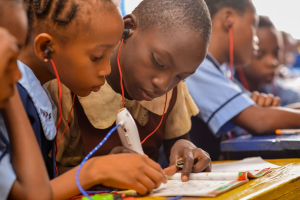
Children using the talking pens and books in Lagos, Nigeria.

Children using the talking pens and books in Lagos, Nigeria.

These digital tools can help address the challenges with basic education in Nigeria, especially in public primary schools and the large number of out-of-school children. The Federal Ministry of Education estimates that 50% of in-school children are not learning because they cannot read or write. Around 84% of children in the lowest economic quartile cannot read at all. Of course, Nigeria has the largest number of out-of-school children in the world, with recent estimates by UNICEF of over 13.2 million children not going to school. We now have the means to address this crisis in a fast and relatively cheap manner. 
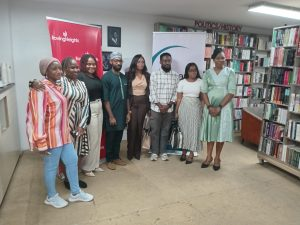
A line-up of the young panellists

According to the young panellists at the event, initially, there was a problem with internet-based digital tools because the poor have limited access due to the cost of the appliances, internet access and the cost of data. Today, cheap appliances have been developed and they do not require internet access because the contents are already stored in the pens and books. Thanks to the Tunani Initiative, Maryam Ibrahim and Alhassan Pereira Ibrahim for drawing attention to a pathway that could greatly advance education attainment in Nigeria.

Nigeria's education
Share. Facebook Twitter Pinterest LinkedIn WhatsApp Reddit Tumblr Email
Editor
  • Website

Related Posts

Abubakar Sokoto Mohammed: The passage of a committed comrade, By Prof. Jibrin Ibrahim

April 24, 2026

Tinubu is unravelling the nation, By Prof. Jibrin Ibrahim

April 17, 2026

The Tinubu regime seeks to deny the opposition party platform, By Prof.Jibrin Ibrahim

April 3, 2026

Leave A Reply Cancel Reply

VAT to states surges 30% to N551.8bn in February

April 24, 2026

Sanusi blasts Nigeria’s borrowing spree despite subsidy gains, demands fiscal accountability

April 24, 2026

CBN, NEXIM meet to align strategies to boost non-oil exports, FX earnings

April 24, 2026

Condom prices set to rise 30%

April 24, 2026
About Us
About Us

ASHENEWS (AsheNewsDaily.com), published by PenPlus Online Media Publishers, is an independent online newspaper. We report development news, especially on Agriculture, Science, Health and Environment as they affect the under-reported rural and urban poor.

We also conduct investigations, especially in the areas of ASHE, as well as other general interests, including corruption, human rights, illicit financial flows, and politics.

Contact Info:
  • 1st floor, Dogon Daji House, No. 5, Maiduguri Road, Sokoto
  • +234(0)7031140009
  • ashenewsdaily@gmail.com
Facebook Twitter Instagram Pinterest
© 2026 All Rights Reserved. ASHENEWS Daily Designed & Managed By DeedsTech

Type above and press Enter to search. Press Esc to cancel.