


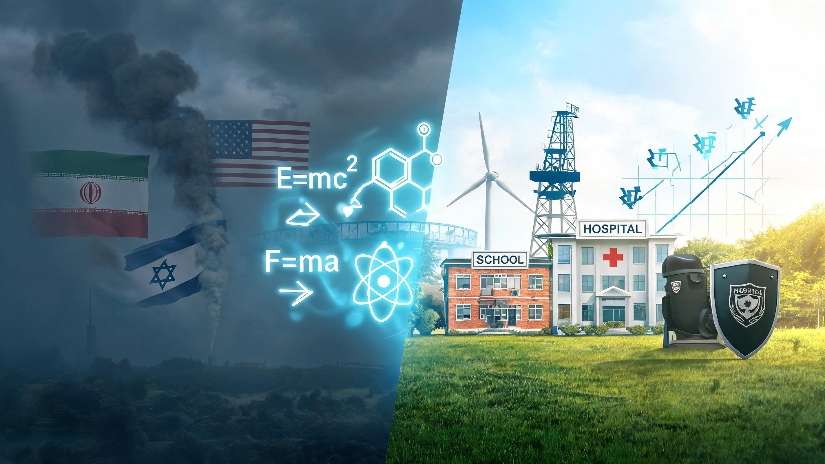
In Physics, we were taught: That a body of mass M, moving at a velocity V, will cover a distance S in time T. We learnt the laws of motion and gravity, and how there is always an equal and opposite reaction to every action. We also studied electricity (energy), magnetism, light and optics, fluid mechanics, tensile strength and elastic limits.
In Nuclear Physics, we learnt how the extreme sun-grade heat energy generated through nuclear fission and fusion reactions can be used peacefully to produce electricity or otherwise to produce destructive military hardware.
In Chemistry, we were taught:
Gases, liquids and solids; the Periodic Table and its halogens, metals, transition and rare earth elements; atoms, protons, neutrons, electrons, elements and compounds.
In Thermodynamics, we learnt that energy can neither be created nor destroyed, but can only be transferred or converted.
We were also taught that the volume of a gas V is directly proportional to its temperature T, provided its pressure P remains constant.
In Mathematics, we were taught:
Calculus and how to differentiate and integrate integers, statistics, ratios, binaries, angles, sines and cosines, exponentials, algebra, latitudes, longitudes, coordinates and logarithms.
I remember these elementary Physics, Chemistry and Mathematics lessons very well during the glorious days of Nagarta College, Sokoto State — a first-generation formal post-primary government science college revitalised and rebranded as a direct product of the visionary education policy of the administration of His Excellency, Governor Malam Yahaya Abdulkarim.
ALSO READ Sultan confers traditional title on Kakale Shuni
A great salute to all those visionary leaders in his cabinet, the Sultanate Council, education administrators, managers and our dedicated Principal Alhaji Sani Muhammad Nahuce and teachers (Allah ya saka musu da alkhairi. Amin) for promoting and prioritising science, technology and technical education in the old Sokoto State, comprising present-day Sokoto, Kebbi and Zamfara states.
That visionary strategy was simple: produce a critical mass of Sokoto State science education graduates who would go on to study Medicine, Pharmacy, Engineering, Architecture, Mathematics, Pure and Applied Sciences, Agriculture and related disciplines in universities within and outside the country, and return home as professionals, researchers, innovators and inventors capable of igniting transformative development in all aspects of human life in Sokoto State and Nigeria at large.
Whether those goals have been fully achieved over 30 years later is a subject for another debate.
Yes, the schools were well funded, with world-class educational quality assurance, student welfare, safety and security, and the best-qualified teachers recruited from Nigeria, Ghana, India, Pakistan and the Philippines.
And the system worked.
At least, I remember very well that out of about 120 of us in the SS3 graduating class of 1992, only four students, with three credits and five passes, were at the lowest end of the Gaussian distribution.
As for the rest? It was rains and splashes of “A”s and “B”s in Physics, Chemistry, Mathematics, Biology, Agricultural Science, Geography and other subjects.
The mean of our SSCE scores was “A”, the median was “A”, the mode was “A”, and the standard deviation from the mean was also an “A”.
Of course, the degree of confidence and the 95th percentile of our SSCE results were all “A”s. “B”s were not even close.
Almost every graduate of Nagarta College in that set gained university admission — except those who declined by choice — to study Medicine, Pharmacy, Engineering, Agriculture, Pure and Applied Sciences and other disciplines.
The science of the Iran-US/Israel war
Iranian missiles and drones fired at enemy targets do not know the municipal addresses of those targets. They do not know who or what lives there, or how they look. They do not know whether the targets are Jews or Arabs.
All they know and understand are mass, speed, gravity, fuel combustion, energy conversion and coordinates.
In essence, they only know, understand and apply Physics, Chemistry and Mathematics.
Iran invested heavily in its education system, particularly in Physics, Chemistry, Mathematics and other sciences, over more than four decades of crushing economic sanctions imposed by the United States and its allies.
Using homegrown expertise from their education system, the Iranians — with a population of about 90 million — built and expanded their oil, gas and petrochemical infrastructure to achieve sufficiency. They ramped up electricity generation and distribution to about 50,000MW to achieve energy sovereignty.
(Compare this with Nigeria — population over 225 million — still struggling with 3,000–4,000MW.)
They revitalised their healthcare and pharmaceutical industries and systems, achieved health sufficiency, reversed medical tourism, and attained food security through advanced climate-resilient agriculture and agro-allied industrialisation.
Their manufacturing base has remained solid through steel mining, processing and production independence, while Nigeria’s Ajaokuta Steel project remains unrealised.
They locally own and operate space, rocket science and nuclear facilities for digital communication, internet services, telecommunications, energy, medicine and industrial research and development.
These are no small achievements for a country operating within the same GDP bracket as Nigeria.
The Iranians pursued these goals not only to achieve education, energy, industrial, health and agricultural sovereignty for the ancient oil-and-gas-rich Persian nation, but also to remain battle-ready and capable of defending themselves against any eventual aggression from the United States and Israel.
And, as sure as the sun rises every day, the day of aggression and attacks came from the usual suspects — the US and Israel.
Iran stood virtually alone against self-acclaimed superpowers whose combined military budgets are several times larger than Iran’s national GDP of about $400 billion.
Yet Iran stood firm and defended itself using strategies and tactics built upon the foundations of its sovereign education system — Physics, Chemistry and Mathematics.
They were expected to be wiped out within days.
But no.
The courage and resilience of Iran in this conflict will remain a subject of study for education scholars, policymakers, military historians, researchers and students for generations to come.
Lessons for Nigeria: The crisis of our education system
For far too long, we have retained educational systems designed by colonial powers — systems that no longer serve our present realities or future aspirations.
These systems have failed to provide sustainable solutions to our health, agricultural, security, energy and economic challenges.
The colonial educational framework has raised generations through curricula that often fail to reflect our realities, aspirations and developmental needs. Instead, they promote dependency, excessive consumerism and unproductive orientations.
The system was primarily designed to “educate” individuals away from their communities.
The more “Western educated” one became, the less connected one often felt to indigenous communities, values, welfare, safety and collective ambitions.
The colonised were compelled to learn the language, history, laws, food, fashion and manners of the colonisers, while indigenous systems, traditions and governance structures were disregarded.
This has contributed to systemic redundancy, poverty and economic decline in many communities, while pushing many young people — our greatest assets — toward fake certificates, unemployable degrees, hopelessness and vulnerability to extremism or destructive alternatives.
We must therefore decolonise our educational theories, policies, curricula, identity, funding, access, pedagogy, sociology and psychology.
An uneducated mind is vulnerable, but a miseducated mind is a tragedy.
The need for educational renewal in Nigeria
We must reinvent our education system from a colonial relic of exploitation into one focused on our present and future needs.
We must produce critical thinkers, pioneers and experts in Physics, Chemistry, Mathematics, Quantum Mechanics, Artificial Intelligence, Machine Learning and Neuroscience.
We must train architects of advanced healthcare systems, genetics, stem cell biology, digital and space communications, blockchain technology, high-speed internet systems, cloud computing, supercomputers, robotics, space science and ocean technology.
One of the major pillars behind China’s emergence as a global superpower is its strategic control of education and its deliberate educational focus.
Let us build an education system that serves our energy sovereignty, health sovereignty, agricultural and food sovereignty, security sovereignty, digital technology sovereignty and economic infrastructure sovereignty.
God Bless Nagarta College.
God Bless Sokoto State.
God Bless the Federal Republic of Nigeria.
Dr. Kakale, who is of the Nagarta College Sokoto, Sokoto State, 1990s), is the Wakilin Makarantar Daular Usmaniya, and Barden Tsangayu da Makarantun Allon Hausa. He writes from Sakkwato Birnin Shehu and can be reached at kakaleshuni@gmail.com.
