


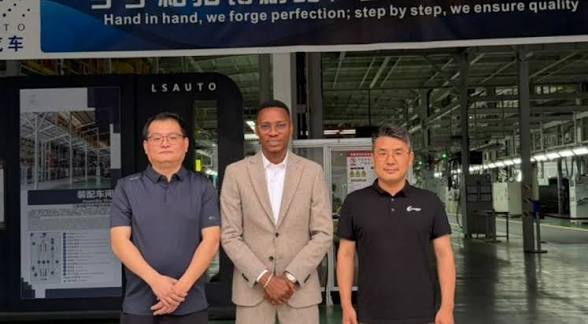
A Chinese company, Launch Design Shanghai, and Hybrid Motors Nigeria have partnered to boost electric vehicle manufacturing and assembly in Nigeria.
Chief Executive Officer of Hybrid Motors Nigeria, Jubril Arogundade, disclosed this in a statement on Sunday in Abuja.
Arogundade said the partnership would support electric vehicle manufacturing and assembly operations in Lagos and Abuja.
He noted that both firms signed a strategic cooperation agreement in Shanghai to accelerate the production of ‘Acely’, Hybrid Motors Nigeria’s indigenous electric vehicle brand.
“Acely is designed to meet local mobility needs,” he said.
Arogundade explained that the agreement would facilitate technology transfer, workforce training, and the gradual development of Nigeria’s electric vehicle supply chain.
He described the partnership as a major step toward strengthening Nigeria’s automotive future.
“This partnership is more than a business agreement; it is a commitment to building Nigeria’s automotive future. With Acely, we are proving that world-class vehicles can be designed, engineered, and assembled in Nigeria, by Nigerians, for Nigerians,” he said.
Arogundade added that the collaboration combines local market understanding with advanced automotive engineering expertise, producing vehicles that meet international standards while remaining suitable for Nigerian roads and consumers.
Chief Executive Officer of Launch Design Shanghai, Wang Xun, described the partnership as transformative.
“Together, we are not just building vehicles, we are building an industry,” Xun said.
The companies said manufacturing operations would be established in Lagos and Abuja, with a combined annual production capacity of 70,000 units at full maturity.
The Lagos facility, located along the Lekki-Epe corridor, will serve as the main production hub with an expected capacity of 50,000 units annually. The Abuja plant, situated within Centenary Economic City, will function as a manufacturing and technology centre with a capacity of 20,000 units per year.
The initiative is expected to create jobs, promote technology transfer, develop the local supply chain, and reduce dependence on imported vehicles.
It also aligns with Nigeria’s automotive development plans and cleaner transportation goals.
