


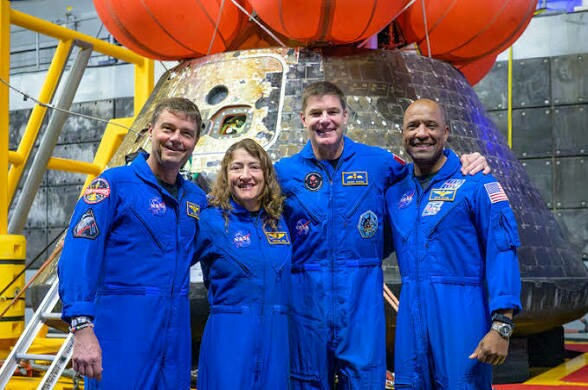
Prof. Babatunde Rabiu, a space physicist, has urged Nigeria and other developing countries to draw inspiration from NASA’s Artemis II Moon mission by prioritising investment in science, research, and technology.
Rabiu, Research Director at the National Space Research and Development Agency (NASRDA), made the remarks on Monday during an interview with the News Agency of Nigeria (NAN) in Abuja.
He was assessing the significance of the Artemis II mission, launched on April 1 as part of NASA’s broader Artemis programme, which aims to return humans to the Moon for the first time in over 50 years and lay the groundwork for future deep space exploration, including Mars.
Rabiu, who is also Head of the Space Physics Programme at the African University of Science and Technology (AUST), described the mission as a scientific milestone demonstrating the results of sustained investment in research.
“To start with, the mission is a breakthrough, a celebration, and a manifestation of human intelligence. It reflects years of deliberate planning and cutting-edge research,” he said.
He emphasised that Artemis II was the product of nearly a decade of structured work, building on the success of Artemis I, an uncrewed mission launched in 2022 to test spacecraft and systems in deep space.
Rabiu clarified that the mission’s goal is not to establish permanent human settlement on the Moon but to advance space exploration capabilities. “The Moon cannot support human life for long periods except in controlled environments. Astronauts can stay briefly in enclosed systems and return,” he explained.
He highlighted that Artemis II tested the Orion capsule’s performance in carrying humans beyond low Earth orbit, conducted experiments on the Moon’s environment, and included diverse crew representation, symbolising inclusivity and progress for humanity.
Beyond its scientific significance, Rabiu urged Nigeria and other African nations to view the mission as proof that no country has a monopoly on space exploration.
“It should inspire us to realise that these things are possible. We can rise beyond our current level if we take science and technology seriously,” he said, calling on leaders, policymakers, and investors to strengthen institutions and support research-driven development.
He stressed the practical applications of space technology for developing countries, including in security, communication, and environmental monitoring, and emphasised collaboration across sectors as essential to achieving progress.
“Many people contributed to the success of Artemis II, beyond science alone. We must draw inspiration from this and change our direction. If others can do it, we can do even greater things—and we must act now,” he concluded.
