


The Vice-Chancellor of the Federal University of Technology, Akure (FUTA), Professor Adenike Oladiji, has reaffirmed the institution’s commitment to combating food insecurity through innovative agricultural initiatives, research advancement, and modern farming technology.
Speaking during a tour of major projects across the university as part of activities marking her fourth anniversary in office on Friday, May 22, 2026, the Vice-Chancellor said the institution was strategically positioning itself for large-scale agricultural production and possible export-driven operations.
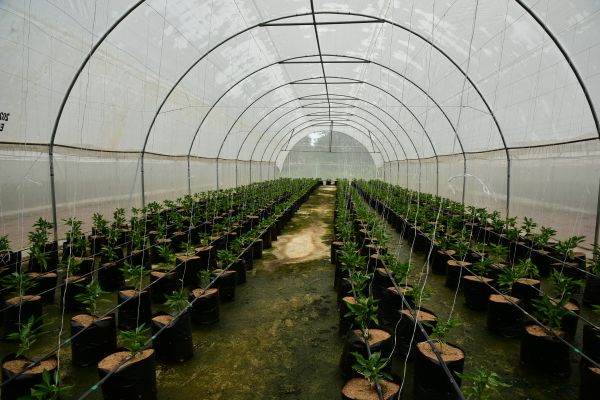
She disclosed that FUTA had completed the construction of new greenhouse structures, which are already being deployed for specialised farming. The 11 new structures, measuring 5 by 30 metres each, were built with reinforced imported steel and locally assembled. They are irrigated using a locally designed and installed drip irrigation system.
Each greenhouse, which is already in use, contains between 550 and 600 plants for the production of bell pepper and habanero pepper. The project is supervised by Professor Ayo Olalusi and supported by Professor Kehinde Jaiyeoba and Professor Jav Olumurewa, alongside some of their students.
Professor Oladiji explained that FUTA’s growing investments in agriculture are aimed at providing practical solutions to national food security challenges while creating opportunities for skills acquisition and economic growth. She noted that the university had expanded its agricultural facilities with support from the Tertiary Education Trust Fund (TETFund), particularly in poultry production, feed milling, and greenhouse farming.
She commended the Federal Government for including FUTA among the beneficiaries of the N1 billion agricultural grant for tertiary institutions, noting that the intervention had significantly boosted agricultural activities within the university.
The Vice-Chancellor highlighted the university’s greenhouse initiative, describing it as a locally developed innovation capable of supporting year-round cultivation of crops such as tomatoes and peppers, regardless of seasonal limitations. She explained that the local fabrication of the greenhouses was intended to make them more adaptable to prevailing conditions in the country while providing researchers and students with hands-on experience.
She added that students from FUTA and other universities undertaking industrial attachment programmes are actively involved in the projects as part of efforts to expose them to practical agricultural entrepreneurship and value-added production processes. According to her, the institution’s long-term plan is to scale up commercial farming activities to support food supply within the host community and create export opportunities.
While conducting the Vice-Chancellor and her entourage around the facility, Professor Olalusi described the F1 bell pepper as an early-ripening hybrid variety with a bushy plant that does not require staking. He said its advantages include a high level of disease resistance, vigorous growth, sweet flavour, and large fruit size, measuring about 10–11cm in width and 11–12cm in length, with an average weight of between 250g and 280g.
Professor Olalusi added that the uniqueness of the F1 bell pepper lies in the fact that it can only be propagated in a greenhouse. He stated that FUTA is willing to guide interested individuals and farmers through greenhouse cultivation processes on either a small or large scale. He added that the university would continue cultivating the pepper within its greenhouses to serve its immediate environment and would also explore partnerships for large-scale production capable of generating substantial revenue for both FUTA and its partners.
The Vice-Chancellor further stated that, apart from greenhouse farming, FUTA is making significant progress in poultry production. She explained that the revitalised poultry section now operates with improved technology and modern systems that enhance productivity and efficiency.
According to her, the poultry section of the university’s livestock farm was recently reactivated to boost egg production, achieving a high success rate. Consequently, the university has commenced the introduction of an additional 4,160 layers into newly acquired and installed automated battery cages at its Teaching and Research Farm. She also disclosed that most of the poultry feed used is produced by FUTA.
Professor Oladiji further inspected several infrastructural projects on campus, including the remodelled Akindeko Hostel, which now provides 653 bed spaces in 145 rooms across eight blocks. The facility also includes a common room, a reading room, and a purpose-built mini-mart.
She also toured the remodelled Public Health Laboratory Museum, upgraded to support research, learning, and documentation. The Vice-Chancellor noted that plans were underway to establish a School of Nursing laboratory to complement the already functional Medical Laboratory Science laboratory.
Members of her entourage were also shown the newly constructed purpose-built guest chalets designed to provide improved accommodation for visiting academics and researchers.
She noted that while some of the projects were financed through TETFund interventions, others were funded through internally generated revenue and support from individuals and stakeholders within the Akure community.
Reiterating the university’s developmental vision, Professor Oladiji stressed that FUTA would continue to play a significant role in advancing agricultural innovation and national development.
