


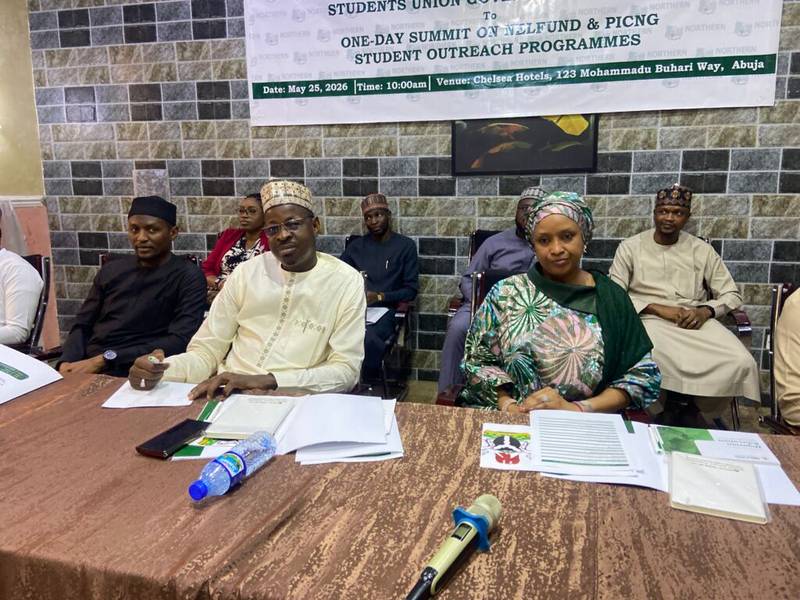
The Federal Government says it will bridge the information gap on ongoing development projects in Northern Nigeria through improved public communication, citizen engagement, and documentation of key interventions across the region.
Hadiza Bala-Usman, Special Adviser to the President on Policy Coordination, said this at a summit organised by the Northern Project Coordination Office (NPCO) for student union leaders from tertiary institutions across the 19 northern states.
Bala-Usman said the initiative would ensure citizens are fully aware of ongoing projects, their status, and areas requiring further government attention.
“We seek to showcase what our government has done in Northern Nigeria, not just to showcase but also to remind us of where we are now and where we were.
“We also look to highlight which projects have been completed, which are lagging, and what the government needs to do to ensure those projects are finished,” she said.
She urged the student leaders to see themselves as future leaders and build capacities that would prepare them for greater responsibilities in governance and nation-building.
She listed key projects being implemented in the North, including the Abuja-Kaduna-Kano road project, rail modernisation, renewable energy deployment, healthcare upgrades, and agricultural interventions.
She also noted that northern students were the largest beneficiaries of the Nigerian Education Loan Fund (NELFUND).
Also speaking, Mr. Abdulaziz Abdulaziz, Senior Special Assistant to the President on Media and Public Enlightenment, said the Tinubu administration had restored stability to the nation’s tertiary education system by ensuring uninterrupted academic calendars.
He said, unlike previous administrations that experienced prolonged strikes, universities had remained largely open since Tinubu assumed office.
“One of the things I remember him saying everywhere during the campaigns was that a four-year course would be a four-year course.”
He said the administration also resolved lingering issues with the Academic Staff Union of Universities (ASUU), granted financial autonomy to universities, and introduced and expanded access to student loans.
Abdulaziz described the student loan scheme as a lifeline for many indigent students, noting that it had widened access to higher education.
“Poverty or lack of money to pay school fees should never be a reason for anybody not to go to school,” he said.
Akintunde Sawyerr, Managing Director of NELFUND, said close to two million students had benefited from the institutional and upkeep loans under the scheme nationwide.
Sawyerr, who was represented by Umar Mukhtar, NELFUND Head of Risk, said over one million of the beneficiaries were from Northern Nigeria.
He explained that President Tinubu removed major barriers in the original Act, including guarantor requirements and income restrictions, to make the loans more accessible to Nigerian students.
“I believe the education loan is one of the most transparent products that we have witnessed in this country.
“With your smartphone, you are able to apply and benefit from the loan without any human interface,” he said.
On energy reforms, Mr. Ismaeel Ahmed, Chief Executive Officer of the Presidential Initiative on Compressed Natural Gas and Electric Vehicles (PI-CNG+EV), said the initiative was introduced to cushion the effects of fuel subsidy removal.
Ahmed, who was represented by Onyekachi Eke, Head of Brand and Communications, said the initiative had led to the establishment of over 300 conversion centres and more than 58 refuelling infrastructures nationwide.
He added that over 100,000 vehicles had already been converted to compressed natural gas under the programme.
Earlier, Shamsuddeen Ahmad, Coordinator of the NPCO, said the summit was designed to bridge communication gaps between government programmes and students across northern campuses.
He said the engagement was aimed at ensuring students are better informed about ongoing reforms and can actively participate in national development conversations.
