


The Nigerian Emergency Medical Services and Ambulance System (NEMSAS) says poor telecommunications connectivity remains a major challenge, limiting effective emergency response across the country.
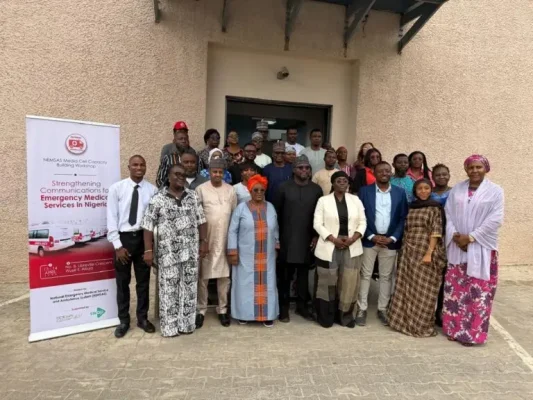
Dr Doubra Emuren, National Coordinator of NEMSAS, said this on Monday in Abuja at a workshop for journalists organised by NEMSAS in collaboration with the Solina Centre for International Development and Research (SCIDaR).
The training, themed “Strengthening Communications for Emergency Medical Services in Nigeria,” is aimed at improving media engagement and public understanding of emergency systems.
Emuren said unreliable network coverage continues to disrupt emergency call systems, noting that the National Emergency Number, 112, coordinated by the Nigerian Communications Commission (NCC), remains inconsistent in several locations.
“Connectivity is critical to emergency response. When networks fail, response time is affected, and lives are put at risk,” he said.
He added that weak coordination among agencies, poor infrastructure, and limited regulatory enforcement further hinder seamless operations.
The coordinator said Nigeria has fewer than 1,000 paramedics and about 500 ambulances, far below the estimated 4,000 needed to adequately serve the population.
He emphasised the need to scale up the training of Emergency Medical Technicians (EMTs) to provide basic life support and strengthen pre-hospital care.
“In the short to medium term, expanding EMT training can help bridge the manpower gap and improve response coverage,” he said.
Emuren also called for increased private sector participation and the integration of air ambulances to improve access in congested and hard-to-reach areas.
He said that poor road access, insecurity, and the lack of traffic management systems further complicate emergency operations, advocating a framework that prioritises ambulance movement.
He also emphasised the need for a Good Samaritan law to protect citizens who assist victims during emergencies.
Emuren said NEMSAS has transported about 47,000 pregnant women and neonates across 132 local government areas under the Maternal Mortality Reduction Innovation and Initiatives (MAMII).
He said the service supports safe delivery by transporting women to health facilities and providing essential kits, while also covering emergencies such as road traffic accidents, snake bites, gunshot injuries, building collapses, and communal clashes at no cost.
According to him, NEMSAS has established structures in 33 states and the Federal Capital Territory.
Also speaking, Dr Lawal Bakare, Lead, Communication and Innovation at the Sector-Wide Approach (SWAp) Coordination Office, Federal Ministry of Health and Social Welfare, said SWAp aims to improve coordination and equity in healthcare delivery.
He said the approach aligns with the National Health Act of 2014 and supports reforms under the Nigerian Health Sector Renewal Investment Initiative.
Bakare emphasised the role of data, governance, and media engagement in strengthening accountability and public trust in the health system.
In her remarks, Mrs Moji Makanjuola, Executive Director of the Initiative for Sustainable Media Policy and Health (ISMPH), highlighted the media’s role in bridging the gap between policy and the public.
She said accurate reporting would enhance awareness, counter misinformation, and promote the responsible use of emergency services.
It was reported that stakeholders called for stronger collaboration to improve communication systems, workforce capacity, and infrastructure for a more responsive emergency healthcare system.
