


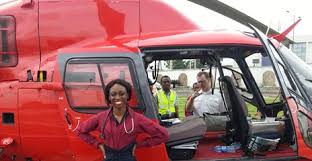
As the government advances plans to introduce air ambulance services into Nigeria’s emergency response system, a pilot has warned that helicopters alone will not address longstanding gaps in trauma care.
At the centre of the discussion is a broader reform: the establishment of a coordinated major trauma network.
Capt. Bukola Agbenike, a volunteer pilot with London’s Air Ambulance, told reporters that such a network is the backbone of any effective emergency medical system.
It was reported that under the leadership of Prof. Muhammed Ali Pate, Coordinating Minister of Health and Social Welfare, the ministry is exploring ways to modernize emergency care, including learning from global best practices in air medical transport.
However, Agbenike stressed that public understanding of the twin concepts of air ambulances and trauma systems is critical to managing expectations and ensuring accountability.
“An air ambulance is a helicopter or aircraft specially equipped to function like a mobile intensive care unit, with trained medical personnel onboard,” he explained.
He added that air ambulances are primarily used to evacuate critically ill or injured patients from accident scenes, transfer patients between hospitals for specialized care, and reach remote or hard-to-access areas quickly.
“In emergencies such as road crashes, strokes, or complicated childbirth cases, speed can mean the difference between life and death. Air ambulances help reduce delays, especially in urban gridlock or rural areas with poor road access.”
Agbenike noted that Nigeria has some experience through private providers like Flying Doctors Nigeria, but services remain limited and largely inaccessible to the average citizen due to cost.
He emphasized that air ambulances are not a standalone solution.
“They are only effective when integrated into a wider emergency care system known as a major trauma network. A helicopter can get a patient to a hospital faster, but if that hospital is not equipped to handle severe trauma, the advantage is lost.”
He described a major trauma network as a coordinated system that ensures patients receive the right care, at the right place, and at the right time.
According to him, it typically includes a central emergency call and dispatch system, ground and air ambulance services, designated trauma centres with specialized capacity, clear referral and transfer pathways, and rehabilitation services.
“Nigeria faces a growing burden of trauma and emergency conditions, driven by high rates of road traffic accidents, delays in accessing care, and weak emergency response infrastructure. A well-structured trauma network can significantly reduce preventable deaths by improving coordination and response time.”
Agbenike, however, warned that several gaps must be addressed, including the lack of a nationwide, unified emergency number, an inadequate number of fully equipped trauma centres, a shortage of trained emergency and trauma specialists, weak coordination between pre-hospital and hospital care, and limited infrastructure such as helipads.
“These are systemic issues. Without fixing them, air ambulances risk becoming expensive assets with limited impact,” he said.
He also cited affordability as a major concern, noting the high operating costs of air ambulances and raising questions about funding, insurance coverage, and equitable access for ordinary Nigerians.
Despite these challenges, Agbenike said the initiative presents a unique opportunity to overhaul Nigeria’s emergency care system.
“For Nigerians, the message is clear: Air ambulances are only one piece of the puzzle. The real impact depends on building a coordinated trauma network that supports rapid response, quality care, and equitable access.”
He concluded that sustained public engagement and expert scrutiny will be essential to ensure the initiative delivers not just visibility, but lifesaving results.
