

• Home
  • Agric
  • Sci & Tech
  • Health
  • Environment
  • Hausa News
  • More
    • Business/Banking & Finance
    • POLITICS
    • Entertainments & Sports
    • International
    • Investigation
    • Law & Human Rights
    • Africa
    • ACCOUNTABILITY/CORRUPTION
    • Hassan Gimba
    • Column
    • Prof. Jibrin Ibrahim
    • Prof. M.K. Othman
    • Defense/Security
    • Education
    • Energy/Electricity
    • Entertainment/Arts & Sports
    • Society and Lifestyle
    • Food & Agriculture
    • Health & Healthy Living
    • International News
    • Interviews
    • Investigation/Fact-Check
    • LAW & HUMAN RIGHTS
    • Oil & Gas/Mineral Resources
    • PRESS FREEDOM/JOURNALISM/PR
    • General News
    • Presidency
  • About Us
    • Contact Us
    • Board Of Advisory
    • Privacy Policy
    • Ethics Policy
    • Teamwork And Collaboration Policy
    • Fact-Checking Policy
    • Advertising
  • Media OutReach Newswire
    • Wire News
  • The Stories
Facebook Twitter Instagram
Trending
  • UNICEF expands digital learning to tackle dropout, youth unemployment in Nigeria
  • Association disburses over N1tn to MSMEs, supports 1.6m jobs
  • Agunbiade continues winning streak at NASCO/ITF junior championship
  • Jawura to train 150 youths for world environment day
  • Say it loud Africa postpones TASE 2026
  • FRSC urges protection for vulnerable road users
  • Africa’s key challenge Is market access, not talent
  • Anambra outlaws cash rent payments for stadiums
Facebook Twitter Instagram YouTube
AsheNewsAsheNews
  • Home
  • Agric

    Niger Assembly approves $14.4m loan to finance Niger Foods

    June 3, 2026

    Expert: Nigerian food products face export challenges

    June 3, 2026

    Agrify, TCF launch AI farming tool in Zuma

    June 3, 2026

    Niger State and AGAN launch private extension initiative to tackle agricultural crisis

    June 2, 2026

    FCT farmers face rainfall, input cost challenges

    June 2, 2026
  • Sci & Tech

    Africa’s key challenge Is market access, not talent

    June 3, 2026

    Association urges proper metrics to boost Africa’s innovation

    June 2, 2026

    Airtel Africa tops NGX gains

    June 2, 2026

    FG trains MDA IT administrators on data protection

    June 2, 2026

    Iran–US/Israel war and Nigeria’s education, energy, health, security, economy: Why STEM matters – Dr. Balarabe Shehu Kakale

    May 30, 2026
  • Health

    Female lab scientists urged to turn research into patient care

    June 3, 2026

    FCTA distributes 48 vein-finding devices to hospitals

    June 3, 2026

    Nigeria launches new rehabilitation standards

    June 2, 2026

    Enugu urges residents to report illness signs to prevent Ebola

    June 2, 2026

    CS-SUNN launches nutrition budgeting workshop in Kaduna

    June 2, 2026
  • Environment

    Jawura to train 150 youths for world environment day

    June 4, 2026

    Oresanya highlights youth preparation for AI era at Abuja debate

    June 3, 2026

    Nasarawa, DPI boost youth engagement on plastic waste

    June 2, 2026

    NEMA flags 178 communities at risk of flooding in Kano

    June 2, 2026

    NUT demands immediate release of abducted teachers, students

    June 2, 2026
  • Hausa News

    Otti plans 250-room 5-star hotel in Umuahia

    April 11, 2026

    Anti-quackery task force seals 4 fake hospitals in Rivers

    August 29, 2025

    [BIDIYO] Yadda na lashe gasa ta duniya a fannin Ingilishi – Rukayya ‘yar shekara 17

    August 6, 2025

    A Saka Baki, A Sasanta Saɓani Tsakanin ‘Yanjarida Da Liman, Daga Muhammad Sajo

    May 21, 2025

    Dan majalisa ya raba kayan miliyoyi a Funtuwa da Dandume

    March 18, 2025
  • More
    1. Business/Banking & Finance
    2. POLITICS
    3. Entertainments & Sports
    4. International
    5. Investigation
    6. Law & Human Rights
    7. Africa
    8. ACCOUNTABILITY/CORRUPTION
    9. Hassan Gimba
    10. Column
    11. Prof. Jibrin Ibrahim
    12. Prof. M.K. Othman
    13. Defense/Security
    14. Education
    15. Energy/Electricity
    16. Entertainment/Arts & Sports
    17. Society and Lifestyle
    18. Food & Agriculture
    19. Health & Healthy Living
    20. International News
    21. Interviews
    22. Investigation/Fact-Check
    23. LAW & HUMAN RIGHTS
    24. Oil & Gas/Mineral Resources
    25. PRESS FREEDOM/JOURNALISM/PR
    26. General News
    27. Presidency
    Featured
    Recent

    UNICEF expands digital learning to tackle dropout, youth unemployment in Nigeria

    June 4, 2026

    Association disburses over N1tn to MSMEs, supports 1.6m jobs

    June 4, 2026

    Agunbiade continues winning streak at NASCO/ITF junior championship

    June 4, 2026
  • About Us
    1. Contact Us
    2. Board Of Advisory
    3. Privacy Policy
    4. Ethics Policy
    5. Teamwork And Collaboration Policy
    6. Fact-Checking Policy
    7. Advertising
    Featured
    Recent

    UNICEF expands digital learning to tackle dropout, youth unemployment in Nigeria

    June 4, 2026

    Association disburses over N1tn to MSMEs, supports 1.6m jobs

    June 4, 2026

    Agunbiade continues winning streak at NASCO/ITF junior championship

    June 4, 2026
  • Media OutReach Newswire
    • Wire News
  • The Stories
AsheNewsAsheNews
Home»Food & Agriculture»Food prices remain elevated despite N7.65trn imports, FG interventions
Food & Agriculture

Food prices remain elevated despite N7.65trn imports, FG interventions

Abdoulaye KayBy Abdoulaye KayApril 23, 2026Updated:April 23, 2026No Comments4 Mins Read
Food-Prices-Surge-91.6-Year-on-Year-in-Nigeria-Reaching-N2920.13-in-December-2024
Share
Facebook Twitter LinkedIn Pinterest Email

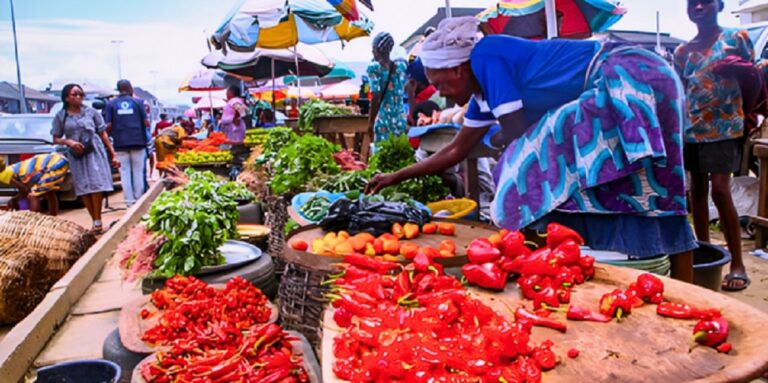
Food prices in Nigeria have remained persistently high despite government interventions and food imports valued at N7.65 trillion in 2025, raising concerns about the effectiveness of policy measures aimed at easing cost pressures on households.

A widening gap persists between fiscal interventions and actual market outcomes, as increased spending on palliatives and imports has yet to translate into meaningful improvements in food affordability nationwide.

Data show that rising import bills and government interventions have not significantly reduced food prices, with inflation still elevated across key consumer categories.

The Federal Government spent N9.74 billion on food palliatives in 2024, according to data from BudgIT’s GovSpend platform, a civic-tech organisation promoting transparency and accountability.

This followed a 2023 intervention in which N5 billion was allocated to each of the 36 states and the Federal Capital Territory (FCT) for rice and fertiliser procurement, amounting to N185 billion for the distribution of 100,000 bags of rice and other grains as palliatives.

Nigeria’s food import bill has also risen sharply, hitting about $10 billion in 2023, including $3 billion spent on grains. Data from the National Bureau of Statistics (NBS) indicate that food and beverage imports increased from N3.83 trillion in 2023 to N6.58 trillion in 2024, and further to N7.65 trillion in 2025.

In 2024, the Federal Government introduced a zero-duty levy on selected food imports to ease soaring prices. While the policy helped moderate food inflation from 40.8 per cent in June 2024 to 8.89 per cent in January 2025, stakeholders say it also resulted in losses for local farmers.

Food inflation stood at 14.31 per cent year-on-year in March 2026, contributing significantly to headline inflation of about 15.38 per cent, underscoring sustained pressure on food prices despite increased spending and import dependence.

Experts attribute the persistence of high food prices to structural inefficiencies in Nigeria’s food system rather than inadequate funding alone, citing production constraints, logistics bottlenecks, and macroeconomic pressures.

Agricultural economist, Dr Adebayo Oladipo, said weak supply chains and post-harvest losses continue to limit the impact of government spending.

“There is a tendency to equate higher spending with better outcomes, but in agriculture, that assumption often fails. If supply chains are inefficient, storage is poor, and farmers cannot scale production, additional funding will not automatically reduce prices,” he said.

He added that significant post-harvest losses continue to create artificial scarcity, even when production improves.

Development expert, Dr Zainab Usman, identified rising fuel costs as a key driver of food inflation through higher transportation and logistics expenses.

“The food system does not operate in isolation. Increased fuel prices raise transport costs, which are passed along the value chain—from farmgate to retail,” she said, noting that improving logistics efficiency could have a substantial impact on food prices.

Abuja-based economist, Ibrahim Yusuf, highlighted exchange rate pressures as another critical factor, noting that volatility has driven up the cost of imported food and agricultural inputs.

“Many inputs—fertiliser, machinery, seeds—are priced in foreign currency. This means both imported and locally produced food become more expensive at the same time,” he said.

A development specialist at the University of Abuja, Aminu Barko, warned against over-reliance on imports, describing it as a short-term fix that exposes the country to global price shocks and foreign exchange constraints.

Security challenges also continue to constrain output. According to Oladipo, insecurity in key food-producing regions limits farmers’ access to land and reduces production capacity, further tightening supply.

Climate variability is compounding the situation. Environmental economist, Hadiza Bello, noted that increasing incidents of floods and droughts are disrupting planting cycles and reducing yields, worsening food supply challenges.

For households, the impact has been severe, as food accounts for a significant share of consumer spending. Rising prices are forcing families to cut both the quantity and quality of food consumed, with long-term implications for health and productivity.

“What we are witnessing is not just inflation but a broader cost-of-living crisis,” Yusuf said, adding that even when inflation slows, prices typically continue to rise, albeit at a slower pace.

Experts agree that addressing the crisis will require structural reforms rather than continued short-term interventions.

Usman stressed the need for a coordinated strategy linking agriculture, infrastructure, energy, and trade policy, noting that isolated measures are unlikely to resolve systemic challenges.

Similarly, Oladipo called for a shift from reactive spending to strategic investment in mechanisation, rural infrastructure, storage, and security, warning that without these foundations, food price volatility will persist.

Food imports Food prices
Share. Facebook Twitter Pinterest LinkedIn WhatsApp Reddit Tumblr Email
Abdoulaye Kay
  • Website

Related Posts

Niger Assembly approves $14.4m loan to finance Niger Foods

June 3, 2026

Expert: Nigerian food products face export challenges

June 3, 2026

Agrify, TCF launch AI farming tool in Zuma

June 3, 2026

Leave A Reply Cancel Reply

UNICEF expands digital learning to tackle dropout, youth unemployment in Nigeria

June 4, 2026

Association disburses over N1tn to MSMEs, supports 1.6m jobs

June 4, 2026

Agunbiade continues winning streak at NASCO/ITF junior championship

June 4, 2026

Jawura to train 150 youths for world environment day

June 4, 2026
About Us
About Us

ASHENEWS (AsheNewsDaily.com), published by PenPlus Online Media Publishers, is an independent online newspaper. We report development news, especially on Agriculture, Science, Health and Environment as they affect the under-reported rural and urban poor.

We also conduct investigations, especially in the areas of ASHE, as well as other general interests, including corruption, human rights, illicit financial flows, and politics.

Contact Info:
  • 1st floor, Dogon Daji House, No. 5, Maiduguri Road, Sokoto
  • +234(0)7031140009
  • ashenewsdaily@gmail.com
Facebook Twitter Instagram Pinterest
© 2026 All Rights Reserved. ASHENEWS Daily Designed & Managed By DeedsTech

Type above and press Enter to search. Press Esc to cancel.