


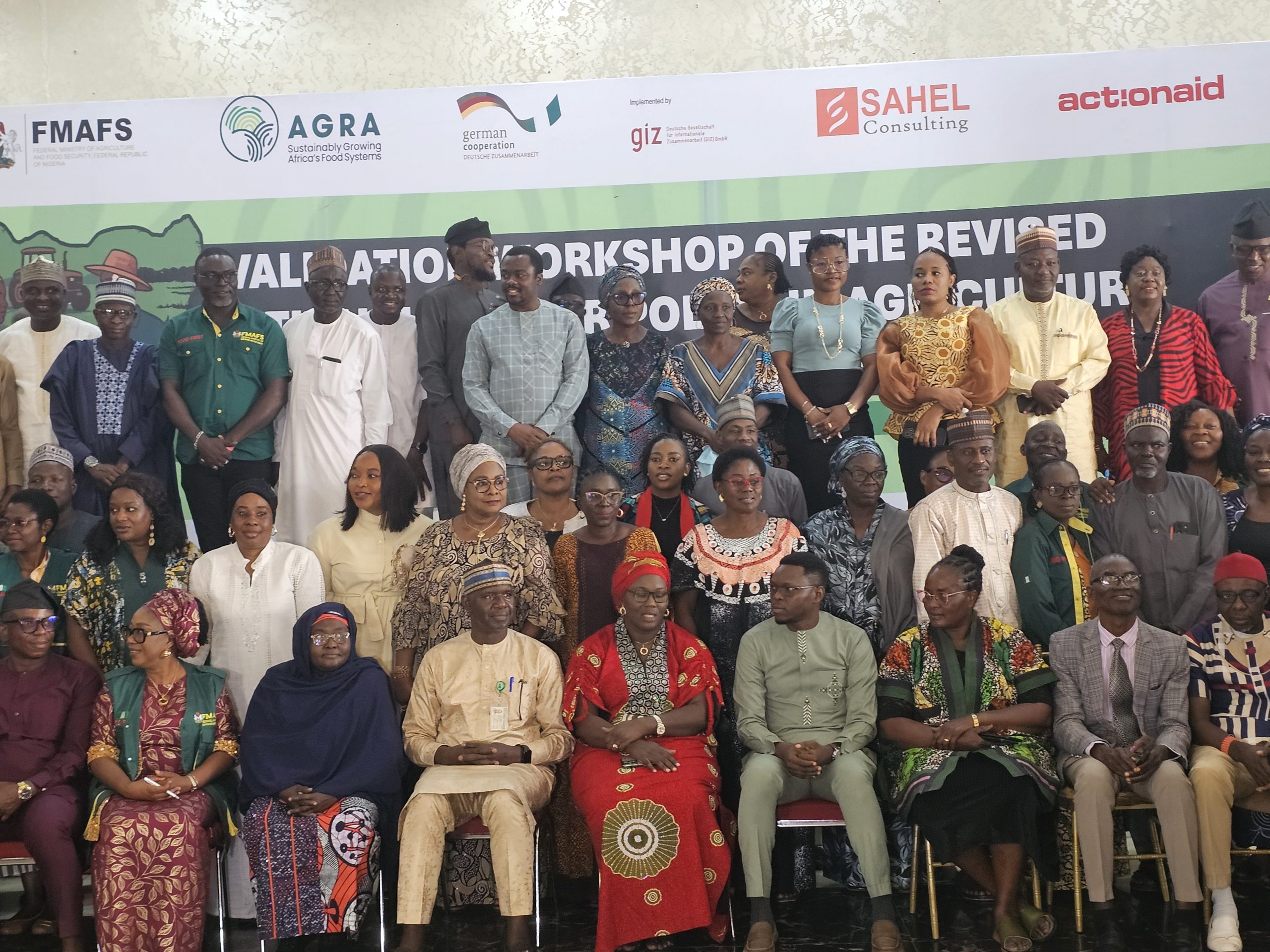
The Federal Government, in collaboration with ActionAid Nigeria and development partners, has unveiled the 2025–2030 Revised National Gender Policy on Agrifood Systems Transformation and its Strategic Action Plan.
The policy aims to promote equitable access to agricultural resources, opportunities, and decision-making across the agrifood value chain.
The Minister of Agriculture and Food Security, Sen. Abubakar Kyari, described the initiative as a major step towards building an inclusive, productive, and sustainable agricultural sector. The minister was represented by the Minister of State, Sen. Aliyu Abdullahi, at the unveiling on Tuesday in Abuja.
Kyari noted that agriculture remains central to Nigeria’s priorities for achieving food security, employment, and economic growth. However, he observed that persistent gender disparities continue to limit the full participation of women, who play vital roles across the agrifood value chain.
“Addressing this challenge is not optional; it is essential to achieving our national development goals,” he said.
READ ALSO: Veterinary experts warn of public health risks from poor livestock practices in Nigeria
Kyari explained that the policy provides a practical framework for ensuring equitable access to resources and opportunities for both women and men, while strengthening gender-responsive approaches in agricultural programmes.
“The success of this policy will depend on effective implementation. We must move from commitment to action. I call on all relevant institutions and stakeholders to integrate this policy into their plans, programmes, and budgets, while ensuring strong monitoring and accountability mechanisms,” he said.
He added that building a resilient and food-secure nation requires inclusive participation, stressing that equitable agrifood systems are both economically beneficial and socially just.
The minister described the unveiling as a milestone in efforts to promote inclusive agricultural development and ensure no segment of the population is left behind. He emphasized that gender mainstreaming remains critical to unlocking the sector’s full potential.
“We are committed to ensuring that the concerns of both women and men are integrated into the design, implementation, monitoring, and evaluation of agricultural policies and programmes,” he said.
The Country Director of ActionAid Nigeria, Dr. Andrew Mamedu, represented by Mrs. Olufunke Olukeye, Director of People and Culture, described the unveiling as a defining moment in Nigeria’s journey towards an inclusive and resilient agrifood system.
Mamedu, who also chairs the National Gender Steering Committee, said the policy was developed through extensive consultations involving government, civil society, development partners, the private sector, and farming communities.
He emphasized that successful implementation would require political will, adequate funding, strong institutions, and accountability at all levels.
“This unveiling is a call to action. We must translate this policy into concrete programmes, inclusive budgets, and measurable outcomes,” he said.
Also speaking, the Country Director of the Alliance for a Green Revolution in Africa (AGRA), Dr. Rufus Idris, pledged the support of development partners for the policy. He noted that gender inclusion is critical to transforming Africa’s food systems.
Similarly, Dr. Nkiruka Okonkwo, National Consultant on the policy review, said the framework was designed to eliminate structural inequalities and institutional barriers to gender inclusion. She noted that the policy is built around six strategic objectives, including equitable access to agrifood resources, services, technologies, and opportunities, as well as institutionalizing gender-responsive planning and budgeting.
The event was organized by ActionAid Nigeria under its Inclusive Food Systems Project, with support from the German International Cooperation (GIZ).
The policy is expected to strengthen commitments to equitable participation across the agricultural value chain.
