


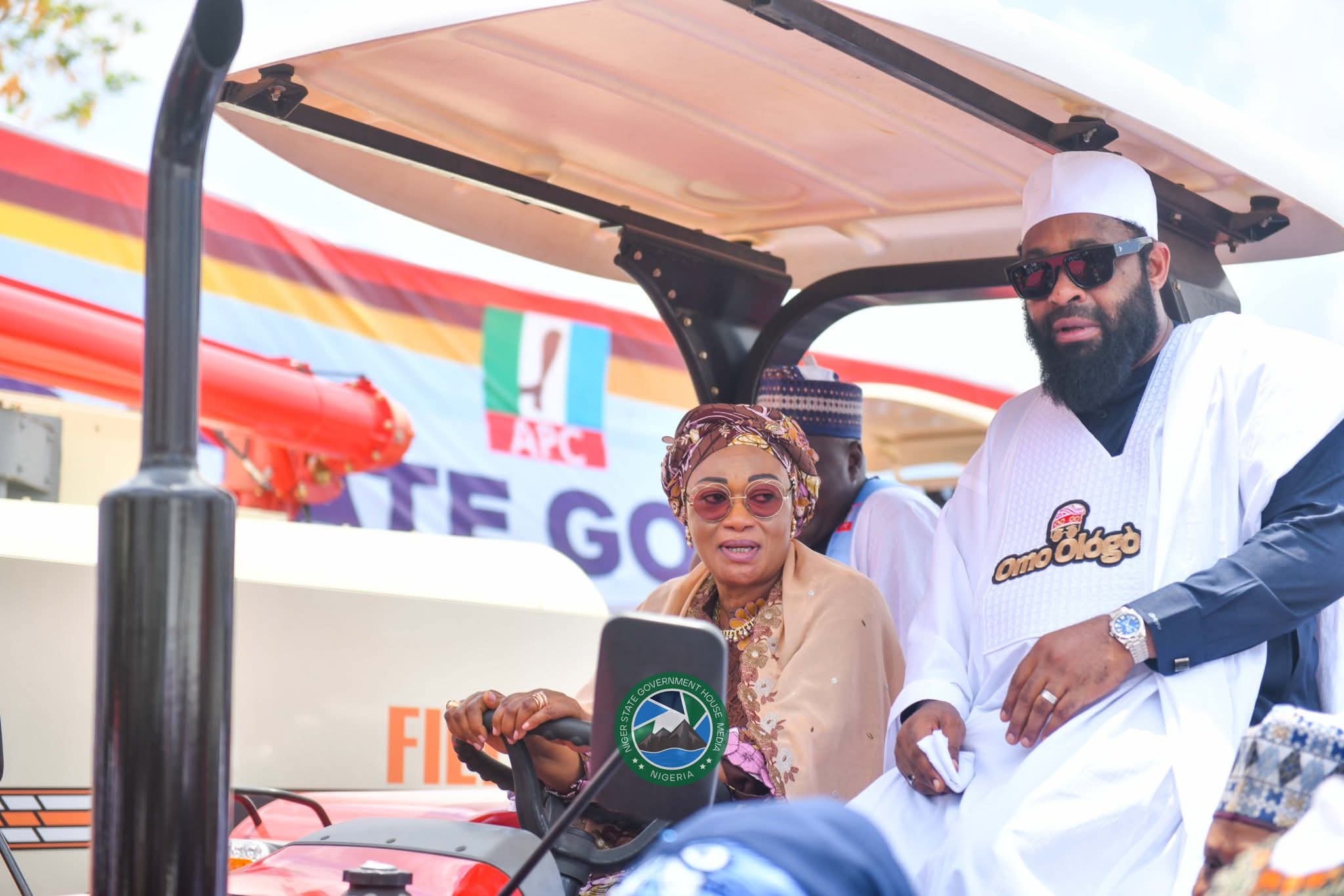
The Wife of the President of Nigeria, Senator Oluremi Tinubu, has declared that the nation can no longer rely on hoes and cutlasses for farming to meet the mounting food demands of its growing population, charging farmers to urgently embrace modern agricultural methods.
Tinubu made this call on Saturday at the Bola Ahmed Tinubu International Airport in Minna during the official flag-off of the 2026 farming season and the massive distribution of mechanisation support equipment.
Speaking to a large gathering of farmers and stakeholders, Tinubu urged the beneficiaries to maximize the newly provided tools and fertilizers.
She emphasized that approaching the farming season with renewed determination and modern practices is the only sustainable path to food security.
The President’s Wife described the massive rollout of farming implements as a bold statement that Nigeria is ready to feed herself, marking a deliberate transition from subsistence practices to commercially viable agriculture.
To actualize this transition, the Niger State Government unveiled a massive agricultural intervention.
The state presented implements of growth that include 250 units of 75Hp tractors, 50 combined multi-crop harvesters, 1,500 farming implements such as planters and boom sprayers, and 150,000 bags of fertilizers.
Niger state Governor, Mohammed Umaru Bago stated that the state is not only formally opening the farming season but is delivering tools that will change the lives of citizens and improve the entire agriculture chain beyond the state.
He noted that agriculture remains a top priority for his administration, stressing his passion for making Niger State a major source of food for the nation.
Detailing the distribution framework, Bago explained that 10 tractors will be allocated per local government to bring much-needed mechanisation to the grassroots across the 25 Local Government Areas.
He added that the provision of 50 combined harvesters is strategically designed to cut harvest time and reduce post-harvest losses, which typically range between 40 to 90 percent depending on the crop.
The Governor projected that these investments will directly support farming activities on 120,000 hectares of land across the state revealing that the mechanisation drive will create about 2,000 direct jobs and roughly 100,000 indirect jobs, yielding an estimated 500,000 tons of assorted food products per season for both wet and dry season farming.
To protect farmers from post-harvest market gluts, the Governor assured that the state government is already working out modalities for the massive off-take of surplus outputs by farmers.
He called on farmers and stakeholders to work closely with the Niger Food Security and Logistics Limited, a state-owned enterprise, to ensure seamless operations.
Looking toward year-round food production, Bago announced plans to embark on the expansion of the state’s irrigation facilities stating that the government will complete a 10,000-hectare solar-powered irrigation system to enable multi-cycles of production within a single year.
Echoing the Governor’s commitment, the state Commissioner of Agriculture stated that the distribution of tractors signifies a major step towards mechanising agricultural activities in the state.
The Commissioner described the initiative as a paradigm shift from usual lip service to actionable plans designed to reposition agriculture as the backbone of the economy, ensure food security, and improve the livelihoods of the people.
