


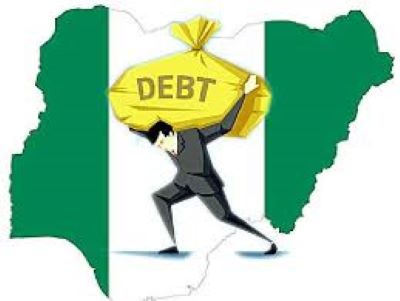
Nigeria’s debt servicing bill climbed to about N16 trillion in 2025, underscoring mounting fiscal pressure driven largely by rising domestic borrowing costs and sustained external obligations.
The figure, based on data from the Debt Management Office (DMO), represents a N2.98 trillion increase or 22.9 per cent compared to the N13.02 trillion recorded in 2024.
A breakdown of the data shows that domestic debt servicing emerged as the primary driver of the increase, rising sharply to N8.61 trillion in 2025 from N5.87 trillion in the previous year — a jump of 46.6 per cent. This accounts for about 53.8 per cent of Nigeria’s total debt service for the year.
Further analysis indicates that the bulk of domestic debt servicing is tied to interest payments, which stood at N8.24 trillion, representing roughly 95.7 per cent of the total. This highlights the heavy burden of accumulated interest, with minimal allocation to principal repayments.
ALSO READ DMO: Nigeria’s public debt hits N159.28trn in December 2025
FGN bonds accounted for the largest share of domestic interest costs at about N5.35 trillion, or 65 per cent, while Nigerian Treasury Bills contributed N2.55 trillion, representing about 31 per cent. Other instruments such as Sukuk, savings bonds and green bonds made up a relatively small portion.
Principal repayments on domestic debt remained low at N370.93 billion, accounting for just 4.3 per cent, reinforcing concerns about the structure of Nigeria’s debt, which is largely interest-driven.
On the external front, debt servicing stood at $5.15 billion in 2025, equivalent to about N7.39 trillion using the official exchange rate of N1,435.2571 per dollar as of December 31, 2025, adopted by the DMO. This represents 46.2 per cent of total debt service.
Although external obligations remain significant, their growth was slower compared to domestic debt. The 2025 figure marks a 10.6 per cent increase from $4.66 billion recorded in 2024.
Commercial debt accounted for the largest share of external servicing at $2.55 billion, driven mainly by Eurobond repayments, which alone stood at $2.49 billion. Multilateral loans followed at $1.996 billion, while bilateral debt accounted for $599.95 million.
In terms of composition, principal repayments made up $3.06 billion or 59.4 per cent of external servicing, while interest payments stood at $2.03 billion or 39.5 per cent.
Meanwhile, Nigeria’s total public debt stock rose to N159.28 trillion as of December 31, 2025, reflecting continued reliance on borrowing. This represents a quarter-on-quarter increase of N5.98 trillion from N153.29 trillion recorded in September 2025.
On a year-on-year basis, public debt grew by N14.61 trillion from N144.67 trillion in December 2024, indicating a 10.1 per cent increase. In dollar terms, the debt stock rose from $94.23 billion to $110.97 billion over the same period.
The data underscores the growing strain of debt servicing on government finances, particularly as rising interest costs continue to absorb a significant share of public resources.
