


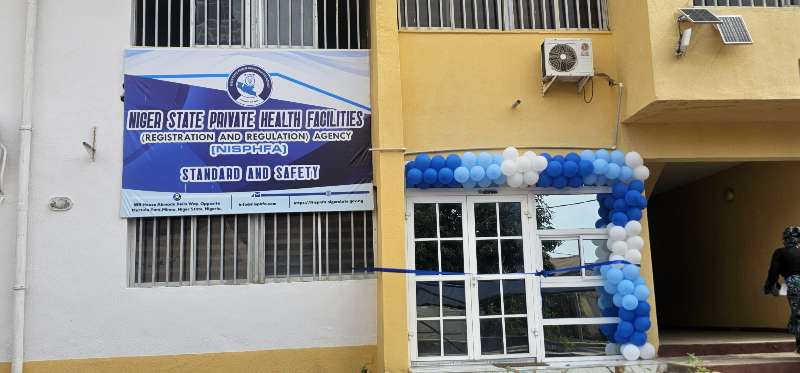
Niger State Government has officially commissioned the Niger State Private Health Facilities Registration and Regulation Agency, (NISPHFA) in its bid to regulate the private health sector and combat quackery.
The newly established body is mandated to eliminate substandard medical practices, protect patient rights, and enforce strict compliance across all private medical establishments operating within the state.
Delivering the keynote address on behalf of the Niger state Governor, Mohamed Umaru Bago, the State Head of Service, Alhaji Abubakar Sadiq Idris formally declared the agency open for full operations, describing the development as a landmark achievement under the administration’s New Niger Agenda.
The Governor emphasized that the public is tired of unfulfilled potential and demands immediate, visible results in governance.
He noted that the deployment of digital systems by the agency perfectly mirrors the state’s broader vision of a modern, data-driven, and transparent public service.
The Governor further commended the leadership of the Ministry of Health for adopting a business-unusual philosophy to drive innovation, charging the new management to prioritize the quality of citizen healthcare over mere revenue generation.
The Niger State Commissioner for Health, Dr. Mutala Mohamed Bagana, disclosed that the regulatory body serves as a critical pillar for operationalizing the ministry’s comprehensive health reform framework.
Bargana revealed that an assessment showed Niger State possesses more private tertiary health institutions than Lagos State, a statistic he described as alarming and indicative of a previously fragmented, unregulated environment where individuals could set up clinics without meeting basic criteria.
Drawing a strict red line, the Commissioner warned operators to conform to established benchmarks immediately.
He explained that the agency’s oversight encompasses all private operators, including traditional medicine practitioners, and will focus heavily on gathering reliable morbidity, mortality, and immunization data from the private sector to improve state-wide health planning.
Bargana also issued a stern warning to the public against the harassment of medical personnel, referencing a recent violent assault on a female medical doctor, stating that the government will aggressively protect the rights of health workers just as it protects patients.
In his introductory remarks, the Executive Chairman of the agency, Dr. Suleiman Abdullahi, outlined the institution’s ambition to become the foremost health regulatory body in the federation by driving an equitable and internationally benchmarked private healthcare system.
Abdullahi reported that within its first three months, the agency has already published registration guidelines spanning more than 20 distinct categories of health facilities, launched a competitive digital registration portal, and successfully mapped out over 1,000 facilities across the state.
He clarified that the framework of regulation is rooted in supportive partnership rather than punitive measures, though he maintained that strict enforcement will be sustained through collaborations with the Civil Defense, the Police, and other security agencies.
Defaulters who violate medical ethics or operate without valid annual licenses will be handed over to law enforcement and relevant professional councils, such as the Medical and Dental Council of Nigeria.
The organized labor movement and various health worker unions also declared their total support for the government’s intervention. Representing the workforce, the Chairman of the State Chapter of Mediacal and Health Workers, Comrade Abubakar Uaman Dabban noted that the unchecked proliferation of unregulated clinics has historically jeopardized patient safety, compromised worker welfare, and diluted the integrity of the health system.
He urged the new board to ensure that fair wages, safe working environments, and the protection of support staff are integrated into the agency’s enforcement mandates.
Speaking for the operators of private health facilities, the representative of the Association of Nigerian Medical Private Practitioners, (ANPMP) welcomed the agency, stating that its mission directly aligns with the association’s vision of delivering high-quality care through highly skilled professionals.
He expressed relief that the regulatory body will help flush out quacks, who often cause severe medical mismanagement that unfairly tarnishes the reputation of legitimate private practitioners.
He expressed optimism that the agency will act as a unified channel to resolve long-standing grievances, including multiple taxation by various local government councils and the historical exclusion of private clinics from receiving government-allocated resources, such as NGO-supplied pharmaceuticals and emergency ambulance boards.
