


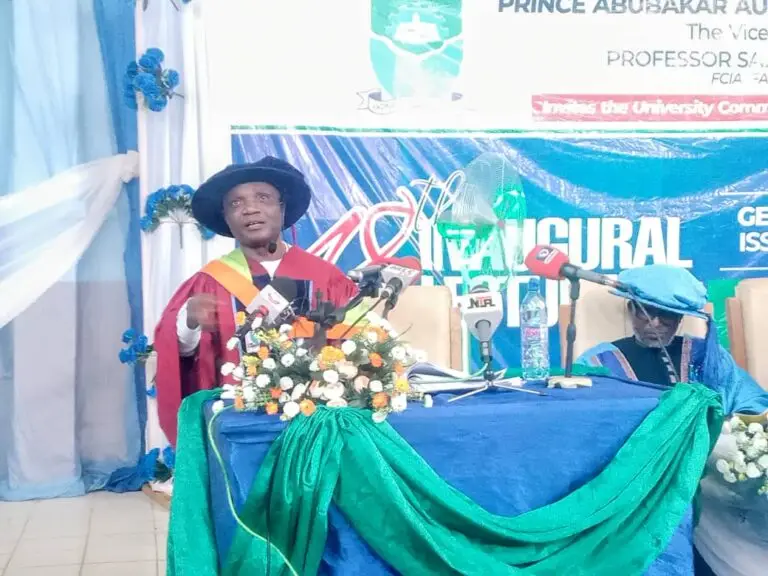
Prof. Adesola Ogidiolu has urged geographers to deploy mapping tools and data-driven approaches to address Nigeria’s worsening forest crisis, stressing that foresters alone cannot tackle the challenge.
Ogidiolu made the call on Tuesday while delivering the 18th inaugural lecture of Prince Abubakar Audu University.
In his lecture titled *“Geographer in the Forest: Issues, Concerns and Tasks,”* the professor emphasised the urgency of safeguarding forest ecosystems, noting their critical role in sustaining human health and livelihoods.
According to him, forests provide essential services, including water storage, energy supply, income generation, and environmental security.
He described a healthy forest as one relatively free of pests, invasive species, and pollution, with the capacity to sustain biodiversity and withstand environmental stress.
“A forest may be healthy and still contain unhealthy trees,” he noted.
Ogidiolu identified key threats to Nigeria’s forests, including wildfires, pests and diseases, over-exploitation, poor harvesting practices, weak management systems, uncontrolled grazing, agricultural expansion, urbanisation, invasive species, air pollution, extreme climate events, and poverty.
He noted that biotic agents such as insects and diseases account for major annual timber losses, especially in areas where silvicultural practices are weak.
Despite these challenges, he said forests also present viable solutions.
“Nigerian forests can support second-generation biofuels if sustainably managed, while providing between 20 and 25 per cent of household income for nearby communities as subsistence and safety nets,” he said.
Ogidiolu, however, warned that dense forests in parts of Zamfara, Katsina, Benue, Niger, and the South-East have also become hideouts for criminal activities, including banditry and kidnapping.
He stressed that geographers have a critical role to play through the use of geospatial technologies and community-led mapping to identify and monitor hotspots.
The don urged professionals to engage in resource mapping, forest health monitoring, environmental modelling, and the use of Geographic Information Systems (GIS) for surveillance, planning, ecotourism development, and policy advisory.
He recommended expanding forest landscapes, restoring degraded areas, achieving zero-net deforestation, and strengthening community participation through Forest Protection Communities, while removing administrative bottlenecks.
Ogidiolu also called on policymakers to make Geography a core and compulsory subject from primary to secondary education.
Earlier, the Vice-Chancellor of the university, Prof. Salisu Usman, described the inaugural lecture as a major milestone in the institution’s intellectual tradition and the first under his administration.
Usman said the university Senate had, on March 25, approved a schedule for 13 additional inaugural lectures within two years, raising the total from 17 to 30 by Oct. 5, 2027.
“Inaugural lectures are defining moments of scholarship, institutional prestige, and a meeting point of town and gown,” he said.
The vice-chancellor commended Prof. Sunday Arogba, the first inaugural lecturer and current chairman of the lecture committee, for driving the renewed agenda.
To encourage wider participation, he announced an increase in the lecturer’s stipend from N250,000 to N500,000, describing it as a demonstration of the university’s commitment to rewarding scholarship.
He also praised Ogidiolu as “a living legend” for setting the pace and urged eligible professors to submit proposals to extend the lecture timetable beyond 2027, even if it requires hosting sessions twice monthly.
Usman emphasized the need for innovation, noting that inaugural lectures should evolve into celebrated intellectual events that reflect the nobility of scholarship and enhance the university’s global relevance.
