


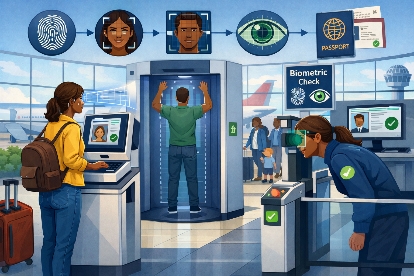
The Federal Government has approved the rollout of a biometric passenger identity verification system, VPASS, across domestic airports to strengthen security and improve passenger identification.
The Minister of Aviation and Aerospace Development, Festus Keyamo, disclosed this in a statement issued on Thursday through his spokesperson.
The initiative forms part of broader reforms aimed at enhancing transparency, accountability, and operational efficiency in Nigeria’s aviation sector, while addressing persistent gaps in passenger verification processes.
Keyamo explained that VPASS is designed to ensure proper identification of all passengers through a contactless biometric verification process, effectively closing loopholes often exploited under the current system.
“The Federal Government has approved the deployment of a contactless biometric passenger verification system, known as VPASS, across Nigeria’s domestic airports as part of efforts to strengthen aviation security, enhance data integrity, and improve revenue generation,” he said.
He noted that while stringent identity verification protocols already exist for international travel, VPASS will extend similar standards to domestic flights. The platform is also expected to be expanded to private aviation in a later phase.
Implementation will begin with infrastructure deployment by VERXID Technologies Limited, followed by a nationwide sensitisation campaign to drive awareness and ensure seamless adoption.
The minister commended key stakeholders, including the Infrastructure Concession Regulatory Commission (ICRC) and the Federal Airports Authority of Nigeria, for advancing the project under a public-private partnership framework.
Permanent Secretary of the ministry, Mahmud Adamu Kambari, said the initiative reflects the government’s commitment to modernising the aviation sector through technology-driven solutions.
Also speaking, FAAN’s Director of Commercial and Business Development, Adebola Agunbiade, described VPASS as a strategic move to eliminate reliance on physical identification, noting that facial recognition technology would enable seamless passenger processing in line with global best practices.
Director-General of the ICRC, Johnson Oseodion Ewalefoh, emphasised the importance of accountability and efficiency in delivering infrastructure through public-private partnerships.
Similarly, Adebayo Bankole, Managing Director of VERXID Technologies, said the system would curb unauthorised movement and improve revenue assurance through accurate data analytics.
Stakeholders stressed that collaboration and strict adherence to timelines will be critical to the successful rollout and scalability of the system.
The VPASS deployment marks a significant shift in passenger identity management within Nigeria’s domestic aviation space. It is expected to eliminate identity fraud and unauthorised boarding, enhance revenue tracking for airlines and airport authorities, and reduce human interference that often contributes to inefficiencies and corruption.
The adoption of biometric technology also aligns Nigeria’s aviation sector with global standards in passenger processing and security management.
The development builds on earlier government plans to deploy electronic gates (e-gates) at international airports. In 2024, the Minister of Interior, Olubunmi Tunji-Ojo, announced that the systems would enable passengers to clear immigration in under 30 seconds, with installations planned across major airports including Lagos, Kano, Enugu, and Port Harcourt. However, full nationwide deployment has yet to be conclusively confirmed.
