


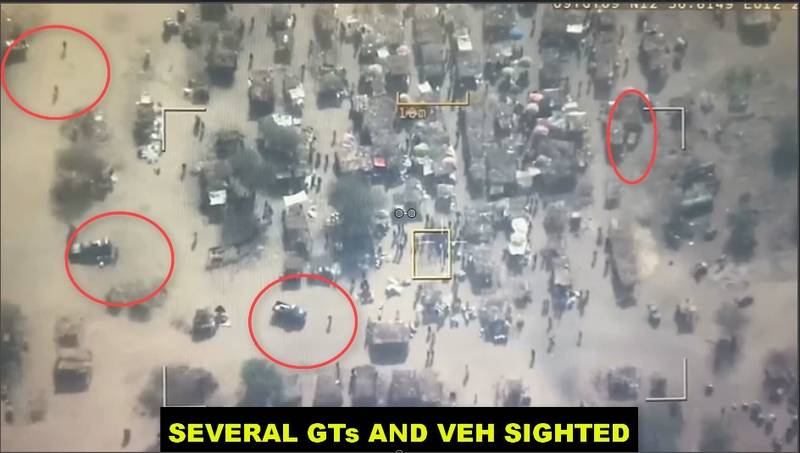
The Air Component of Operation Hadin Kai (OPHK) has neutralised scores of terrorists and destroyed their operational assets in Jilli, Gubio Local Government Area of Borno State.
Sani Uba, Media Information Officer at the Headquarters of the Joint Task Force (North East), Operation Hadin Kai, made this known in a statement on Sunday in Maiduguri.
Uba said the airstrike successfully hit a major Islamic State West Africa Province (ISWAP) logistics hub.
He stated that the operation was conducted on Saturday following sustained Intelligence, Surveillance, and Reconnaissance (ISR) missions over the Bindul–Jilli axis.
According to him, the Bindul–Jilli corridor is a major terrorist movement route and convergence point for insurgents and their collaborators.
“On April 11, 2026, multiple reports were received of ISWAP gun trucks and motorcycles moving along the axis. Consequently, ISR coverage was intensified.
“During the surveillance mission, a contingent of motorcycles was observed moving toward Jilli, followed shortly by additional vehicles, all converging on the same location,” he said.
Uba said the movements were corroborated by credible human intelligence sources, confirming that the elements were terrorists, collaborators, and logistics handlers.
He added that after rigorous target validation, the Air Component executed a series of precision strikes on the enclave with high accuracy.
“Post-strike assessment confirmed that the target area was hit with high accuracy, destroying the identified terrorist logistics enclave.
“Scores of terrorists were neutralised, with their vehicles and technicals destroyed, while surviving elements were seen fleeing in multiple directions,” he said.
Uba further disclosed that intelligence indicated the neutralised elements were in the final stages of receiving logistics supplies for coordinated attacks on troop locations within the Gubio axis before the strike disrupted their plans.
He recalled that the Bindul–Jilli corridor had been linked to previous attacks, including a January improvised explosive device (IED) incident along the Gubio–Damasak road that claimed the lives of eight soldiers, as well as coordinated attacks in Ngamdu and Benisheik on April 9.
Uba also said that on April 12, troops arrested a suspected ISWAP logistics courier identified as “Turja Bulu” in Ngamdu.
“Preliminary investigation showed he took part in the attack on the 29 Brigade location at Benisheik and was dispatched from Jilli to deliver food items to another group of terrorists hibernating within the Magumeri–Gubio area,” he said.
Meanwhile, the Nigerian Air Force (NAF) said it conducted follow-up mop-up airstrikes on fleeing insurgents and regrouping elements within the Jilli axis to consolidate gains from the initial operation.
In a statement, the Director of Public Relations and Information, Air Commodore Ehimen Ejodame, said the action underscored the effectiveness of intelligence-driven joint operations.
“The mission was conducted as part of a coordinated air-ground integration operation with the Nigerian Army, following an earlier successful engagement that decimated terrorist positions in the area.
“The follow-up strikes targeted fleeing remnants and regrouping cells attempting to exploit the difficult terrain,” Ejodame said.
He added that the sustained strikes are part of ongoing efforts to deny terrorists freedom of movement, prevent attacks on security forces, and protect civilian populations.
Meanwhile, the Yobe State Government clarified reports alleging that residents of Geidam Local Government Area were directly targeted in the airstrike.
In a statement by the Special Adviser on Security Matters to Governor Mai Mala Buni, Dahiru Abdulsalam, the government said the operation was conducted on a known Boko Haram stronghold in Jilli, Gubio LGA of Borno State.
He explained that some residents of Geidam, which borders the area, had visited the Jilli weekly market and were affected by the strike.
“They have been evacuated to Geidam Specialist Hospital and are responding to treatment,” Abdulsalam said.
He reiterated that Jilli remains an insurgent-controlled enclave with no legitimate civilian presence, describing it as a “no man’s land” used for logistics, coordination, and staging of attacks.
Abdulsalam also restated that the use of motorcycles remains prohibited across the North-East operational theatre due to their continued use by terrorist elements.
He, however, assured residents of sustained operations to dismantle terrorist enclaves and restore lasting peace in the region.
