


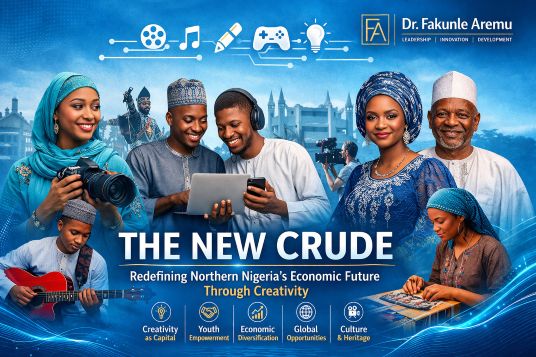
Nigeria’s long-standing dependence on crude oil is increasingly at odds with global economic shifts. Across both developed and emerging markets, value creation is migrating toward knowledge, culture and digital expression. In this context, the creative economy, which spans film, music, fashion, gaming, publishing and digital media, is no longer peripheral. It is becoming central. For Northern Nigeria, this transition presents a rare and timely opportunity.
Globally, the creative economy is already a significant growth engine. According to UNESCO, cultural and creative industries generate over $2.25 trillion annually and employ nearly 30 million people worldwide, with strong growth driven by digital platforms and youth participation (UNESCO, 2024). Nigeria, with its globally recognized Nollywood, Kannywood and music industry, is well positioned. However, the Northern region remains under-leveraged despite its demographic advantage and deep cultural capital.
A strategic shift: From natural resources to creative capital
Northern Nigeria is home to one of the youngest populations in Africa. This demographic reality, when combined with a rich heritage of storytelling, craftsmanship, music and visual arts, forms the foundation of a viable creative economy. Yet, structural gaps which include limited access to finance, insufficient policy coordination and low global market integration have constrained the growth of this unique sector.
The emerging concept of “the new crude” reframes creativity as a strategic economic resource. Unlike oil, creative capital is renewable, scalable and inclusive. It thrives on human ingenuity rather than extraction. For a region seeking diversification, this is not just a cultural argument, it is an economic imperative.
Building an ecosystem, not just hosting an event
As a starting point, I propose convening a high-level dialogue that focus on Northern Nigeria’s creative economy would signal a clear shift toward a more coordinated and intentional approach to unlocking the region’s potential. Designed as a multi-stakeholder platform, the initiative would bring together policymakers, investors, development institutions and creators to address long-standing structural gaps within the ecosystem.
The approach is deliberate and outcome-oriented. It would combine policy dialogue with practical capacity building, investor engagement and cultural showcasing which will ensure that discussions are directly linked to implementation. This hybrid model draws on proven global frameworks such as Afreximbank’s Creative Africa Nexus (CANEX), while being carefully adapted to reflect regional realities and constraints.
At its core, the initiative will be structured to move beyond dialogue into execution systematically by linking talent to capital, ideas to markets and policy to measurable economic outcomes.
Priority areas for intervention
Several strategic priorities are emerging as critical for scaling the Northern creative economy:
1. Skills and monetization
While creative talent is abundant, commercialization capabilities remain uneven. Training in branding, intellectual property management, digital distribution and revenue optimization is essential. Without this, creators remain participants rather than beneficiaries of value chains.
2. Access to finance
Creative enterprises often fall outside traditional lending frameworks due to intangible assets and perceived risk. Blended finance models, creative funds and targeted interventions from development finance institutions can help to bridge this gap.
3. Policy alignment
A fragmented regulatory environment limits growth. Coordinated policy frameworks which cover taxation, export facilitation and digital infrastructure are necessary to create a predictable ecosystem for investors and creators alike.
4. Market integration
Global demand for African content is rising, but Northern Nigeria’s representation remains limited. Structured pathways into international markets through distribution partnerships, festivals and digital platforms are critical.
5. Cultural positioning
The region’s cultural identity is a competitive advantage. Strategic storytelling and branding can reposition Northern Nigeria as a source of premium cultural exports rather than a peripheral player.
Multi-stakeholder participation as a force multiplier
One of the defining features of this initiative is the breadth of stakeholder engagement. Creators and entrepreneurs are positioned alongside policymakers, financial institutions, development partners, diaspora networks and private sector actors. This reflects a systems-thinking approach: no single actor can unlock the creative economy in isolation.
Development institutions such as UNESCO and UNDP bring technical expertise and global frameworks. Financial institutions contribute capital and structuring capabilities. Technology firms enable distribution and scale. Meanwhile, government provides the regulatory backbone.
The alignment of these actors is not incidental but foundational.
Expected economic and social outcomes
If effectively executed, the outcomes extend beyond the creative sector itself:
- Expansion of employment opportunities for youth in high-growth, future-facing industries
- Increased non-oil export revenues through cultural and digital products
- Strengthened regional identity and global cultural influence
- Attraction of both domestic and foreign investment into creative value chains
- Development of a structured roadmap for sustained ecosystem growth
There is also a less quantifiable but equally important outcome: narrative change. Repositioning Northern Nigeria from a consumption market to a production hub alters both internal confidence and external perception.
From event to movement
What distinguishes this effort is its positioning—not as a one-off gathering, but as the foundation of a broader economic movement. The emphasis on policy roadmaps, investment linkages and sustained capacity building suggests an intent to institutionalize progress rather than celebrate isolated success.
The creative economy, by its nature, resists rigid structures. Yet it thrives within enabling systems. The challenge and opportunity, lies in striking that balance by providing enough structure to scale, without stifling innovation.
Conclusion
Northern Nigeria stands at a strategic inflection point. The decline of oil as a dominant economic driver is not merely a risk; it is an opening. By investing in creativity as “the new crude,” the region can build a more resilient, inclusive and globally competitive economy.
The real test will not be in the articulation of vision, but in the discipline of execution. If momentum is sustained, this could mark the beginning of a structural shift, one where ideas, culture and digital expression become the region’s most valuable exports.
Stakeholders across government, finance, technology and the creative industries are invited to move beyond dialogue into coordinated execution. This requires deliberate investment, policy alignment and institutional backing to build a functional ecosystem that supports creators from ideation to global distribution. Development partners, private investors and corporate institutions should prioritize catalytic funding and infrastructure, while policymakers must enable a regulatory environment that reduces friction and incentivizes growth. The opportunity is immediate but time-sensitive. Those positioned to act now will not only shape the trajectory of Northern Nigeria’s creative economy but also secure early advantage in a sector with expanding global demand.
Dr. Fakunle John Aremu is a development strategist and management consultant with extensive experience in economic development, public-private partnerships, and enterprise growth across Africa. He eads initiatives that focused on investment facilitation, policy advisory, and sectoral transformation. His work spans engagements with government institutions, development partners, and private sector actors, with a strong emphasis on unlocking opportunities within emerging industries, including the creative economy.
For planning and execution of some of the recommendations in this article, call/W: +2348063284833; fakunle2014@gmail.com
