



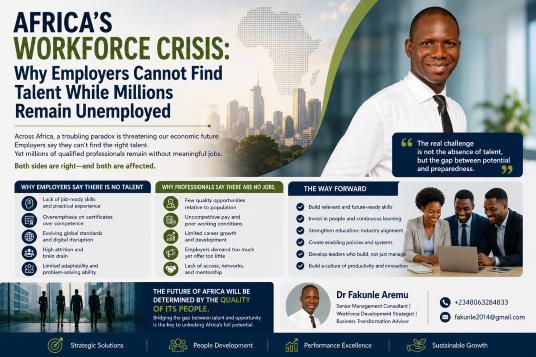
Across Africa today, a silent workforce crisis is unfolding beneath the surface of rising unemployment statistics and corporate recruitment struggles. On the one hand, organisations continue to complain about the shortage of competent professionals. On the other side, millions of educated young Africans insist there are simply no jobs available.
At first glance, the contradiction appears illogical.
How can unemployment remain high while employers simultaneously struggle to recruit qualified people?
Yet this paradox is now becoming one of the biggest threats to Africa’s economic competitiveness, private sector growth and future industrial transformation.
Recent debates triggered by comments from the CEO of Moniepoint concerning the challenges in sourcing qualified talent have once again exposed deep fractures within Africa’s labour market ecosystem. The reactions that followed were emotional, divided and highly revealing. Employers defended the need for competence and global standards, while many professionals argued that organizations have become disconnected from economic realities.
However, beneath the social media arguments lies a more strategic issue that Africa can no longer ignore.
The continent is not only facing an unemployment problem. It is facing a workforce preparedness crisis.
The collapse of workforce alignment
For decades, many African economies focused heavily on educational expansion without paying equal attention to labour market alignment. Universities and institutions produced graduates in large numbers, but industries evolved much faster than educational systems could adapt.
Today, employers increasingly seek professionals with:
- digital competence
- analytical reasoning
- communication intelligence
- practical execution ability
- innovation capacity and adaptive learning skills.
Unfortunately, many graduates still enter the labour market with largely theoretical exposure and limited workplace readiness.
This disconnect has created a dangerous gap between:
- What institutions produce
- What employers expect and what the economy actually requires.
The result is frustration everywhere.
Graduates feel excluded.
Organizations feel underserved.
Governments face mounting youth unemployment pressure.
Africa’s workforce problem is no longer local
One major shift many people fail to recognize is that recruitment standards have become increasingly globalized.
A company operating in Lagos, Nairobi, Kigali, Johannesburg, Accra, or Cairo is no longer competing only within its domestic market. Many firms now operate within regional or international ecosystems where speed, quality, innovation and operational efficiency determine survival.
This means businesses are benchmarking talent against global standards.
A software engineer in Nigeria may now compete indirectly with professionals from:
- India
- Eastern Europe
- Southeast Asia or remote global talent pools.
The same applies to finance, consulting, operations, marketing, engineering and project management.
As globalization deepens, organizations are prioritizing professionals who can:
- deliver immediately
- adapt quickly
- communicate effectively
- solve complex problems and work across digital systems.
This shift is fundamentally changing the definition of employability in Africa.
The dangerous rise of “paper qualification economies”
One of the major structural weaknesses across parts of Africa remains the overdependence on credentials instead of competencies.
Many recruitment systems still place excessive emphasis on:
- certificates
- degrees
- institutional prestige and years of experience
while paying insufficient attention to actual capability.
At the same time, many professionals also focus heavily on acquiring qualifications without deliberately building:
- practical skills
- industry exposure
- portfolio evidence
- leadership abilities or commercial understanding.
This has created what many HR leaders quietly describe as “paper qualification economies,” where academic attainment does not necessarily translate into workplace productivity.
Increasingly, employers are asking a more practical question:
“What value can this individual create under real business conditions?”
That question is reshaping modern recruitment.
The economic pressure on employers is also real
While professionals often criticise organisations for unrealistic expectations, many businesses themselves are operating under intense pressure.
Across Africa, companies are facing:
- inflation
- currency volatility
- rising operational costs
- energy instability
- weak infrastructure and shrinking profit margins.
As a result, many organizations now prefer smaller teams with multi-functional capabilities. Employers increasingly seek professionals who can combine:
- technical skills
- strategic thinking
- communication
- adaptability and technology usage.
In many sectors, organizations no longer have the financial flexibility to maintain large workforces with extensive retraining periods.
This has intensified pressure on recruitment quality.
The “japa” and brain drain reality
Another major contributor to the talent crisis is Africa’s accelerating brain drain challenge.
Highly skilled African professionals continue to migrate abroad or work remotely for foreign organizations offering:
- stronger compensation
- better career progression
- stable infrastructure and more structured work environments.
Ironically, this migration trend proves that African talent is globally competitive.
From technology and healthcare to consulting and engineering, African professionals are making significant contributions worldwide.
The challenge, therefore, is not the absence of talent but the inability of many African systems to retain, continuously develop and strategically deploy that talent locally.
The role of organizations in solving the crisis
Businesses must also accept an uncomfortable truth.
Talent does not develop automatically.
Globally competitive organizations invest heavily in:
- workforce development
- leadership pipelines
- mentorship systems
- graduate trainee programs
- performance management and continuous learning cultures.
Many African organizations still underinvest in these areas while expecting immediate world-class performance from employees.
This approach is increasingly unsustainable.
Organizations that will dominate the next decade are not necessarily those that are paying the highest salaries alone. They will be the organizations that are capable of intentionally building strong internal talent ecosystems.
A new workforce era is emerging
Africa is entering a new workforce era where employability will depend less on titles and more on demonstrable value.
Professionals who will thrive in the future are likely those who continuously invest in:
- digital literacy
- communication
- adaptability
- project execution
- data interpretation
- strategic thinking and industry relevance.
Likewise, organizations that succeed will be those that build:
- healthier workplace cultures
- structured HR systems
- employee development pathways and long-term workforce strategies.
The future of work in Africa will increasingly reward competence, learning agility and innovation over traditional assumptions about employment.
Africa must treat human capital as infrastructure
For too long, infrastructure conversations in Africa have focused mainly on roads, power, rail and construction.
However, human capital is infrastructure.
A nation cannot sustainably industrialize, attract quality investment or compete globally without a highly functional workforce ecosystem.
The continent’s economic future will depend heavily on how effectively governments, universities, private sector leaders and HR institutions collaborate to create workforce systems that are:
- practical
- modern
- technology-driven and globally competitive.
Without this alignment, Africa risks producing large populations of educated but economically disconnected youth while businesses continue searching unsuccessfully for employable talent.
Conclusion
The growing debate around talent and unemployment across Africa should not become another social media argument between employers and job seekers.
It should become a continental conversation about economic transformation, workforce modernization and institutional reform.
Africa’s future competitiveness will not be determined only by natural resources, population size, or market potential.
It will increasingly be determined by the quality, adaptability and productivity of its human capital.
Until stronger bridges are built between education, skills, industry and workforce development, the paradox will persist:
Employers will continue saying there is no talent.
Professionals will continue saying there are no jobs.
And Africa’s economic transformation may continue to move more slowly than its potential deserves.
Dr. Fakunle Aremu is a Senior Management Consultant and can be reached via fakunle2014@gmail.com +2348063284833
