



For decades, Nigeria’s economy has largely been discussed through the lenses of oil, agriculture, telecommunications, banking and infrastructure. Yet quietly, another sector has been expanding into a powerful economic force with growing continental and global relevance.
That sector is Nigeria’s creative economy.
What many once viewed merely as entertainment is now rapidly evolving into a serious investment ecosystem capable of generating jobs, exports, foreign exchange earnings, technology innovation, tourism growth and global commercial influence.
The conversation is no longer simply about music stars or movie celebrities.
The conversation is now about:
- intellectual property
- digital monetization
- cultural exports
- technology-driven content distribution
- youth enterprise development and creative infrastructure investment.
Across Africa and increasingly around the world, Nigeria is becoming a cultural powerhouse whose influence extends beyond entertainment into commerce, branding and digital economic expansion.
The globalization of Nigerian culture
Few countries in Africa currently possess the cultural visibility that Nigeria commands globally.
Nigerian music dominates clubs, streaming platforms and radio stations across Africa, Europe, North America and parts of Asia.
Nigerian movies are increasingly featured on global streaming platforms.
Nigerian fashion, comedy, dance culture, online content creation and lifestyle trends are shaping youth culture internationally.
Social media has accelerated this transformation dramatically.
Unlike previous generations, where global recognition depended heavily on Western media gatekeepers, Nigerian creators can now build international audiences directly through digital platforms.
This shift has fundamentally changed the economics of creativity.
A talented creator in Lagos, Abuja, Port Harcourt, Kano, or Enugu can now reach audiences in London, Toronto, Johannesburg, Dubai, or New York almost instantly.
That level of global accessibility is creating entirely new commercial opportunities.
Why investors are beginning to take the sector seriously
Global investors are increasingly realizing that Nigeria’s creative industry is not simply a trend-driven entertainment market.
It is becoming a scalable economic sector supported by:
- a massive youth population
- increasing smartphone penetration
- expanding internet access
- digital payment systems
- diaspora demand and a growing international appetite for African cultural products.
The sector also offers something many traditional sectors struggle to provide: which is strong youth engagement.
At a time when unemployment and economic inclusion remain major concerns across Africa, creative industries are proving capable of absorbing large numbers of young people across both formal and informal value chains.
From sound engineering to digital marketing, video editing, scriptwriting, animation, costume design, event management, gaming, photography and content production, the sector supports a wide ecosystem of jobs beyond celebrity performers.
This is one reason that development institutions are beginning to pay closer attention.
The real opportunity is behind the spotlight
One of the biggest misconceptions about Nigeria’s creative economy is that the money exists only around celebrities.
In reality, some of the largest long-term opportunities may exist behind the scenes.
Consider the infrastructure gaps that are currently visible across the sector:
- limited film studios
- Weak copyright enforcement
- Inadequate live event infrastructure
- Poor royalty systems,
- Insufficient production financing,
- Weak talent management systems and underdeveloped merchandising structures.
These gaps represent commercial opportunities.
Globally, industries that surround entertainment often generate more consistent wealth than the entertainers themselves.
For example:
- Streaming platforms
- Publishing companies
- Licensing firms
- Ticketing systemsPproduction equipment providers
- Digital advertising companies and intellectual property managers are frequently becoming major wealth creators.
Nigeria’s creative ecosystem remains relatively underdeveloped in these supporting structures. This is creating room for new entrants and early movers.
Fashion, gaming and digital content are quietly exploding
While Afrobeats and Nollywood dominate media attention, several other creative sectors are expanding rapidly.
Fashion and beauty
Nigerian fashion brands are increasingly attracting attention for their creativity, African identity and modern appeal.
There is a growing global demand for:
- African-inspired luxury wear
- cultural fabrics
- beauty products
- natural skincare products and Afrocentric lifestyle brands.
The diaspora market alone represents a significant commercial opportunity.
However, scaling requires improvements in:
- manufacturing
- quality control
- branding
- export logistics and global retail partnerships.
Gaming and animation
Africa’s gaming market remains relatively untapped despite having one of the world’s youngest populations.
Nigeria’s digitally connected youth population creates strong growth potential for:
- mobile gaming
- educational games
- esports
- local storytelling and animation
This sector sits at the intersection of entertainment and technology, which makes it especially attractive for future-focused investors.
Creator economy
Thousands of Nigerian content creators are building businesses around:
- YouTube channels
- podcasts
- TikTok content
- online education
- influencer marketing and digital storytelling.
Many are monetizing through:
- advertising
- sponsorships
- subscriptions
- affiliate marketing and brand collaborations.
This creator economy is becoming a legitimate commercial sector in its own right.
Government must move beyond symbolic support
Despite the growth potential, Nigeria’s creative economy still faces major structural constraints.
These include:
- piracy
- weak intellectual property protection
- inconsistent regulation
- inadequate financing access
- limited insurance products
- poor infrastructure and policy fragmentation.
If Nigeria intends to transform creativity into a globally competitive economic sector, more deliberate policy coordination will be required.
Government support should move beyond ceremonial recognition toward:
- financing frameworks
- tax incentives
- export promotion
- digital infrastructure
- creative hubs
- skills development and stronger intellectual property enforcement.
Countries that transformed their cultural industries into major economic assets did so through strategic state support.
South Korea’s entertainment industry, for example, did not become globally dominant by accident.
It emerged through coordinated investment, policy alignment, technology integration and aggressive international market positioning.
Nigeria possesses similar demographic and cultural advantages.
The challenge now is institutional execution.
Why development partners should pay attention
Development agencies and international institutions often focus heavily on agriculture, manufacturing, governance and infrastructure.
However, the creative economy deserves equal strategic attention because it intersects:
- youth empowerment
- digital inclusion
- entrepreneurship
- export diversification
- social inclusion and SME development.
Creative sectors can provide relatively low-barrier entry opportunities for young entrepreneurs compared to heavily capital-intensive industries.
They also contribute significantly to national branding and soft power. This is particularly important in a globally connected digital economy where perception increasingly shapes investment attractiveness.
The future will belong to structured creativity
The next phase of Nigeria’s creative economy will not be driven by talent alone.
It will be driven by structure.
The winners will likely be those who successfully build:
- scalable creative enterprises
- intellectual property portfolios
- digital platforms
- export systems
- financing mechanisms and globally competitive brands.
The future of the sector lies not merely in producing stars but in building sustainable creative institutions.
Nigeria already has the talent.
Nigeria already has the audience.
Nigeria already has a cultural influence.
What remains is the coordinated investment ecosystem that is capable of converting creative energy into long-term economic power.
The global creative economy is expanding rapidly.
The question is no longer whether Nigeria has creative potential.
The question is whether Nigeria can strategically commercialize that potential before competing markets move faster.
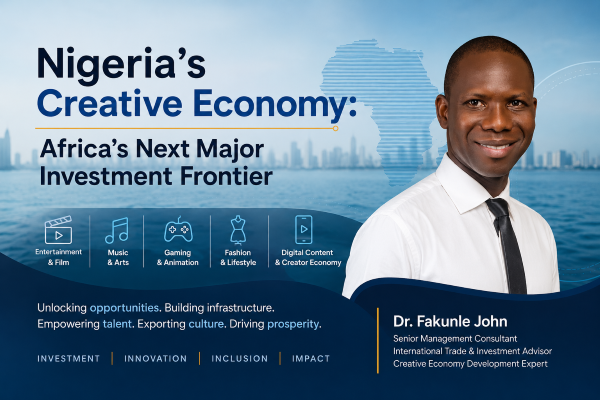
Dr. Fakunle Aremu is a Senior Management Consultant and international trade and investment advisor with interests in creative economy development, export competitiveness, enterprise growth and Africa-focused investment facilitation. He can be reached at +2348063284833 and fakunle2014@gmail.com
