

• Home
  • Agric
  • Sci & Tech
  • Health
  • Environment
  • Hausa News
  • More
    • Business/Banking & Finance
    • Politics/Elections
    • Entertainments & Sports
    • International
    • Investigation
    • Law & Human Rights
    • Africa
    • ACCOUNTABILITY/CORRUPTION
    • Hassan Gimba
    • Column
    • Prof. Jibrin Ibrahim
    • Prof. M.K. Othman
    • Defense/Security
    • Education
    • Energy/Electricity
    • Entertainment/Arts & Sports
    • Society and Lifestyle
    • Food & Agriculture
    • Health & Healthy Living
    • International News
    • Interviews
    • Investigation/Fact-Check
    • Judiciary/Legislature/Law & Human Rights
    • Oil & Gas/Mineral Resources
    • Press Freedom/Media/PR/Journalism
    • General News
    • Presidency
  • About Us
    • Contact Us
    • Board Of Advisory
    • Privacy Policy
    • Ethics Policy
    • Teamwork And Collaboration Policy
    • Fact-Checking Policy
    • Advertising
  • Media OutReach Newswire
    • Wire News
  • The Stories
Facebook Twitter Instagram
Trending
  • Cocoa farmers push for local processing factories
  • Faith leaders call for just energy transition in Nigeria
  • Drunken passenger forces plane to land in Germany
  • Association endorses federal govt support programme for cancer patients
  • Kebbi vulcanisers chairman trains 48 apprentices, earns Up to ₦30,000 daily
  • Sightsavers mobilises 87 district heads to administer Azithromycin to 1.2m children in Sokoto
  • AFAN blames middlemen, high transport costs for rising food prices
  • Court convicts ex-Power Minister Mamman over N33bn fraud
Facebook Twitter Instagram YouTube
AsheNewsAsheNews
  • Home
  • Agric

    Cocoa farmers push for local processing factories

    May 7, 2026

    AFAN blames middlemen, high transport costs for rising food prices

    May 7, 2026

    Lagos resident lament soaring tomato prices

    May 6, 2026

    FG unveils 2025–2030 revised national gender policy on agrifood systems

    May 6, 2026

    High fertiliser prices threaten 2026 farming season in Bauchi

    May 5, 2026
  • Sci & Tech

    Nigeria ranks among top AI-adopting nations

    May 7, 2026

    UBA, MTN MoMo, RedTech unveil cardless payment solution

    May 6, 2026

    Uganda unveils first homegrown biotech livestock vaccine, targets regional leadership

    May 3, 2026

    Samsung revenue jumps 43% in Q1

    May 1, 2026

    AfricaX summit to support commercialisation of innovations

    April 30, 2026
  • Health

    Association endorses federal govt support programme for cancer patients

    May 7, 2026

    Sightsavers mobilises 87 district heads to administer Azithromycin to 1.2m children in Sokoto

    May 7, 2026

    Lagos signs 10-year primary health care compact

    May 7, 2026

    Benue children stunted as malnutrition worsens — Nutrition officer

    May 7, 2026

    Lagos faces 500-year doctor shortage without urgent action — Commissioner warns

    May 7, 2026
  • Environment

    Faith leaders call for just energy transition in Nigeria

    May 7, 2026

    FG to close 1 carriageway of Eko bridge for repairs

    May 7, 2026

    Oyo introduces daily environmental sanitation enforcement

    May 6, 2026

    Shettima reaffirms FG commitment to humanitarian response

    May 6, 2026

    Lagos bridge crash kills 1, injures 4

    May 5, 2026
  • Hausa News

    Otti plans 250-room 5-star hotel in Umuahia

    April 11, 2026

    Anti-quackery task force seals 4 fake hospitals in Rivers

    August 29, 2025

    [BIDIYO] Yadda na lashe gasa ta duniya a fannin Ingilishi – Rukayya ‘yar shekara 17

    August 6, 2025

    A Saka Baki, A Sasanta Saɓani Tsakanin ‘Yanjarida Da Liman, Daga Muhammad Sajo

    May 21, 2025

    Dan majalisa ya raba kayan miliyoyi a Funtuwa da Dandume

    March 18, 2025
  • More
    1. Business/Banking & Finance
    2. Politics/Elections
    3. Entertainments & Sports
    4. International
    5. Investigation
    6. Law & Human Rights
    7. Africa
    8. ACCOUNTABILITY/CORRUPTION
    9. Hassan Gimba
    10. Column
    11. Prof. Jibrin Ibrahim
    12. Prof. M.K. Othman
    13. Defense/Security
    14. Education
    15. Energy/Electricity
    16. Entertainment/Arts & Sports
    17. Society and Lifestyle
    18. Food & Agriculture
    19. Health & Healthy Living
    20. International News
    21. Interviews
    22. Investigation/Fact-Check
    23. Judiciary/Legislature/Law & Human Rights
    24. Oil & Gas/Mineral Resources
    25. Press Freedom/Media/PR/Journalism
    26. General News
    27. Presidency
    Featured
    Recent

    Cocoa farmers push for local processing factories

    May 7, 2026

    Faith leaders call for just energy transition in Nigeria

    May 7, 2026

    Drunken passenger forces plane to land in Germany

    May 7, 2026
  • About Us
    1. Contact Us
    2. Board Of Advisory
    3. Privacy Policy
    4. Ethics Policy
    5. Teamwork And Collaboration Policy
    6. Fact-Checking Policy
    7. Advertising
    Featured
    Recent

    Cocoa farmers push for local processing factories

    May 7, 2026

    Faith leaders call for just energy transition in Nigeria

    May 7, 2026

    Drunken passenger forces plane to land in Germany

    May 7, 2026
  • Media OutReach Newswire
    • Wire News
  • The Stories
AsheNewsAsheNews
Home»Science/Tech & Innovation/R&D»Genetic abdaptation to cold brought migraines with it
Science/Tech & Innovation/R&D

Genetic abdaptation to cold brought migraines with it

Abdallah el-KurebeBy Abdallah el-KurebeMay 15, 2018No Comments4 Mins Read
Share
Facebook Twitter LinkedIn Pinterest Email

Humans living in higher latitudes tend to have a variant of a gene involved in sensing cold temperatures, but it comes with a cost.  

By Viviane Callier

A human genetic variant in a gene involved in sensing cold temperatures became more common when early humans migrated out of Africa into colder climates between 20,000 and 30,000 years ago, a study published today (May 3) in PLOS Genetics shows.

The advantage conferred by this variant isn’t definitively known, but the researchers suspect that it influences the gene’s expression levels, which in turn affect the degree of cold sensation. The observed pattern of positive selection strongly indicates that the allele was beneficial, but that benefit had a tradeoff—bringing with it a higher risk of getting migraines.

“This paper is the latest in a series of papers showing that humans really have adapted to different environments after some of our ancestors migrated out of Africa,” explains evolutionary geneticist Rasmus Nieslen of the University of California, Berkeley, who was not involved in the study. “There are a number of adaptations associated with moving into an arctic climate, but none with as clear a connection to cold as this one,” he adds.

Selection is optimizing fitness. It doesn’t optimize health, it doesn’t optimize happiness, so sometimes things are pushed by selection and they have negative side effects. —Johns Hawks,
University of Wisconsin-Madison

Although studies have demonstrated some striking examples of recent human adaptation, for instance, warding off infectious diseases such as malaria or having the ability to digest milk, relatively little was known about the evolutionary responses to fundamental features of the environment, namely, temperature and climate.

“Obviously, humans lived in Africa for a long time, and one of the main environmental factors that changed as humans migrated north was temperature,” explains population geneticist Aida Andres. So she and Felix Key the Max Planck Institute in Leipzig homed in on a gene, TRPM8, that encodes a cation channel in the neurons that innervate the skin. It is activated by cold temperatures and necessary for sensing cold and for thermoregulation. If there was a place to look for human adaptation, this gene looked like a good candidate.

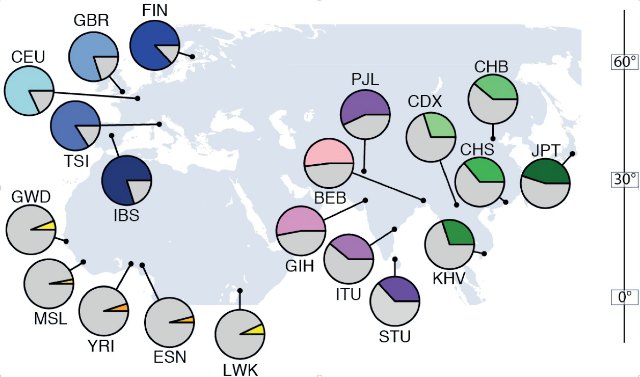
Using the 1000 Genomes dataset and the Simons Genome Diversity Panel, the researchers investigated variants of this gene in populations throughout Africa, Europe, and Asia. They found that a single nucleotide polymorphism (SNP) in a regulatory region of the TRPM8 gene was “highly differentiated between different populations in the world,” Andres, now at University College London, says. And genotype correlated with latitude: 5 percent of people with Nigerian ancestry, versus 88 percent of people with Finnish ancestry, carry the cold-adapted variant.

Using models of population genetics, the researchers inferred that the cold-adapted allele had already existed in the ancestral African population, and that it became more common as people migrated northward. The geographic pattern was consistent with positive selection for the SNP at higher latitudes, Andres says.

“One of the interesting things about [this variant] is that it is relatively more common in Europe than in Asian people who live at the same latitude,” notes Hawks. “We don’t know why that should be. Maybe there’s a historical factor here that isn’t yet understood.”

To find out when selection on this variant occurred, the researchers looked for the SNP in the genomes from ancient remains of hunter gatherers or farmers that lived 3,000–8,000 years ago in Eurasia. It turned out that the allele was already common among these groups at least 3,000 years ago.

The connection between TRPM8 and migraine isn’t clear, other than the association. “Selection is optimizing fitness,” says anthropologist John Hawks of the University of Wisconsin-Madison who was not associated with the study. “It doesn’t optimize health, it doesn’t optimize happiness, so sometimes things are pushed by selection and they have negative side effects. This seems to be a case where a gene is pushed higher in frequency by selection for adaptation to cold, and it maybe has a bad side effect on increased susceptibility to migraines.” It’s also possible that the downside to having the cold-adaptive TRPM8 allele is a modern phenomenon, and that the migraine risk didn’t appear until more recently as environments have changed, says Nielsen.

F.M. Key et al., “Human local adaptation of the TRPM8 cold receptor along a latitudinal cline,”  PLOS Genet, 14:e1007298, 2018.

Cold genetics and genomics human genetics migraines
Share. Facebook Twitter Pinterest LinkedIn WhatsApp Reddit Tumblr Email
Abdallah el-Kurebe
  • Website
  • Facebook
  • Twitter
  • LinkedIn

Related Posts

Nigeria ranks among top AI-adopting nations

May 7, 2026

UBA, MTN MoMo, RedTech unveil cardless payment solution

May 6, 2026

Uganda unveils first homegrown biotech livestock vaccine, targets regional leadership

May 3, 2026

Leave A Reply Cancel Reply

Cocoa farmers push for local processing factories

May 7, 2026

Faith leaders call for just energy transition in Nigeria

May 7, 2026

Drunken passenger forces plane to land in Germany

May 7, 2026

Association endorses federal govt support programme for cancer patients

May 7, 2026
About Us
About Us

ASHENEWS (AsheNewsDaily.com), published by PenPlus Online Media Publishers, is an independent online newspaper. We report development news, especially on Agriculture, Science, Health and Environment as they affect the under-reported rural and urban poor.

We also conduct investigations, especially in the areas of ASHE, as well as other general interests, including corruption, human rights, illicit financial flows, and politics.

Contact Info:
  • 1st floor, Dogon Daji House, No. 5, Maiduguri Road, Sokoto
  • +234(0)7031140009
  • ashenewsdaily@gmail.com
Facebook Twitter Instagram Pinterest
© 2026 All Rights Reserved. ASHENEWS Daily Designed & Managed By DeedsTech

Type above and press Enter to search. Press Esc to cancel.