


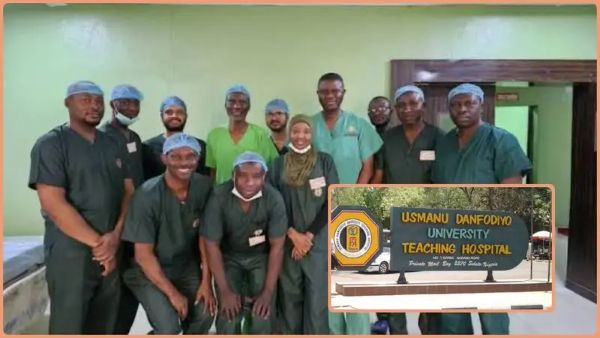
As we celebrate a second successful kidney transplant at the prestigious Center of Excellence in Urology and Nephrology (CEUN) of Usman Danfodiyo University Teaching Hospital (UDUTH) on a 22‑year‑old female patient with CKD this April 2026, let’s rewind to the over 200 years of glorious and progressive history of the Sokoto Caliphate.
Note: The first successful kidney transplant in UDUTH was in January 2025 on a 32-year-old male.
This second kidney transplant is watershed and historic as it was done entirely by our UDUTH local team of nephrologists, radiologists, urologists, vascular surgeons, anaesthesiologists, clinical pharmacologists, intensive care nurses, clinical laboratory scientists, and biomedical engineers. Meaning: massive cost cuts, delays minimised, multispecialty capacity and expertise established, confidence built, medical logistics and value chains established, research advanced, reversal of medical tourism and, most importantly, lives, livelihoods, and families saved.
A retrograde urography of this incredible medical feat in Danfodiyo’s own university.
The science and medicine of kidney health and disease had been well established in the Sokoto Caliphate with documented evidence of knowledge, training, and practice of the health sciences by our leaders in areas of nephrology, ophthalmology, pharmacology, orthopedics, gastroenterology, paediatrics, midwifery, psychiatry, etc.
Amrilil Kulyati Wa Ilajiha is a book on kidney health and disease written by Sultan Muhammadu Bello (1817–1837) following a written prescription on a kidney condition/ailment suffered by the Emir of Zazzau, Mal Yamusa (1821–1834), diagnosed by the Sultan and after which the Emir had a remarkable full recovery. That was the best kidney care/treatment you could get in 19th‑century Africa, from the Caliph himself — a consultant and emeritus professor of medicine by any standards of the time.
It’s instrumental and historic that 200 years on, a university teaching hospital named after the founder of the Sokoto Caliphate (Usman Danfodiyo University Teaching Hospital) has raised world‑class medical sciences manpower and experts to perform the apex, most advanced, delicate, and sophisticated last‑resort care of kidney conditions in the 21st century — successful kidney transplants.
To celebrate this important milestone in the footsteps of our great-great-grandfathers, SokotoDNA visited HRH the Emir of Zazzau, Mal Ahmed Nuhu Bamalli, CFR, to revitalise and reinforce awareness among the general public, Nigerians, and the world on the positions, roles, and contributions of the Caliphal leaders in medicine and healthcare from centuries past.
Amir of Zazzau Mal Yamusa taught, practised, and played significant roles in advancing health and medical practises in his domain, making Zaria and Zazzau Emirate a hub and referral centre for complementary, alternative, traditional, and herbal medicine to this day, amongst other developments.
SokotoDNA made a symbolic presentation of a book by Sultan Muhammadu Bello on kidney diseases and treatment, and a clinical/anatomical model of the human kidney to the Emir of Zazzau as a relic and testimony of the enduring legacies and contributions of the leaders of the Caliphate in medicine and healthcare.
The history of the Sokoto Caliphate is not all about wars or conquests, as some people may want to project. Yes, there were wars and conflicts that were offensive for territorial integrity, but the vast majority were defensive from aggressors, internal or external. This is part of the natural history of any human civilization on this planet.
It’s on record that the Sokoto Caliphate contributed far more to human capital development, scholarship, intellectualism, establishing peace, justice, economic development, arts, sciences, medicine, and human rights and dignity than any of its contemporary empires/kingdoms of the 19th century.
Love always, CEUN/UDUTH. Proud of our great team of clinicians, surgeons, radiologists, nurses, pharmacists, laboratory scientists, biomedical engineers, CEUN and UDUTH/UDUS leadership.
Kakale, a Medical Doctor and CEO of the SokotoDNA, writes from Sokoto
