


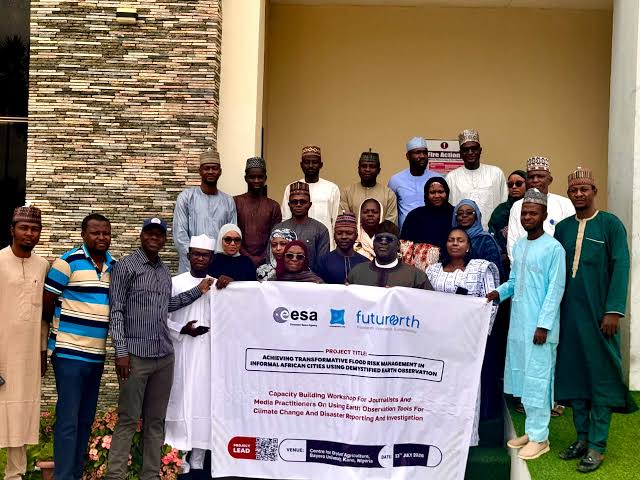
A Geography expert at Bayero University Kano (BUK), Dr Suleiman Yunus, has urged journalists to leverage Earth Observation technology to shift from reactive disaster reporting to a more proactive approach.
According to Yunus, embracing the tool will enable journalists to provide early warning communication capable of saving lives and reducing property losses.
He made the call while presenting a paper at a training on Earth Observation Satellite Tools organised by BUK in collaboration with the European Space Agency and Future Earth on Monday.
Earth Observation (EO) is a satellite-based technology designed to enhance climate change and disaster risk reporting. It utilises a network of spaceborne sensors to gather precise, real-time data about the planet’s physical, chemical, and biological systems.
High-resolution satellites continuously monitor atmospheric changes, ocean temperatures, and soil moisture levels. By analysing multi-year patterns, EO helps researchers and journalists predict and map emerging flood threats, drought cycles, and wildfire risks before they escalate.
Yunus described EO as one of the world’s leading technologies, noting that its rapid advancement has transformed virtually every sector, including journalism.
He said journalists have a critical role to play in communicating disaster risks and providing timely early warning information to vulnerable communities before disasters strike.
“Earth observation technology has brought significant transformation across different disciplines, including journalism. It provides journalists with the opportunity to communicate disaster risks and early warning information to the public,” he said.
Yunus noted that disaster reporting in Nigeria has largely remained reactive, with journalists often covering incidents only after lives and property have been lost.
He, however, said the availability of satellite-based Earth Observation data now offers journalists the opportunity to anticipate potential disasters and alert the public ahead of time.
“The current pattern of disaster reporting is mostly reactive, where journalists visit disaster scenes to report the magnitude of destruction. We must now embrace a proactive approach by using Earth Observation technology to understand the likelihood of disasters before they occur and communicate the risks to the people,” he said.
The don explained that timely dissemination of early warning information would enable communities, emergency responders, and government agencies to take preventive measures, thereby reducing the devastating impact of disasters.
He stressed that integrating Earth Observation into journalism would strengthen disaster risk communication, improve public awareness, and contribute to building more resilient communities.
The training brought together academics, journalists, and other stakeholders to explore the application of Earth Observation technologies in disaster risk reduction, environmental monitoring, and sustainable development.
