

• Home
  • Agric
  • Sci & Tech
  • Health
  • Environment
  • Hausa News
  • More
    • Business/Banking & Finance
    • POLITICS
    • Entertainments & Sports
    • International
    • Investigation
    • Law & Human Rights
    • Africa
    • ACCOUNTABILITY/CORRUPTION
    • Hassan Gimba
    • Column
    • Prof. Jibrin Ibrahim
    • Prof. M.K. Othman
    • Defense/Security
    • Education
    • Energy/Electricity
    • Entertainment/Arts & Sports
    • Society and Lifestyle
    • Food & Agriculture
    • Health & Healthy Living
    • International News
    • Interviews
    • Investigation/Fact-Check
    • LAW & HUMAN RIGHTS
    • Oil & Gas/Mineral Resources
    • PRESS FREEDOM/JOURNALISM/PR
    • General News
    • Presidency
  • About Us
    • Contact Us
    • Board Of Advisory
    • Privacy Policy
    • Ethics Policy
    • Teamwork And Collaboration Policy
    • Fact-Checking Policy
    • Advertising
  • Media OutReach Newswire
    • Wire News
  • The Stories
Facebook Twitter Instagram
Trending
  • Association trains farmers on agroforestry, carbon opportunities
  • Nigerian SMEs boost growth via digital payments, investments
  • Benin residents urge quick completion of Ramat park flyover
  • NCoS launches new PPP committee for infrastructure projects
  • Osun residents seek alternatives amid gas price surge
  • Lagos police nab woman over human trafficking of Kaduna girls
  • Jigawa techs call for vocational skills support
  • Oyo assembly cancels anniversary celebrations over security concerns
Facebook Twitter Instagram YouTube
AsheNewsAsheNews
  • Home
  • Agric

    Association trains farmers on agroforestry, carbon opportunities

    June 18, 2026

    IWMI, IFPRI link Kano farmers to solar irrigation support

    June 17, 2026

    Dangote expects over $4bn annual forex earnings from fertiliser exports

    June 16, 2026

    AFAN Kano calls for fertilizer subsidy to boost agriculture

    June 16, 2026

    Food security expert urges youth involvement in agriculture

    June 16, 2026
  • Sci & Tech

    Nigerian SMEs boost growth via digital payments, investments

    June 18, 2026

    Jigawa techs call for vocational skills support

    June 18, 2026

    Mupita warns against rising Afrophobic sentiments

    June 18, 2026

    AI expert urges youth to focus on human skills

    June 18, 2026

    Nigeria fully digitized 38 MDAs, says civil service head

    June 17, 2026
  • Health

    WHO releases first guidelines for Filovirus diseases

    June 18, 2026

    NAFDAC prepares for second phase of sachet alcohol enforcement

    June 18, 2026

    Nigeria launches N50m fund for cancer patients

    June 17, 2026

    NEDC boosts healthcare in Adamawa

    June 17, 2026

    Niger intensifies Ebola screening for returning pilgrims from Saudi Arabia

    June 17, 2026
  • Environment

    Benin residents urge quick completion of Ramat park flyover

    June 18, 2026

    Shettima urges states to document assets, boost investment, tourism

    June 18, 2026

    GlobalFact summit brings 500 fact-checkers from 80 countries to Lithuania

    June 17, 2026

    All injured passengers discharged after train accident

    June 16, 2026

    SWEEP calls for waste management reforms in Lagos

    June 16, 2026
  • Hausa News

    UNA signs MoU to launch air Bissau in Guinea-Bissau

    June 15, 2026

    Otti plans 250-room 5-star hotel in Umuahia

    April 11, 2026

    Anti-quackery task force seals 4 fake hospitals in Rivers

    August 29, 2025

    [BIDIYO] Yadda na lashe gasa ta duniya a fannin Ingilishi – Rukayya ‘yar shekara 17

    August 6, 2025

    A Saka Baki, A Sasanta Saɓani Tsakanin ‘Yanjarida Da Liman, Daga Muhammad Sajo

    May 21, 2025
  • More
    1. Business/Banking & Finance
    2. POLITICS
    3. Entertainments & Sports
    4. International
    5. Investigation
    6. Law & Human Rights
    7. Africa
    8. ACCOUNTABILITY/CORRUPTION
    9. Hassan Gimba
    10. Column
    11. Prof. Jibrin Ibrahim
    12. Prof. M.K. Othman
    13. Defense/Security
    14. Education
    15. Energy/Electricity
    16. Entertainment/Arts & Sports
    17. Society and Lifestyle
    18. Food & Agriculture
    19. Health & Healthy Living
    20. International News
    21. Interviews
    22. Investigation/Fact-Check
    23. LAW & HUMAN RIGHTS
    24. Oil & Gas/Mineral Resources
    25. PRESS FREEDOM/JOURNALISM/PR
    26. General News
    27. Presidency
    Featured
    Recent

    Association trains farmers on agroforestry, carbon opportunities

    June 18, 2026

    Nigerian SMEs boost growth via digital payments, investments

    June 18, 2026

    Benin residents urge quick completion of Ramat park flyover

    June 18, 2026
  • About Us
    1. Contact Us
    2. Board Of Advisory
    3. Privacy Policy
    4. Ethics Policy
    5. Teamwork And Collaboration Policy
    6. Fact-Checking Policy
    7. Advertising
    Featured
    Recent

    Association trains farmers on agroforestry, carbon opportunities

    June 18, 2026

    Nigerian SMEs boost growth via digital payments, investments

    June 18, 2026

    Benin residents urge quick completion of Ramat park flyover

    June 18, 2026
  • Media OutReach Newswire
    • Wire News
  • The Stories
AsheNewsAsheNews
Home»Environment/Climate Change»Climate change might be more rapid than predicted – New data
Environment/Climate Change

Climate change might be more rapid than predicted – New data

NewsdeskBy NewsdeskMay 28, 2022No Comments5 Mins Read
Share
Facebook Twitter LinkedIn Pinterest Email

About 30 massive, intricate computer networks serve the scientists who stand at the forefront of climate change research. Each network runs a software program comprised of millions of lines of code. These programs are computational models that combine the myriads of physical, chemical and biological phenomena that together form the climate of our planet. The models calculate the state of Earth’s atmosphere, oceans, land and ice, capturing past and present climate variability and using the data to predict future climate change.

These results are analyzed by leading research institutes across the globe, including the Weizmann Institute of Science, and then incorporated into the UN’s Intergovernmental Panel on Climate Change (IPCC) assessment report. Policymakers rely on the IPCC report when they form adaptation and mitigation strategies for climate change, one of our generation’s greatest crises.

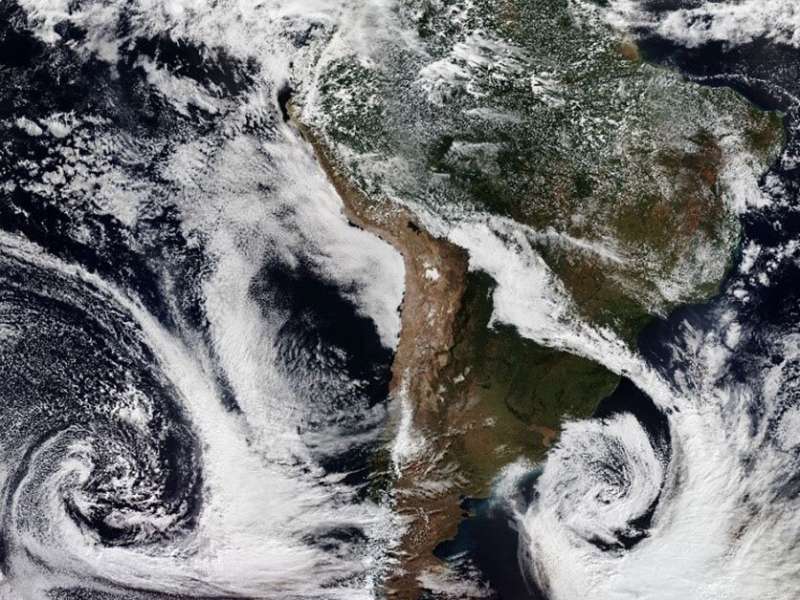
A new study, published today in Nature Climate Change, will certainly make the IPCC—and other environmental bodies—take notice. A team of scientists led by Dr. Rei Chemke of Weizmann’s Earth and Planetary Sciences Department revealed a considerable intensification of winter storms in the Southern Hemisphere. The study, conducted in collaboration with Dr. Yi Ming of Princeton University and Dr. Janni Yuval of MIT, is sure to make waves in the climate conversation. Until now, climate models have projected a human-caused intensification of winter storms only toward the end of this century. In the new study, Chemke and his team compared climate model simulations with current storm observations. Their discovery was bleak: It became clear that storm intensification over recent decades has already reached levels projected to occur in the year 2080.

“A winter storm is a weather phenomenon that lasts only a few days. Individually, each storm doesn’t carry much climatic weight. However, the long-term effect of winter storms becomes evident when assessing cumulative data collected over long periods of time,” Chemke explains. Cumulatively, these storms have a significant impact, affecting the transfer of heat, moisture and momentum within the atmosphere, which consequently affects the various climate zones on Earth.

“One example of this is the role the storms play in regulating the temperature at the Earth’s poles. Winter storms are responsible for the majority of the heat transport away from tropical regions toward the poles. Without their contribution, the average pole temperatures would be about 30°C lower.”

Similarly, the collective intensification of these storms yields a real and significant threat to societies in the Southern Hemisphere in the next decades.

“We chose to focus on the Southern Hemisphere because the intensification registered there has been stronger than in the Northern Hemisphere,” Chemke says. “We didn’t examine the Northern Hemisphere, but it seems that the intensification of storms in this hemisphere is slower compared to that in the Southern Hemisphere. If the trend persists,” Chemke adds, “we will be observing more significant winter storm intensification here in the upcoming years and decades.”

In his lab at the Weizmann Institute, Chemke researches the physical mechanisms underlying large-scale climate change. In this study, he and his research partners sought to understand whether these changes in climate patterns were caused by external factors (such as human activity), or whether they have resulted from the internal fluctuations of the global climate system. They analyzed climate models that simulated storm intensification patterns under the isolated influence of internal climatic causes, without external impact. They showed that over the past 20 years, storms have been intensifying faster than can be explained by internal climatic behavior alone.

In addition, the researchers discovered the physical process behind the storm intensification. An analysis of the growth rate of the storms showed that changes in atmospheric jet streams over the past few decades have caused these escalations, and current climate models are unable to reflect these changes accurately.

Chemke, Ming and Yuval’s study has two immediate, considerable implications. First, it shows that not only climate projections for the coming decades are graver than previous assessments, but it also suggests that human activity might have a greater impact on the Southern Hemisphere than previously estimated. This means that rapid and decisive intervention is required in order to halt the climate damage in this region. Second, a correction of the bias in climate models is in order, so that these can provide a more accurate climate projection in the future.

Could the climate models be inaccurately predicting other important phenomena? “The models are doing a very good job at forecasting nearly all the parameters,” Chemke says. “We’ve discovered one parameter for which the sensitivity of the models needs to be adjusted. Changes in temperature, precipitation, sea ice, and summer storm patterns, for example, are all being simulated accurately.”

The study’s findings are expected to help climate researchers around the world correct the bias in the models and create a more accurate prediction of future climate patterns. In addition, the updated understanding of the intensification of winter storms over the past several decades will help us gain a better understanding of the state of the Earth’s climate. Climate scientists will now be able to estimate more accurately the extent of the damage that climate change is expected to wreak—damage that will only be mitigated if humanity intervenes and takes responsibility for the future of the planet.

By Nature Climate Change

environment IPCC Nature Climate change Weizmann Institute
Share. Facebook Twitter Pinterest LinkedIn WhatsApp Reddit Tumblr Email
Newsdesk
  • Website

Related Posts

Benin residents urge quick completion of Ramat park flyover

June 18, 2026

NCoS launches new PPP committee for infrastructure projects

June 18, 2026

Osun residents seek alternatives amid gas price surge

June 18, 2026

Leave A Reply Cancel Reply

Association trains farmers on agroforestry, carbon opportunities

June 18, 2026

Nigerian SMEs boost growth via digital payments, investments

June 18, 2026

Benin residents urge quick completion of Ramat park flyover

June 18, 2026

NCoS launches new PPP committee for infrastructure projects

June 18, 2026
About Us
About Us

ASHENEWS (AsheNewsDaily.com), published by PenPlus Online Media Publishers, is an independent online newspaper. We report development news, especially on Agriculture, Science, Health and Environment as they affect the under-reported rural and urban poor.

We also conduct investigations, especially in the areas of ASHE, as well as other general interests, including corruption, human rights, illicit financial flows, and politics.

Contact Info:
  • 1st floor, Dogon Daji House, No. 5, Maiduguri Road, Sokoto
  • +234(0)7031140009
  • ashenewsdaily@gmail.com
Facebook Twitter Instagram Pinterest
© 2026 All Rights Reserved. ASHENEWS Daily Designed & Managed By DeedsTech

Type above and press Enter to search. Press Esc to cancel.