


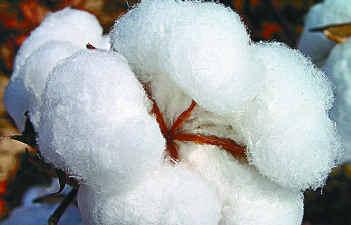
Uganda’s lost glory as one of Africa’s top producers of the ’white-gold’ (cotton) in the 1950s-70s, is slowly being regained with farmers already reaping over 2,000 metric tons, hardly a year after engaging in the revival. The country’s central region is leading the revival, [which ironically wasn’t growing much cotton then]. Uganda has two cotton planting seasons in a year.
Policy pundits say political instability during the early 1970-80s, coupled with the collapse of co-operatives to make timely payments to cotton growers, the disruption of research to improve on old varieties and fight biotic and abiotic stresses, failure to maintain and multiply the existing varieties, and the poorly maintained ginneries, eventually led to the collapse of the industry. Over-cultivated soils, and the emergence of more valuable agro-enterprises that are less labour-intensive, virulent pests and diseases, besides political instability, have been the other key factors responsible for the decline of cotton-growing. Uganda’s cotton revival campaign is led by the Buganda Kingdom, a cultural institution located in the central region—the most densely-populated/wealthy region—where the capital city Kampala is found.
Five of the 18 traditional counties of the Kingdom have led the cotton-growing revival drive, their latest harvest being 2,000 metric tons, according to the cotton revival program, whose results are regularly broadcast on the Kingdom’s Central Broadcasting Service (CBS) radio—one of Uganda’s largest and most influential media houses. The aim is to interest more Ugandans and mobilize more farmers, to take on cotton as a profitable agro-enterprise.
The cotton revival in Uganda tallies well with neighbouring Kenya’s national cotton-textile strategic plans. Way back 20 years ago, the Kenya Institute for Public Policy Research and Analysis (KIPPRA) undertook a study: Developing a Revival Strategy for Kenya’s Cotton-Textile Industry: A Value Chain Approach [Working Paper No. 8 January 2003], which found that the government’s cotton-textile revival in Kenya was motivated by the huge potential in poverty reduction, its unprecedented decline since the second half of the 1980s, the United States (US) market opportunities offered by African Growth and Opportunity Act (AGOA) and other trade initiatives. The Government recognizes the cotton and textile industry’s chain—starting with production and ending with the sale of manufactured garments—offers great anti-poverty and employment opportunities, among others. Kenya recently announced a 25 percent levy on imported clothes to revive her local cotton-textile sector. Ugandan President, Gen. Yoweri Museveni too, in September 2023 announced a directive to ban the importation of second-hand clothes, as a protective measure for revival and sustenance of Uganda’s cotton-textile industry. He argued that the step would benefit domestic cotton farmers, textile manufacturers, and traders in the long term. These were also the Kenya Trade Cabinet Secretary Moses Kuria’s arguments for imposing a high imported clothes’ levy, in 2023—twenty years after the KIPPRA study. Therefore Uganda and Kenya have identified cotton as a strategically important agro-subsector that can help boost their economies among other post-COVID initiatives.
It involves a huge population (growing, harvesting, sorting, ginning, industrial spinning and textile manufacture etc), on one hand. Cotton-textile also involves designing, coloring, tailoring, co-creations in types of fabrics/textiles, the fashion of garments and styles, and exports, on the other hand. Developed countries have cotton as a powerful agro-industrial subsector: USA, China, Canada, India, Brazil etc.
Uganda’s Buganda-led cotton revival began in 2021 in the Kingdom’s counties of Butambala, Mawokota, Busujju, and Buuddu in the central region, where farmers have lately harvested 2,000 metric tons. Ms. Juliana Nabuuma (Wajinja), Ms Goretti Nambalirwa (Kasozi-Kituntu), and Mr. Stephen Lujalaba Kipankulawa—all who had earned cash payments expressed happiness with the performance of their cotton farms and the cash payments, upon harvesting. Mohammed Sejiri, another farmer says: “The involvement of the kingdom’s leadership in cotton revival gives them great hope and optimism that drives them to work hard….”
Cotton is one of the traditional cash crops grown in Uganda after coffee and tea, and it is among the top exports, however, the amounts and revenue values declined over the years. The Uganda government in 1994, established the State-run Cotton Development Organization (CDO) a statutory public body, to regulate cotton production, marketing, processing, and export. CDO also promotes the distribution of seeds and generally facilitates the development of the cotton industry.
Today, approximately 250,000 households are engaged in cotton production, each with an average farm size of less than 0.5 hectares. With an average household size of 5 in Uganda, cotton production supports approximately 1.25 million people. Cotton was introduced in Uganda in 1903 by British colonialists and has been cultivated at altitudes varying from 3,500 feet to 4,500 feet above sea level. It is entirely rain-fed. In the Northern areas, with one rainy season, cotton planting starts with the April-June rains [prior to Climate Changes—where the weather has become an unpredictable affair]. In Africa, big cotton growers are Benin, Ivory Coast, Mali, Burkina Faso, Nigeria, Ghana, Niger, Egypt, Sudan, Ethiopia, Chad, Malawi, Tanzania, Kenya etc. Some of these countries have adopted new cotton varieties, among them genetically modified (GM) as part of many interventions, to boost yields and bolster farmers’ incomes and exports. Uganda has also attempted to introduce GM-cotton to fight off the most challenging pests (boll-worms) and weeds, as some of the biotic stress factors hampering a productive cotton enterprise among farmers. The African Union (AU)’s Development Agency (AUDA)-New Partnership for African Development (NEPAD) cite GM-cotton among the crops governments are prioritizing to genetically modify in order to manage the low productivity challenge as a result of pests, disease and weed infestations.
AUDA-NEPAD states: “Current GM-crops being grown in Africa include Bt-cotton by farmers in South Africa, Burkina Faso [as Eswatini—formerly Swaziland]…. The farmers growing these crops have obtained increased yields, reduced production costs and losses, and higher income.” This is in the AUDA-NEPAD Nov. 24, 2020 report, titled: Development of GM crops in Africa.
Uganda’s pursuit of GM-cotton began in earnest in 2006/2007 by the State-run National Agricultural Research Organization (NARO) through its mandated National Semi-Arid Resources Research Institute (NaSARRI)-Serere, located in the east. For nearly five years research for Bacillus thuringiensis (Bt)-cotton and Herbicide Tolerant (Ht)-cotton was successfully conducted by NARO/NaSARRI, culminating in a stacked-gene cotton (single Bt-Ht) variety.
“While these traits were bred into African cultivars and adapted to African growing conditions, the technologies largely originated from outside the continent. Now, there are a number of advances in research and development of GM crops specifically of importance to the African people that are underway in African universities and research institutions,” says AUDA-NEPAD. The continental body says GM crops being grown in Africa include…. Bt-maize in South Africa and Egypt… Agricultural biotechnology such as genetic engineering in combination with conventional breeding methods is seen as one of the opportunities that can boost agricultural growth (Ojuederie et al., 2011). So far, four African countries are growing GM crops: South Africa, Burkina Faso, Egypt, and Sudan, says AUDA-NEPAD. Nigeria, Eswatini, Ethiopia, Kenya, and Ghana, are also following suit. Ironically, while Uganda’s cotton-textile industry declined due to pests, diseases, and weeds, its neighbors near and far embraced GM-cotton (Sudan, Ethiopia, and lately Kenya) to solve the same challenges for which Uganda had modified its cotton and build capacity in research and farmer-management. It, however, lacks a Biosafety law that permits open growing of GM crops.
Most farmers in traditional cotton growing districts in the north, north-east, and eastern Uganda have shifted to alternative crops like groundnuts and sorghum which are cheaper to produce. It is yet to be seen if the Buganda kingdom begins experiencing bollworms, other pests and weeds, shall embrace GM-cotton, to fight these off and sustain white gold production. US-based Genetic Literacy Project (GLP)—an online publication—quotes NaSARRI Cotton Program Leader, Dr. Martin Orawu, as blaming Ugandan policy-makers for the delay to make a Biosafety law to enable farmers to grow GM-cotton. “Due to lack of correct information some people think that if we grow GMO cotton it will destroy other crops and the environment,” says Dr. Orawu. “However our research findings have proved that GM cotton is cheaper to grow, it has higher yields, and it does not affect other crops or the environment in any way,” Orawu adds in the LP published in 2018. Other countries around the world that grow GM cotton, include the USA, India, China, Brazil, Canada, Pakistan, and Argentina.
