


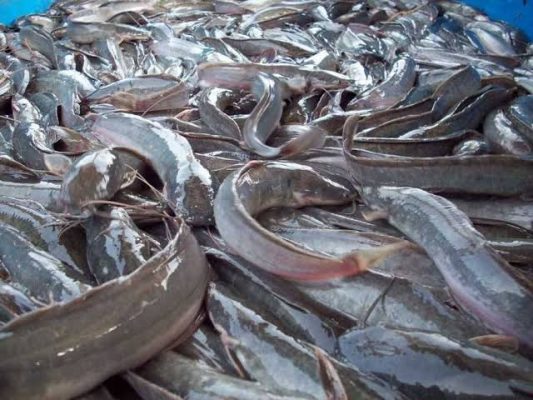
Some catfish farmers in Anguwa Tiv community, Ado, Nasarawa State, have expressed concern that middlemen make more profit than those involved in actual fish production.
The farmers, in separate interviews on Sunday in Karu Local Government Area of the state, said the dominance of intermediaries in the fish market had made it difficult for them to earn fair returns on their investments.
They explained that middlemen often dictate prices, leaving farmers at the mercy of exploitative market forces despite the rising cost of fish feed, transportation, and pond maintenance.
Mr. Christopher Ewalefo, a catfish farmer, said farmers were “suffering silently” because middlemen control the market chain and reap most of the profits.
He said the practice forces farmers to bear high costs, receive low returns, and, in some cases, fall victim to fraud.
“People hardly come to the farm to buy fish; they go to the market. Many don’t even know their way to the farms, so middlemen capitalise on this to make more profits,” he said.
Ewalefo explained that middlemen often flood the market during the rainy season, artificially lowering prices through oversupply.
He said they buy at cheaper rates and resell at high prices when demand rises, leaving farmers at a loss.
According to him, the only sustainable solution is for farmers to reduce their reliance on intermediaries by adding value to their fish through processing, packaging, and selling directly to consumers, hotels, and restaurants.
Mr. Solomon Uduka, another catfish farmer, said that while middlemen had served as intermediaries for years, many now exploit farmers rather than support them.
“Farmers place so much trust in middlemen, which I consider risky.
“Once they buy at a cheaper price from farmers, they resell to consumers at outrageous prices, thereby making more profits than the farmers.
“As a farmer, imagine how much you lose when you sell per kilo of fish for ₦1,800 to ₦1,900, and middlemen resell at ₦2,500 to ₦3,000,” he said.
Uduka advised catfish farmers to find potential customers through various channels, including social media platforms, instead of depending entirely on middlemen.
Mrs. Magdalen Opoki, a catfish farmer in Karu, said the situation had forced many farmers to remain poor despite their efforts and heavy investment in production.
“We face high costs of production and put in so much effort to boost output, but in the end, we experience unfair prices from middlemen.
“The real profit goes to the middlemen who buy farm produce in bulk at discounted prices, especially during the rainy season when consumers prefer river catfish to pond-raised catfish,” she said.
Opoki advised farmers to establish a structured pricing mechanism to ensure fairness between farmers and middlemen and prevent exploitation.
Ms. Elizabeth Aonodongu, another farmer, acknowledged that although some middlemen could be exploitative, they also play an important role in connecting farmers to markets.
“While some middlemen may engage in dubious business practices, they also alleviate some of the stress farmers face, allowing them to focus on production and increase efficiency.
“It’s a mutually beneficial relationship, as middlemen need farmers, and farmers need them,” she said.
She added that farmers’ desperation to sell quickly often makes them vulnerable to unfair deals, giving middlemen the upper hand in negotiations.
“The presence of middlemen has discouraged genuine investors from coming into the fish business because they take away the bulk of the profit,” she said.
Aonodongu urged fish farmers to form strong cooperative societies or market unions that can regulate prices, monitor market activities, and protect the interests of members.
“This will help penalise offenders who violate agreed trade rules and ensure fairness in the system,” she added.
The farmers collectively appealed to relevant government agencies to support policies that protect producers’ interests, enhance value addition, and promote fair trade practices in Nigeria’s aquaculture sector.
