


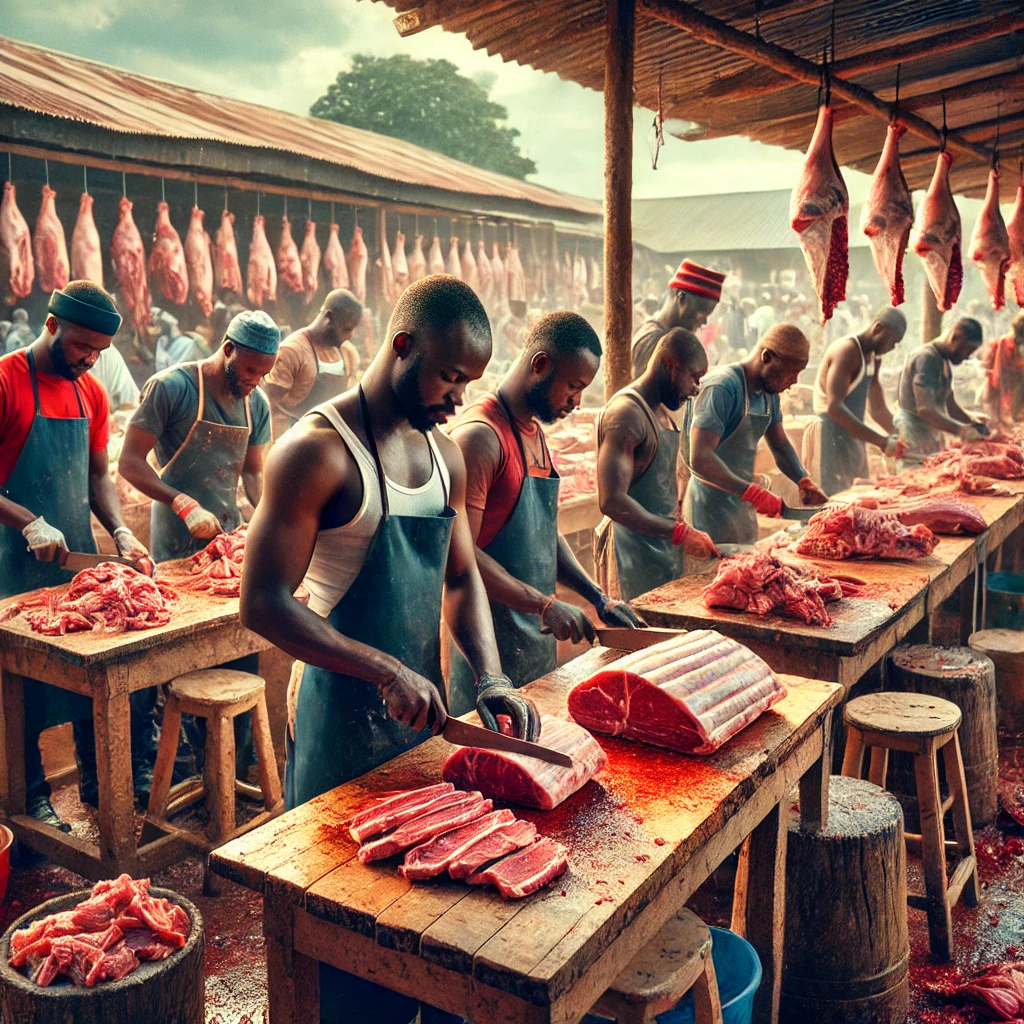
Livestock sellers in the Federal Capital Territory (FCT), have expressed concern over the high cost of livestock, attributing the increase in prices to transportation, cost of feed and insecurity.
The traders in various Markets in the FCT, who spoke on Sunday, expressed concern over the high cost of living.
A meat seller in Karu Market, Mr Kadiri Musa said the cost of cows and rams were increasing on a daily basis.
According to him, I have never experienced high cost of livestock in this market like they are being sold this year.
“We sold just one ram at one million Naira this period, this has never happened in this market since I started the business,” Musa said.
Idris Mohammad said “a ram that we sold at between N50,000 to N60,000 in 2023, and 2024 is now being sold for between N80,000 and N90,000 this year and those sold at N70,000 to N80,000, was now sold for N150,000 to N200,000.
“For cow, there are some we are selling at N500,000, a million naira, N1.2 and above,” he said.
Tanko Bello, also a livestock dealer in Nyanya Market attributed the hike in prices to high cost of transportation and other factors such as the current high inflation rate in the country.
According to him, an average size of ram currently go for N120,000 to N150,000, while big sizes are between a million and above.
Bello said that the minimum price for smaller ones goes for N45, 000 and above, adding that the increase was not limited to rams but other livestock like cows and goats.
He said that few years ago, to transport livestock per lorry from Jigawa, Katsina, Taraba and other northern parts of the country to Abuja costs about N200,000 to N300,000.
“But now, the transportation costs between N500,000 to N600,000.
According to him, criminal activities and cattle rustling in some parts of the country have also affected the availability of livestock and their prices.
A 45-year-old butcher at Nyanya market, Mohammed Yusuf, who sells live chickens of different sizes, however, lamented low patronage.
Yusuf attributed the high prices to increased feed costs and transportation expenses, as such impacting their businesses and patronage by consumers.
“Livestock sellers, including those selling poultry, are facing challenges due to the escalating prices of chicken feed and transportation.
“The increased costs are leading to higher prices for livestock products, which in turn, are discouraging consumers and impacting sales for the sellers,” he said.
A poultry farmer, in Jikwoyi area of the FCT, Mrs Funmilayo Ayoola said that poultry farming was a profitable business and involved a lot of capital.
Ayoola said that the business suffered setbacks at the point of sales, as the price of bird feed was incressing on a daily basis.
“You will spend so much in setting up a business, at the end of the day, if you are not careful and calculative enough you will lose both the capital and profit.
“In Nigeria today, cost of feed or even other goods hardly come down once they went up. Sometimes it suffers artificial scarcity and then a hike in price when it resurfaces, ” she said.
Also, another poultry farmer, at Karu, Mr Joshua Igwe said the cost of chicken feed was high, ranging from N15,000 to N20,000 per 50kg bag, depending on the brand and location of farm.
According to him, a lot of farmers are experiencing low patronage, especially this period. People are really managing, some families don’t even border to buy chicken.
“This is because of the constant increase of the price.
“The cost of feeds has made farmers to put high price on the birds yet, buyers do not have that kind of money to buy them.
“Some of us actually made good breeds grow well enough for the price we put but the buyers don’t know this, they have no idea what it takes to feed and make the birds gain weight.
“Also, with the economic situation today, people want to buy but they don’t have the money. It is unfortunate. I wish we all can just help each other make things easy for ourselves.”
A medical expert, Dr Bobade Akindele said that the cost of drugs for the birds was another challenge to the farmers, who were being forced to use organic methods to treat diseases in birds.
“The farmers sometimes use medicinal plants like bitter leaves and pawpaw leaves to either treat minor infections or boost their feeding, except when the situation is severe.
The veterinarian, who also has farm said that the cost of drugs for birds were also increasing tremendously.
Akindele urged various farmers and other relevant stakeholders to intervene and assist in finding a lasting solution to the challenges, to ease the plight of the farmers.
He also said that governments could help mitigate the high cost of livestock and support the development of a sustainable and resilient livestock sector.
Akindele urged the government to review trade policies and support local livestock production.
He also encouraged government to promote local production of feed ingredients, such as maize and soybeans, through initiatives like subsidies, credit facilities and extension services.
A livestock expert, Mr Thomas Adedeji said the high cost of chicken and bird feed was primarily driven by the increasing price of ingredients such as maize, soybean meal and other grains.
Adedeji said: “this is largely due to the widespread use of maize for ethanol production, leading to competition between livestock and humans for these essential ingredients” .
“To control the high cost of living, particularly in relation to poultry feed, several strategies can be employed, which involved, improving feed management,” he said.
Adedeji said that neccessary measures such as implementing efficient feed storage systems, minimising wastage, and optimising feeding techniques would support in mitigating high cost of living.
He said that using alternative feed sources could as well help to control high cost of living.
According to him, explore alternative feed ingredients, such as fermented feed or hydroponic feed, which can be more cost-effective and nutritious.
“Also, we can choose breeds that require less feed, such as laying breeds or dual-purpose breeds.
” We can as well grow our own feed if possible and ensure proper flock management, including adequate space, healthcare, and nutrition, to minimise losses and optimise productivity.
“In implementing these strategies, the poultry farmers and individuals should help mitigate the high cost of chicken and bird feed, by contributing to a more affordable and sustainable food system,” he advised,
The expert called on government and relevant stakeholders in the sector to support research and development by funding researchers and encouraging them for alternative feed sources, like insect-based feed or hydroponic feed.
A kilo of cow and goat meat were sold for N7,000 in Karu, Nyanya and Mararaba Markets, while a kilo of soft chicken was sold for N5,000, hard chicken goes for N6,000.
Both kilos of hard and soft turkey were sold for between N7,000 and N8,000.
A catoon of chicken was now being sold for N60,000 to N65,000 in Nyanya and Jikowyi cold rooms.
NAN
