


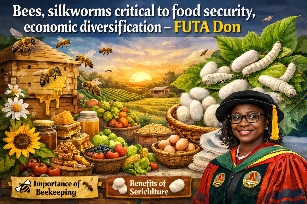
A Professor of Applied Entomology and Pest Management at the Federal University of Technology Akure (FUTA), Olufunmilayo Oladipo, has urged Nigeria to treat insects such as bees and silkworms as strategic economic resources capable of boosting food security, industrial growth and national diversification.
She made the call while delivering the institution’s 193rd Inaugural Lecture on February 24, 2026.
Speaking on the topic, “Six-Legged Arthropods: Food Security, Health and National Economic Development,” Oladipo said insects should not be viewed merely as pests but as biological assets that, if properly managed, could generate income, support pharmaceutical innovation and reduce dependence on crude oil.
She described the honeybee as a prime example, noting that beyond honey production, bees provide beeswax, royal jelly, propolis and venom used in pharmaceuticals and cosmetics. Their pollination services, she added, significantly increase crop yields and biodiversity.
The professor also highlighted the economic value of silkworms in textile production and export earnings. She identified black soldier flies, houseflies, locusts, grasshoppers, mealworms and crickets as emerging sources of high-protein livestock and aquaculture feed, reducing reliance on costly imported feed ingredients.
Oladipo further cited termites and dung beetles for improving soil fertility through nutrient recycling and aeration, while ladybird beetles and parasitic wasps serve as natural pest control agents that reduce environmental harm.
On public health, she acknowledged the heavy economic burden of insect vectors such as mosquitoes and tsetse flies, which transmit malaria, yellow fever, dengue and sleeping sickness. She noted that malaria alone costs Africa over $12 billion annually in healthcare expenses and lost productivity.
However, she pointed to medical breakthroughs such as maggot therapy already practiced in teaching hospitals in Kano, as well as medicinal compounds derived from insect-fungus complexes like Bombyx batryticatus and Beauveria bassiana, which possess anticonvulsant, anticancer and antifungal properties. She added that bee venom, weaver ants and cantharidin from blister beetles also show therapeutic potential.
The don advocated integrated pest management strategies that prioritise biological control, botanicals and pheromones over excessive synthetic insecticide use, warning that chemical overdependence has led to resistance and environmental pollution. She called for stricter pesticide regulation and stronger surveillance against invasive species.
To strengthen capacity, Oladipo urged government investment in insect rearing, conservation of beneficial species, expanded entomology departments in universities and improved research funding. She also emphasised the need for better food storage systems to curb post-harvest losses caused by insect infestation.
Presenting the lecturer, FUTA Vice-Chancellor, Professor Adenike Oladiji, represented by Deputy Vice-Chancellor (Development), Professor Sunday Oluyamo, described Oladipo as a distinguished scholar whose work has advanced entomology and strengthened the university’s research profile.
The Vice-Chancellor said the lecture was timely amid Nigeria’s food security, public health and diversification challenges, reaffirming FUTA’s commitment to research that addresses national development priorities.
