


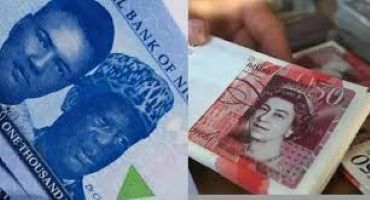
The Nigerian naira gained ground against the British pound sterling, trading at N1,840/£1 in the official foreign exchange market, according to the latest data from the Central Bank of Nigeria (CBN).
The local currency has rebounded from its April lows and remained relatively stable in recent weeks, supported by the CBN’s liquidity management measures and easing pressure in the foreign exchange market.
The naira’s recovery comes as the pound faces headwinds from growing political uncertainty in the United Kingdom. Sterling recently slipped to monthly lows amid leadership tensions within the ruling Labour Party and speculation over the future of Prime Minister Keir Starmer.
Market data show the naira has traded within the N1,825/£1 to N1,950/£1 range in recent months, with traders reacting to both domestic monetary policies and developments in the UK economy.
Analysts say the naira could find strong support around the N1,750–N1,800/£1 range if the CBN sustains foreign exchange liquidity injections. Conversely, resistance is seen around N1,880–N1,900/£1, with a break above that level potentially pushing the exchange rate closer to the N2,000/£1 mark.
The naira’s performance remains closely tied to foreign exchange inflows from oil exports and portfolio investments. Any decline in liquidity within the Nigerian Autonomous Foreign Exchange Market (NAFEM) often spills over into the parallel market, increasing demand for foreign currencies and driving volatility.
Despite recent gains, Nigeria continues to grapple with high inflation and structural economic challenges. While the CBN has periodically intervened to support the currency, persistent price pressures continue to erode the naira’s purchasing power.
In the UK, sterling has struggled to attract strong investor demand amid mixed signals over the Bank of England’s (BoE) monetary policy outlook and heightened political uncertainty.
BoE policymaker Swati Dhingra recently suggested that further interest rate hikes may not be necessary if higher energy prices have only limited effects on inflation. However, fellow Monetary Policy Committee member Catherine Mann warned that wage negotiations could keep inflationary pressures elevated in the coming years.
BoE Governor Andrew Bailey also indicated that policymakers are closely assessing the economic implications of ongoing geopolitical tensions and shifts in global financial markets. Nevertheless, investors continue to price in the possibility of further monetary tightening in 2026.
Broader geopolitical concerns, including uncertainty surrounding US-Iran relations and tensions over the Strait of Hormuz, have also contributed to cautious sentiment across global currency markets.
While analysts maintain that the pound’s long-term outlook against the naira remains relatively strong, near-term movements are expected to be influenced by central bank policies, political developments, and global risk sentiment.
