


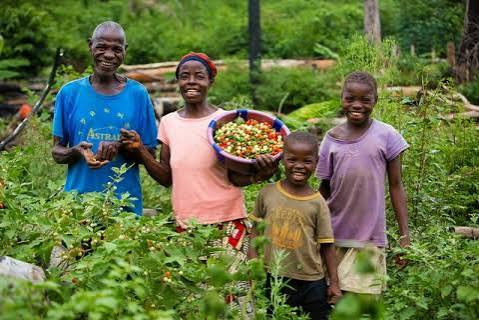
Food security expert AfricanFarmer Mogaji has emphasized the importance of involving youth in agriculture to boost food security.
Mogaji noted that empowering young farmers would help increase food production and address hunger challenges.
He shared this in an interview with reporters on Tuesday in Lagos.
According to him, one of the quickest ways to improve food security is to deliberately engage young people through grassroots mentorship and coaching programs.
“When politicians campaign, they go to the grassroots, ward by ward, street by street. But when implementing agricultural policies, we ask farmers to apply online.
“More than 70 percent of agricultural activities occur in rural communities, so interventions must be brought directly to the people,” he said.
He advocated for distributing farm inputs at the local government level rather than at state capitals, noting that transportation costs often discourage farmers from accessing government support.
He explained that many farmers spend a significant portion of their input value on transportation, rendering such interventions less effective.
Mogaji also stressed the need to increase agricultural awareness through traditional media channels, especially radio and print platforms, to reach rural farmers.
He called for decentralizing agricultural markets to reduce post-harvest losses and improve farmers’ earnings.
“Excessive concentration of produce in major urban markets often leads to saturation, forcing farmers to sell at low prices.
“During the COVID-19 pandemic, public schools were temporarily converted into neighborhood markets, which improved food access and reduced losses.
“We should revive such initiatives so food can move closer to consumers, and farmers can get better returns,” he said.
Mogaji criticized what he called the over-centralization of agricultural planning around the farming calendar of northern Nigeria.
He explained that farming seasons vary across regions, and support programs should be tailored to the specific planting periods in different areas.
“The North and South have different farming seasons, and even within the North, there are variations.
“If farmers receive support and inputs at least a month before their planting season, productivity will improve significantly,” he added.
He commended the timely distribution of fertilizers and farm inputs in 2024, which he said positively impacted food production in 2025.
He urged the government to sustain and expand such interventions.
Mogaji also called for the creation of youth-focused commodity associations, arguing that many existing agricultural groups are dominated by older members and offer limited opportunities for young farmers.
He suggested that dedicated associations for youth onion growers, tomato farmers, maize producers, and other commodities would encourage greater youth participation in agriculture.
He concluded that practical and achievable solutions are needed to transform the sector.
