


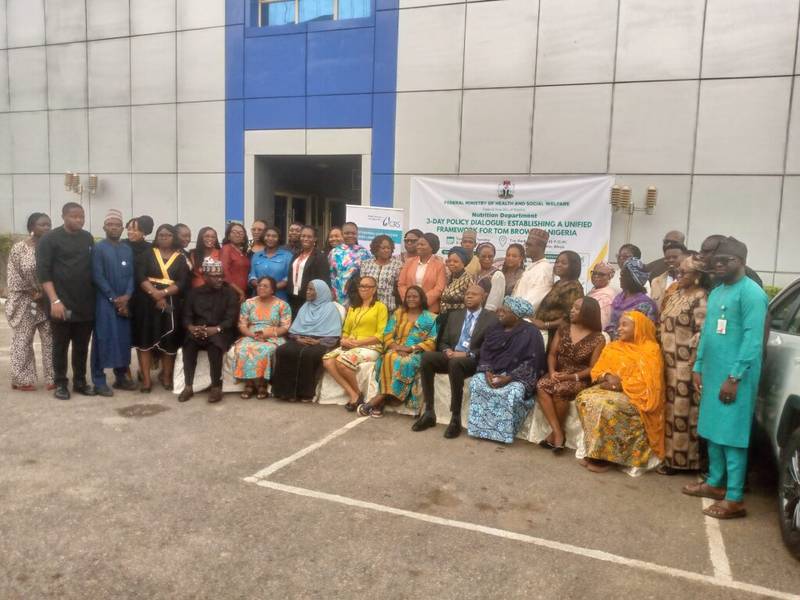
The Ministry of Health and Social Welfare, in collaboration with nutrition stakeholders, has launched a three-day policy dialogue to develop a framework for standardizing the production, quality, and nutritional content of Tom Brown in Nigeria.
Tom Brown is a complementary food made from roasted grains and legumes such as millet, sorghum, maize, soybeans, and groundnuts.
Speaking at the opening of the meeting in Abuja on Tuesday, Mrs. Olufunmilola Adegbite, Director and Head of the Ministry’s Nutrition Department, stated that malnutrition remains a major public health challenge in Nigeria.
She noted that despite progress through various nutrition interventions, undernutrition—especially stunting, wasting, and micronutrient deficiencies—continues to threaten national development.
According to Adegbite, the ministry has prioritized food-based nutrition strategies and the promotion of locally available, nutrient-dense complementary foods.
“Tom Brown, a traditional complementary food made from a blend of cereals and legumes, has gained recognition for its potential to improve dietary intake among young children.
However, its preparation methods, nutrient composition, hygiene standards, quality control measures, and scalability remain inconsistent across the country.
This meeting presents a critical opportunity to harmonize efforts and develop a national framework for the standardized production, quality assurance, and implementation of Tom Brown.
Our goal is to institutionalize this home-grown solution as an affordable, culturally acceptable complementary food for combating malnutrition and to provide clear technical guidance for households, small-scale producers, states, and development partners,” she said.
Mr. Akim Kikonda, Country Representative of Catholic Relief Services (CRS) Nigeria, also spoke, noting that the organization has supported efforts to tackle malnutrition among children under five.
He highlighted that Tom Brown has shown positive results in the recovery of moderately malnourished children.
Kikonda explained that the policy development process, which began with an initial dialogue in November 2025, has advanced through extensive stakeholder consultations.
“We are here with stakeholders from the United Nations system, the Standards Organisation of Nigeria (SON), ministries, departments, and agencies.
We want to ensure that all relevant stakeholders contribute to the process before the final draft framework is produced,” he said.
Mrs. Nene Obianwu, Deputy Director of the Standards Development Department at SON, stated that the agency is participating to ensure appropriate standards are incorporated into the framework.
“We are here to ensure consumer safety and quality assurance so that consumers receive value for what they pay for,” she said.
Development partners participating in the dialogue include UNICEF, WHO, Save the Children, Helen Keller International, Action Against Hunger, and the International Rescue Committee.
Participants were drawn from Borno, Jigawa, Katsina, Bayelsa, Ogun states, and the Federal Capital Territory.
