


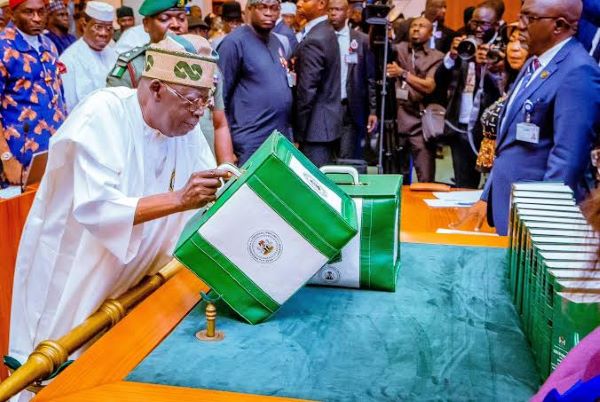
The claim that Nigeria is “running four budgets concurrently” is a simplified way of describing a real, documented fiscal practice—but it is not literally four full, separate annual budgets in the strict sense. What has been happening is an overlap of multiple budget instruments (main appropriation, supplementary budgets, and carry-over/carry-forward capital liabilities from prior years) being executed at the same time.
Government officials themselves have acknowledged operating three concurrent budget instruments at points in 2025–2026 (2024 main, 2024 supplementary, and 2025 appropriation), while critics and analysts sometimes frame this as “four budgets” when they include:
- the current year’s main budget,
- supplementary budget(s),
- prior-year capital carry-over, and
- a newly signed budget for the next year that starts before the old ones are fully closed.
President Tinubu has publicly admitted the anomaly and promised to end it, stating in his 2026 budget speech that Nigeria would terminate “the habit of running three budgets on one inflow” and move to a single budget backed by a single revenue cycle from April 2026.
So: partly true in spirit, imprecise in wording. Nigeria has been running multiple overlapping budget windows, not four entirely separate annual budgets in the textbook sense.
The “four budgets” explained (one by one)
Below is how the “four budgets” narrative is usually constructed, using the recent Tinubu-era practice as reference.
1. The Main Appropriation Budget (e.g., 2024 or 2025)
This is the standard annual budget passed by the National Assembly and signed into law. It sets:
- Total revenue projections (oil and non-oil)
- Total expenditure (recurrent + capital)
- Sectoral allocations to ministries, departments and agencies (MDAs)
- Deficit financing plan (borrowing, multilateral loans, etc.)
For example, the 2025 budget was extended into 2026 to allow capital projects to be completed, even as the 2026 budget was being prepared.
Role: Legal basis for most government spending in that fiscal year.
2. Supplementary Budget(s) within the Same Year
Mid-year, the executive often returns to the National Assembly with a supplementary appropriation bill to:
- Respond to shocks (security emergencies, humanitarian crises, exchange-rate shocks)
- Adjust for revenue shortfalls or windfalls
- Re-prioritise projects without waiting for the next budget cycle
In 2024–2025, Nigeria ran a 2024 supplementary budget alongside the main 2024 budget and the incoming 2025 budget.
Role: Adds or reallocates funds within the same fiscal year without repealing the main budget.
3. Prior-Year Capital Carry-Over / Extension Window
Because many capital projects span more than 12 months, Nigeria has routinely allowed carry-over of unspent capital allocations or formally extended the implementation period of previous budgets.
Examples:
- The 2023 budget’s implementation was extended into 2024.
- The capital component of the 2025 budget was extended from March 31, 2026 to June 30, 2026, creating a window where 2025 capital liabilities were still being funded while 2026 was already in force.
In public discourse, this is often described as a “third” or even “fourth” budget because it is a separate legal envelope of commitments tied to a past year but still drawing on current revenues.
Role: Allows multi-year projects to be completed without losing their legal funding base.
4. The New Year’s Budget Starting Before the Old Ones Close
To return to a January–December cycle and avoid perpetual slippage, the government has sometimes signed the next year’s budget before fully closing the previous one.
In April 2026, for instance:
- The 2026 Appropriation Act (₦68.32 trillion) came into force on April 1, 2026.
- At the same time, the 2025 capital budget was still being implemented under an extension to June 30, 2026.
Combine this with any lingering supplementary or carry-over instruments, and you get multiple active budgets funded from the same revenue pool.
Role: Starts the new fiscal framework while cleaning up old commitments.
Why this happens: context, not just incompetence
The Budget Office of the Federation has argued that overlapping budgets are not unprecedented and reflect:
- Multi-year project realities
- Administrative transitions between administrations or fiscal frameworks
- Attempts to shift back to a January–December cycle after years of misalignment
However, the IMF and local experts warn that chronic overlap signals weak planning, poor revenue forecasting, and a lack of discipline in the budget cycle.
Implications for Nigeria’s economy
1. Blurred accountability and weaker oversight
When three or four legal budgets coexist:
- It becomes harder for the National Assembly, auditors, and citizens to track which budget a project belongs to.
- The same project can appear in multiple budgets, creating room for duplication, inflation of costs, or creative accounting.
This undermines the core purpose of the budget as a fiscal control tool.
2. Distorted priorities and delayed capital execution
In practice:
- Recurrent costs (salaries, debt service) are paid first from whatever revenue comes in.
- Capital projects—already competing across multiple budgets—get deferred, re-scoped, or stalled.
Even when revenues beat targets, the complexity of juggling multiple budgets can slow cash releases to contractors, delaying roads, schools, hospitals, and power projects that drive growth.
3. Higher deficits, borrowing, and debt-service burden
Multiple budgets often emerge from:
- Weak initial assumptions (oil price, exchange rate, revenue)
- Mid-year shocks that force supplementary spending
- Carry-over of projects that were underfunded in the first place
The result: larger deficits, more borrowing, and a bigger share of revenue devoted to debt service. In the 2026 budget, for example, debt servicing is around ₦15.5–15.8 trillion in a total budget of ₦58–68 trillion, crowding out productive spending.
4. Investor uncertainty and macroeconomic instability
Frequent revisions and overlapping budgets:
- Signal policy unpredictability to investors and rating agencies.
- Make it harder to plan long-term investments when the fiscal framework keeps shifting.
- Contribute to the “budget credibility gap” flagged by the IMF for Nigeria.
That feeds into higher risk premiums, cost of borrowing, and a weaker investment climate.
Implications for ordinary Nigerians
1. Slower delivery of public goods
For citizens, the technical overlap translates into:
- Roads that take longer to finish or are abandoned mid-way
- Schools and clinics that are budgeted but not commissioned on time
- Power and transport projects that lag behind schedule
People pay taxes and endure hardship, but see less visible return from public spending.
2. More inflationary pressure and cost-of-living stress
When deficits rise and borrowing increases:
- More money chases fewer goods, adding to inflationary pressure.
- Exchange-rate volatility worsens as import needs for projects rise, but execution lags.
- Contractors delay payments to subcontractors and workers, spreading financial stress through the real economy.
This compounds the cost-of-living crisis for households already struggling with high food and fuel prices.
3. Erosion of trust in government
Opaque, overlapping budgets:
- Make it easier for budget padding and corruption to thrive.
- Fuel public cynicism that “the budget is just paperwork.”
- Undermine civic engagement, since citizens cannot easily follow where money goes.
When people stop believing the budget is real or enforceable, compliance with taxes and support for reforms weaken.
The reform promise: one budget, one revenue cycle
In his 2026 budget speech, President Tinubu explicitly committed to:
- Ending the practice of “running three budgets on one inflow.”
- Fully funding and closing all capital liabilities from previous years by March 31, 2026.
- Operating a single budget backed by a single revenue cycle from April 2026 onward.
The 2026 “Budget of Consolidation, Renewed Resilience and Shared Prosperity” is framed as the instrument to enforce this new discipline, with a stronger emphasis on capital execution and a clear timeline to close old windows.
Whether this works will depend on:
- Realistic revenue and macro assumptions
- Strict enforcement of the new single-cycle rule
- Stronger legislative and civil-society oversight to prevent new overlaps from creeping in.
Bottom line
- The “four budgets” claim is a shorthand for a real problem: Nigeria has been running multiple, overlapping budget instruments funded from the same revenue base.
- Technically, this has mostly been three concurrent legal budgets (main, supplementary, and carry-over/extension), sometimes with a new year’s budget starting before the old ones close.
- The economic and social costs are significant: weaker accountability, slower project delivery, higher deficits and debt service, and a heavier burden on ordinary Nigerians.
- The stated shift to a single budget, single revenue cycle in 2026 is a necessary correction—but its credibility will be judged by implementation, not rhetoric.
For Nigeria’s economy and its people, moving from “four budgets on one inflow” to one credible, executable budget is not just a technical fix; it is a prerequisite for restoring trust, accelerating development, and delivering tangible improvements in living standards.
