


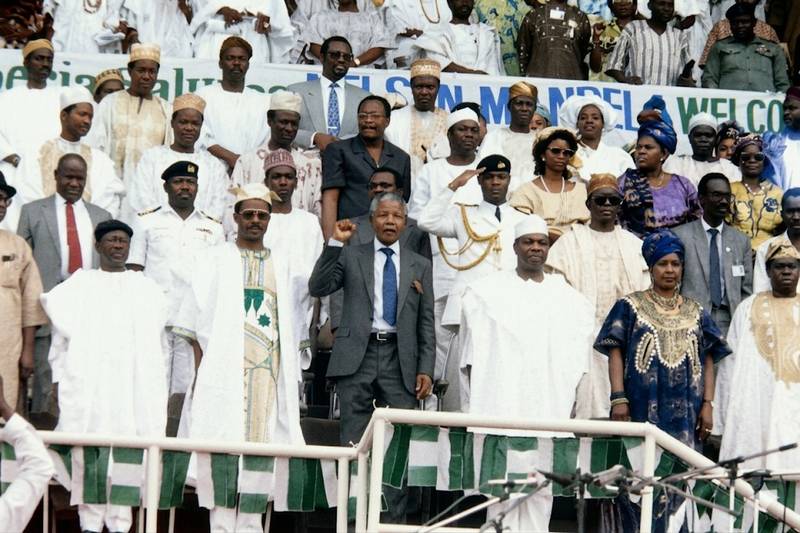
Esther Oladimeji, Curator of the Hakeem Shitta Photo Archives and Cultural Centre (HSPACA), says the organisation will release a documentary commemorating Nelson Mandela’s 1990 visit to Nigeria.
Oladimeji told reporters in Lagos that the documentary marks the 36th anniversary of the historic visit by Mandela and his wife, Winnie.
She said the documentary features rare photographs taken by the late Nigerian photojournalist Hakeem Shitta during the civic reception at Tafawa Balewa Square.
According to her, the visit symbolised Nigeria’s unwavering solidarity with South Africa during the anti-apartheid struggle.
Oladimeji noted that Mandela arrived in Nigeria aboard a presidential jet on May 13, 1990 — barely three months after his release from Victor Verster Prison — to personally thank Nigerians for their sacrifices.
“Mandela did not just come on a diplomatic tour; he came home to Nigeria to say thank you for standing firmly with South Africa.
“The documentary revives the spirit of African brotherhood witnessed at Tafawa Balewa Square during the historic civic reception.
READ ALSO: Senate restricts presidency to returning members of 10th Assembly
“It ensures younger Africans never forget the sacrifices Nigerians made for the liberation of South Africa,” she said.
Oladimeji described HSPACA as Nigeria’s “Alternative Archive”, containing more than 6,000 rare photographs that document the country’s political and cultural history between 1981 and 1997.
She said the archive preserves iconic moments involving African and global cultural figures, including Yvonne Chaka Chaka, Miriam Makeba, Fela Kuti, and Wole Soyinka.
The curator identified other personalities captured in the photographs as Augustus Aikhomu, Raji Rasaki, Sonny Okosun, Peter Obe, and Onyeka Onwenu.
She said Okosun performed anti-apartheid songs, including “Fire in Soweto”, while Onwenu performed her famous tribute song, “Winnie Mandela”, during the reception.
Oladimeji added that the massive crowd at Tafawa Balewa Square reflected the emotional bond Nigerians shared with the Mandelas and the ANC.
“Mandela himself acknowledged that Nigeria’s support for the anti-apartheid movement was second to none. He said Nigeria provided scholarships, financial support and diplomatic backing for ANC exiles during the struggle,” she said.
She explained that the documentary remains relevant as it addresses current tensions between Nigeria and South Africa through historical reflection. It challenges xenophobia and mutual distrust by highlighting decades of shared sacrifices.
Oladimeji noted that Nigeria spent billions supporting liberation movements through the Southern Africa Relief Fund established in 1976, while ordinary Nigerians contributed via what became known as the “Mandela Tax”.
The curator described Nigeria as a frontline state against apartheid despite having no common border with South Africa. She added that the documentary also highlights the role of music and culture in sustaining the anti-apartheid movement.
South African traditional dancers performed alongside Nigerian entertainers, creating what she called a “festival of freedom”. Legendary broadcasters Ikenna Ndaguba and Bisi Olatilo anchored the event.
The release of the Mandela documentary coincides with activities marking the centenary of Steve Rhodes. Oladimeji said a separate documentary on Rhodes’ contributions to Nigeria’s cultural and entertainment history was also released.
“While political leaders such as Augustus Aikhomu and Raji Rasaki represented state authority, Steve Rhodes shaped the cultural atmosphere of the celebration,” she said.
“This year, Africa is reflecting on 36 years since Mandela’s historic visit to Nigeria and celebrating 100 years of Steve Rhodes. By commemorating both, HSPACA is connecting the political backbone of African liberation with its musical soul,” Oladimeji added.
