


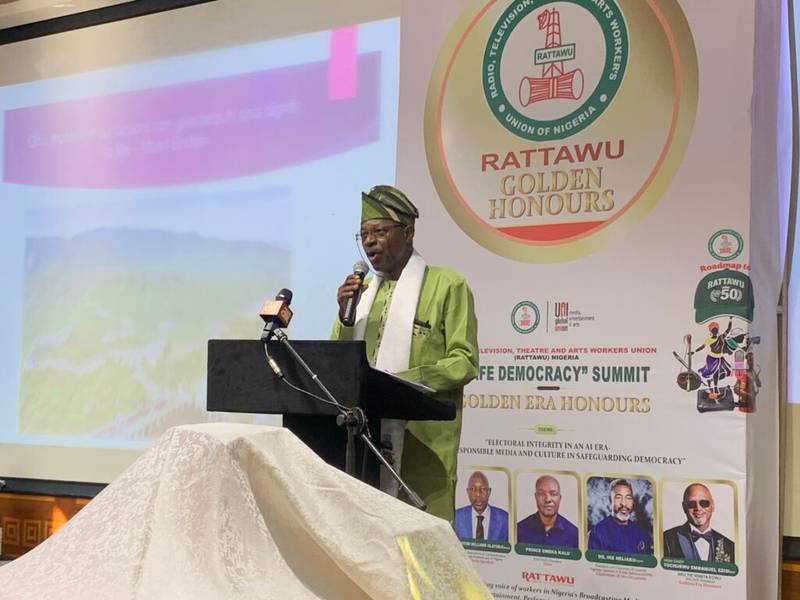
Mr. Rotimi Olatunji, President of the Association of Communication Scholars and Professionals of Nigeria, has urged media organisations to rigorously verify Artificial Intelligence-generated content to safeguard the integrity of the 2027 General Elections.
Olatunji gave the advice on Monday while delivering the keynote address at the Safe Democracy Summit organised by the Radio, Television, Theatre and Arts Workers Union (RATTAWU) in Lagos.
He spoke on the theme, “Electoral Integrity in an AI Era: Role of Responsible Media and Culture in Safeguarding Democracy”.
Olatunji said Artificial Intelligence (AI) presented enormous opportunities for strengthening democracy but could also undermine electoral credibility if deployed irresponsibly.
He urged newsrooms to treat AI-generated materials as potentially deceptive until their authenticity is established.
“If a video or image cannot be independently confirmed, then leave it out,” he said.
Olatunji said media organisations should adopt strict verification procedures by tracing the origin of content, identifying the first uploader, and examining metadata where available.
He added that media organisations should conduct reverse image searches and cross-check information with multiple credible sources before publication.
He also called on media organisations to establish AI verification protocols and train journalists to detect cloned voices, manipulated screenshots, and synthetic text patterns.
Olatunji advised media organisations to strengthen collaboration with fact-checking organisations.
“In the 2027 elections, verification must be treated not as an option but as a democratic duty,” he said.
Olatunji noted that technology had progressively strengthened Nigeria’s electoral process, from electronic data capture introduced in 2007 to biometric voter registration in 2011, and the deployment of permanent voter cards and card readers in 2015.
According to him, these reforms demonstrated that technology can deepen democracy when properly deployed.
He, however, warned that the increasing use of AI posed new challenges capable of undermining public confidence in the electoral process if not responsibly managed.
Olatunji said a study by his association on previous elections showed that media coverage had consistently emphasised issues of ethnicity and religion, while hate speech — which peaked during the 2015 General Elections — remained a growing concern.
He said democracy depended not only on technology but also on credible institutions, ethical political leadership, responsible journalism, and an informed citizenry.
“If media organisations become ethical, culturally grounded, and technologically disciplined, AI can strengthen democracy instead of weakening it.”
Earlier, the National President of RATTAWU, Mr. Emeka Kalu, described the summit as part of the union’s efforts to promote responsible media practice and democratic governance.
Kalu said the summit underscored RATTAWU’s commitment to fostering dialogue on emerging issues affecting the media industry and Nigeria’s democracy.
The unionist expressed optimism that the summit would produce strong recommendations for safeguarding electoral integrity ahead of the 2027 General Elections in Nigeria.
