


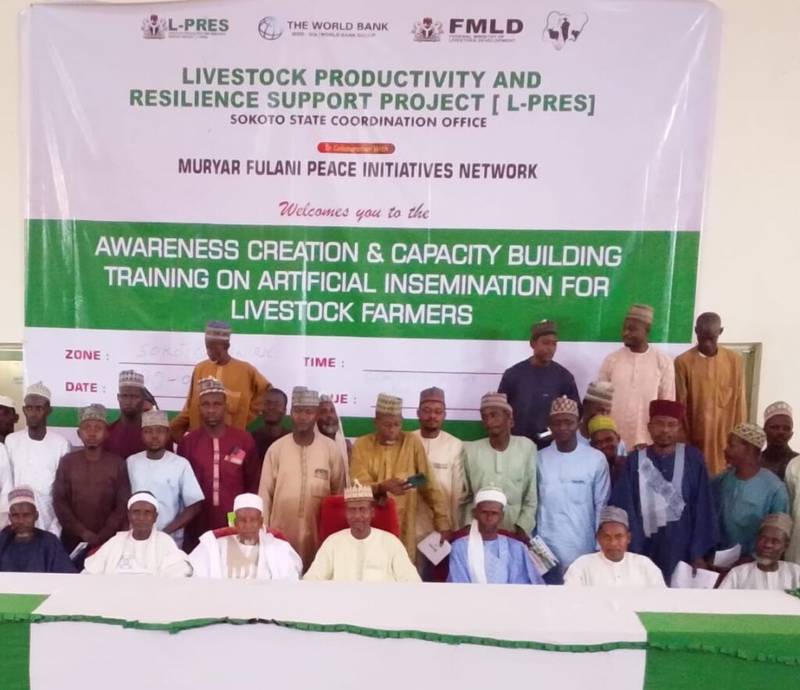
The Sokoto State Government has begun training livestock farmers in modern artificial insemination technology to boost breeding, productivity and incomes.
The training is being implemented under the Livestock Productivity and Resilience Support (L-PRES) Project in collaboration with the Muryar Fulani Peace Initiatives Network across the state’s three senatorial districts.
Speaking at the training on Monday, the State L-PRES Project Coordinator, Mr. Sirajo Abubakar, said the initiative would strengthen breeders’ capacity. Abubakar was represented by the project’s Animal Husbandry Officer, Mr. Kabiru Yusuf.
He said the programme would promote artificial insemination and educate farmers on modern breeding techniques for improved livestock production.
“This campaign is aimed at sensitising livestock farmers and other stakeholders on artificial insemination to enhance animal production systems and improve economic well-being,” he said.
Abubakar added that participants would return to their senatorial districts after the training to conduct community sensitisation programmes. This, he said, would enable more livestock farmers to benefit from the initiative.
The coordinator disclosed that the L-PRES Project had established a modern Artificial Insemination Centre at Runjin Sambo. He noted that the facility would improve livestock productivity and provide quality breeding services to farmers across the state.
Abubakar urged livestock farmers to utilise the centre to improve the quality and productivity of their animals. He also encouraged participants to share the knowledge gained during the training with their communities.
In her presentation, Dr. Asma’u Bashar of the Muryar Fulani Peace Initiatives Network described artificial insemination as crucial to modernising livestock production. She commended the Sokoto State Government and the L-PRES Project for promoting livestock development through modern technology.
Bashar added that wider adoption of artificial insemination would boost productivity, encourage commercial livestock production, and improve the livelihoods of farmers across the state.
