


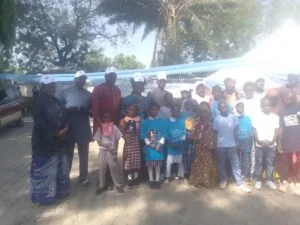
The Kaduna State Ministry of Women Affairs and Social Development has called for a stronger protection, education and welfare system for children across the state.
The ministry, in collaboration with the United Nations Children’s Fund (UNICEF), made the call on Thursday as it marked the 2025 World Children’s Day in Kaduna.
The News Agency of Nigeria (NAN) reports that the event has the theme, “My Day, My Rights.”
It formed part of UNICEF’s Global Day of Action, commemorating the adoption of the Convention on the Rights of the Child.
Speaking, the State Commissioner for Women Affairs and Social Development, Hajiya Rabi Salisu, said the day offered an opportunity to recommit to building a society where every child could survive, thrive, learn and be heard.
She said that the state, under Gov. Uba Sani, remained committed to making children’s right a lived reality through targeted policies and programmes.
’The ministry is strengthening community-based child protection structures, improving access to quality education, and expanding social welfare services.
It is also supporting children with disabilities, and promoting health, nutrition and early childhood development,” the commissioner said.
Salisu urged parents, schools, communities and policymakers to take responsibility in creating a safer and more inclusive environment for children.
The measure of any society is how it treats its most vulnerable members,” she said.
Also speaking, the UNICEF Chief of Field Office in Kaduna, Dr Gerida Birukila, said the 2025 celebration came at a time when children’s right were under increasing threat from rising insecurity, climate shocks and dwindling resources.
She expressed concern that 90 per cent of Nigerian children had experienced violence.
“The newly released Nigerian Child 2025 Report paints a troubling picture, with nearly one in two Nigerian children living in income poverty, while 70 per cent of households lack access to safe drinking water.
“Newborn mortality stands at 41 per 1,000 live births; maternal mortality at 1,047 per 100,000 live births, with 40 per cent of children under-five years stunted.
“An estimated 10.2 million primary school-age and 8.1 million secondary school-age children are out of school.
‘’Also, 73 per cent of children aged seven years to 14 years cannot read simple sentences and 75 per cent cannot solve basic Maths problems,” she said.
Birukila added that half of Nigeria’s population was under 18, stressing the urgent need for child-centred policies that ensured safety, education and health for all children.
She said that ending child poverty required sustained political commitment and implementation of proven strategies.
Also speaking, the state Commissioner for Information, Ahmed Maiyaki, emphasised the importance of giving children accurate information about their rights.
He warned against misleading schoolchildren with incorrect claims.
Kaduna has reopened over 500 schools previously shut due to insecurity, following the success of the state’s peace model, which has restored safer learning spaces for children,” he said.
Maiyaki commended the participation of public-school pupils at the event.
He said that it demonstrated the impact of the government’s investment in public education through improved infrastructure, teacher training and better pay for teachers.
He added that UNICEF’s declaration of child rights was enshrined both in the UN Convention and the Kaduna State Child Protection and Welfare Law of 2018.
The commissioner, therefore, urged media practitioners to help to promote accurate reporting.
He offered that his ministry a partnership with UNICEF would train journalists on child-rights reporting, describing it as a critical, but often neglected area.
Maiyaki said journalists must track budget performance, not just budget allocations, particularly in the education sector, where millions of Nigerian children remained out of school.
He described the figure of 10.1 million out-of-school children reported in UNICEF’s 2025 assessment as alarming, noting that 70 per cent to 80 per cent of the affected children were from northern Nigeria.
‘’This disparity makes it imperative for journalists and stakeholders to hold institutions accountable and ensure every child enjoys the right to education, safety and development,” he said.
NAN reports that the event featured presentations by pupils from public schools across Kaduna, highlighting their understanding of child rights.
The children also shared their hopes for better education, safer environments and brighter futures.
The schools present at the event include Sheikh Gumi Primary School; Association of Orphanage Home; Army Children School; Unguan Sarki Primary School and Research Model School.
Others are Sabon Gari Primary School; Ibrahim Taiwo Road Primary School; UBE Tudun Wada Primary School, and LGEA Lokoja Road Primary School, Rigasa.
