

• Home
  • Agric
  • Sci & Tech
  • Health
  • Environment
  • Hausa News
  • More
    • Business/Banking & Finance
    • Politics/Elections
    • Entertainments & Sports
    • International
    • Investigation
    • Law & Human Rights
    • Africa
    • ACCOUNTABILITY/CORRUPTION
    • Hassan Gimba
    • Column
    • Prof. Jibrin Ibrahim
    • Prof. M.K. Othman
    • Defense/Security
    • Education
    • Energy/Electricity
    • Entertainment/Arts & Sports
    • Society and Lifestyle
    • Food & Agriculture
    • Health & Healthy Living
    • International News
    • Interviews
    • Investigation/Fact-Check
    • Judiciary/Legislature/Law & Human Rights
    • Oil & Gas/Mineral Resources
    • Press Freedom/Media/PR/Journalism
    • General News
    • Presidency
  • About Us
    • Contact Us
    • Board Of Advisory
    • Privacy Policy
    • Ethics Policy
    • Teamwork And Collaboration Policy
    • Fact-Checking Policy
    • Advertising
  • Media OutReach Newswire
    • Wire News
  • The Stories
Facebook Twitter Instagram
Trending
  • Association call for restraint over SERAP-DSS court judgment
  • Sultan celebrates former communications minister, Gen. Olanrewaju at 80
  • Afri Invoice Nigeria secures NRS accreditation as e-invoicing system integrator
  • “Killing innocent people in the name of Islam leads to hell” — Sultan
  • KSCHMA completes statewide reaccreditation of primary healthcare centres
  • Mahmoud named minister of state of the year
  • We’ll deliver victory for Adeyanju in 2027, Ondo North supporters vow
  • Tumsah donates relief materials, cash to victims of Yobe airstrike
Facebook Twitter Instagram YouTube
AsheNewsAsheNews
  • Home
  • Agric

    Uganda’s new anti-tick vaccine a revolution for African agriculture — Scientists

    May 9, 2026

    Cocoa farmers push for local processing factories

    May 7, 2026

    AFAN blames middlemen, high transport costs for rising food prices

    May 7, 2026

    Lagos resident lament soaring tomato prices

    May 6, 2026

    FG unveils 2025–2030 revised national gender policy on agrifood systems

    May 6, 2026
  • Sci & Tech

    Association calls for stronger penalties to protect telecom infrastructure

    May 8, 2026

    Hemingway’s Safaris Africa, LCCI host AI robotics bootcamp

    May 8, 2026

    Nigeria ranks among top AI-adopting nations

    May 7, 2026

    UBA, MTN MoMo, RedTech unveil cardless payment solution

    May 6, 2026

    Uganda unveils first homegrown biotech livestock vaccine, targets regional leadership

    May 3, 2026
  • Health

    KSCHMA completes statewide reaccreditation of primary healthcare centres

    May 9, 2026

    Uganda’s new anti-tick vaccine a revolution for African agriculture — Scientists

    May 9, 2026

    World Asthma Day 2026: Can Nigeria prosper if its children cannot breathe? By Prof. Chiwuike Uba, Ph.D.

    May 9, 2026

    Red Cross urges Nigerians to unite for humanity

    May 9, 2026

    Hantavirus outbreak risk to public ‘extremely low’ — WHO

    May 8, 2026
  • Environment

    Mahmoud named minister of state of the year

    May 9, 2026

    Tyre burst kills 4 in bus crash

    May 8, 2026

    Faith leaders call for just energy transition in Nigeria

    May 7, 2026

    FG to close 1 carriageway of Eko bridge for repairs

    May 7, 2026

    Oyo introduces daily environmental sanitation enforcement

    May 6, 2026
  • Hausa News

    Otti plans 250-room 5-star hotel in Umuahia

    April 11, 2026

    Anti-quackery task force seals 4 fake hospitals in Rivers

    August 29, 2025

    [BIDIYO] Yadda na lashe gasa ta duniya a fannin Ingilishi – Rukayya ‘yar shekara 17

    August 6, 2025

    A Saka Baki, A Sasanta Saɓani Tsakanin ‘Yanjarida Da Liman, Daga Muhammad Sajo

    May 21, 2025

    Dan majalisa ya raba kayan miliyoyi a Funtuwa da Dandume

    March 18, 2025
  • More
    1. Business/Banking & Finance
    2. Politics/Elections
    3. Entertainments & Sports
    4. International
    5. Investigation
    6. Law & Human Rights
    7. Africa
    8. ACCOUNTABILITY/CORRUPTION
    9. Hassan Gimba
    10. Column
    11. Prof. Jibrin Ibrahim
    12. Prof. M.K. Othman
    13. Defense/Security
    14. Education
    15. Energy/Electricity
    16. Entertainment/Arts & Sports
    17. Society and Lifestyle
    18. Food & Agriculture
    19. Health & Healthy Living
    20. International News
    21. Interviews
    22. Investigation/Fact-Check
    23. Judiciary/Legislature/Law & Human Rights
    24. Oil & Gas/Mineral Resources
    25. Press Freedom/Media/PR/Journalism
    26. General News
    27. Presidency
    Featured
    Recent

    Association call for restraint over SERAP-DSS court judgment

    May 9, 2026

    Sultan celebrates former communications minister, Gen. Olanrewaju at 80

    May 9, 2026

    Afri Invoice Nigeria secures NRS accreditation as e-invoicing system integrator

    May 9, 2026
  • About Us
    1. Contact Us
    2. Board Of Advisory
    3. Privacy Policy
    4. Ethics Policy
    5. Teamwork And Collaboration Policy
    6. Fact-Checking Policy
    7. Advertising
    Featured
    Recent

    Association call for restraint over SERAP-DSS court judgment

    May 9, 2026

    Sultan celebrates former communications minister, Gen. Olanrewaju at 80

    May 9, 2026

    Afri Invoice Nigeria secures NRS accreditation as e-invoicing system integrator

    May 9, 2026
  • Media OutReach Newswire
    • Wire News
  • The Stories
AsheNewsAsheNews
Home»Food & Agriculture»Uganda’s new anti-tick vaccine a revolution for African agriculture — Scientists
Food & Agriculture

Uganda’s new anti-tick vaccine a revolution for African agriculture — Scientists

By Peter Wamboga-Mugiryan Uganda
EditorBy EditorMay 9, 2026Updated:May 9, 2026No Comments4 Mins Read
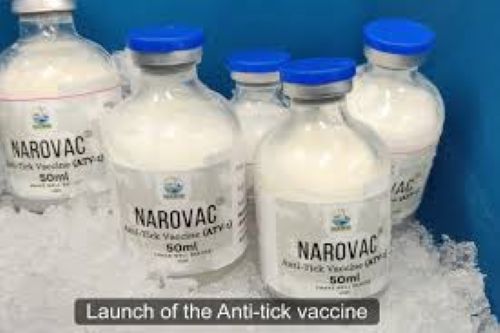
NAROVAC anti-tick biotech vaccine
The anti-tick biotech vaccine, NAROVAC
Share
Facebook Twitter LinkedIn Pinterest Email

Scientists at National Agricultural Research Organization (NARO) have declared that Uganda’s newly launched anti-tick vaccine, NAROVAC1, could transform livestock farming across Africa by effectively eliminating ticks without allowing them to develop resistance.

The genetically engineered vaccine, which officially entered the market last week, is being hailed as a breakthrough in the fight against tick infestations and tick-borne diseases that have long devastated cattle production in Uganda and across the region.

Speaking on the vaccine’s mechanism, Dr. Swidiq Mugerwa, Deputy Director-General in charge of Research Coordination at NARO and a senior member of the vaccine research team, explained that the vaccine works by triggering cattle to produce antibodies that attack ticks when they feed on vaccinated animals.

“When protein in the form of a vaccine is injected into a cow, the animal recognizes it as a foreign body and produces antibodies,” Mugerwa said. “When a tick sucks blood containing these antibodies, the antibodies attack and kill the tick.”

ALSO READ Uganda unveils first homegrown biotech livestock vaccine, targets regional leadership

He added that unlike conventional acaricides, ticks cannot develop immunity against the vaccine.

Ugandan President Yoweri Museveni described the innovation as “a revolutionary step in African agriculture,” saying it offers a lasting solution to the persistent challenge of tick infestations in cattle-rearing communities.

“The cows will now kill ticks. If vaccination is done repeatedly and cows continue killing ticks, eventually there will be no ticks on your land,” Museveni said during the launch ceremony, drawing applause from lawmakers, ruling party members, and stakeholders present at the event.

The President praised Uganda’s scientific community for the achievement and pledged continued government support for research and innovation.

“This is a big step by our scientific community. I congratulate the scientists, and I will give you all my support,” he stated.

Museveni also revealed plans to invite the scientists to vaccinate livestock on his own farms, joking that they would need to bring large quantities of the vaccine because of the size of his herd.

The President noted that ticks and tick-borne diseases such as East Coast Fever, anaplasmosis, heart-water disease, and Babesia infections have caused severe losses for cattle farmers over the years.

According to NARO officials, the vaccine manufacturing facility located at the National Livestock Resources Research Institute (NALIRRI) in Wakiso District is the first anti-tick vaccine production plant of its kind in the Great Lakes region of Africa.

The facility is expected to produce between 42 million and 60 million doses annually.

NARO estimates that ticks and tick-borne diseases currently cause Uganda losses exceeding Shs3 trillion (about $800 million) annually.

Dr. Yona Baguma, Director-General of NARO, said the development positions Uganda as a global leader in livestock research and biotechnology innovation.

“It is 100 percent funded by the Government of Uganda, and the research team is entirely Ugandan,” Baguma said in a phone interview. “We already have orders from neighboring countries.”

He added that the vaccine demonstrates NARO’s capacity to develop effective genetically modified technologies to address local agricultural challenges.

Clinical trials reportedly showed that NAROVAC1 is more than 95 percent effective against ticks and related diseases, with the potential to save Uganda’s livestock industry up to $1.1 billion annually.

Farmers are expected to vaccinate cattle twice yearly. The vaccine will cost farmers about Shs10,000 (approximately $2.70) per dose, while factory production costs stand at about Shs5,000 per dose.

Museveni also criticized the growing ineffectiveness of conventional acaricides, noting that many ticks had developed resistance despite repeated spraying.

Uganda’s State Minister for Animal Industry, Bright Rwamirama, described the vaccine launch as a turning point for the livestock sector.

“With this vaccine, we shall work towards ending the use of toxic and ineffective acaricides,” the minister said.

Following the launch, the President flagged off trucks transporting vaccine doses to Uganda’s cattle corridor, a livestock belt stretching from northeastern Uganda to the southwest and into neighboring Tanzania, where tick infestations are most severe.

NALIRRI NARO NAROVAC1
Share. Facebook Twitter Pinterest LinkedIn WhatsApp Reddit Tumblr Email
Editor
  • Website

Related Posts

KSCHMA completes statewide reaccreditation of primary healthcare centres

May 9, 2026

World Asthma Day 2026: Can Nigeria prosper if its children cannot breathe? By Prof. Chiwuike Uba, Ph.D.

May 9, 2026

Red Cross urges Nigerians to unite for humanity

May 9, 2026

Leave A Reply Cancel Reply

Association call for restraint over SERAP-DSS court judgment

May 9, 2026

Sultan celebrates former communications minister, Gen. Olanrewaju at 80

May 9, 2026

Afri Invoice Nigeria secures NRS accreditation as e-invoicing system integrator

May 9, 2026

“Killing innocent people in the name of Islam leads to hell” — Sultan

May 9, 2026
About Us
About Us

ASHENEWS (AsheNewsDaily.com), published by PenPlus Online Media Publishers, is an independent online newspaper. We report development news, especially on Agriculture, Science, Health and Environment as they affect the under-reported rural and urban poor.

We also conduct investigations, especially in the areas of ASHE, as well as other general interests, including corruption, human rights, illicit financial flows, and politics.

Contact Info:
  • 1st floor, Dogon Daji House, No. 5, Maiduguri Road, Sokoto
  • +234(0)7031140009
  • ashenewsdaily@gmail.com
Facebook Twitter Instagram Pinterest
© 2026 All Rights Reserved. ASHENEWS Daily Designed & Managed By DeedsTech

Type above and press Enter to search. Press Esc to cancel.