


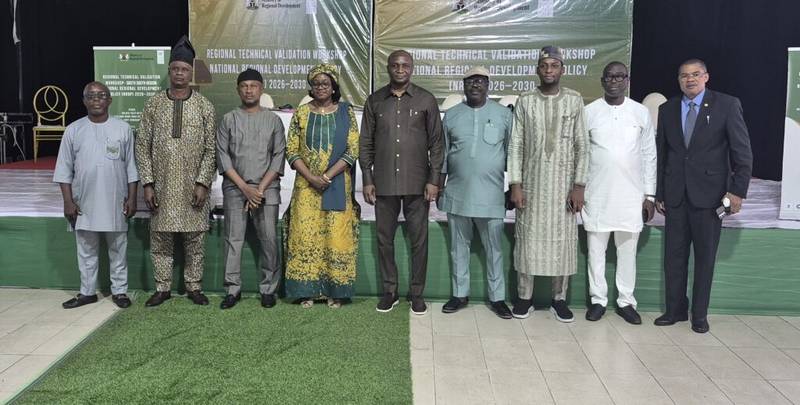
The Federal Government has begun engaging stakeholders to validate the National Regional Development Policy (NRDP) 2026–2030, aimed at driving development and reducing rural-urban migration.
The Minister of Regional Development, Mr Abubakar Momoh, made this known on Thursday in Port Harcourt during the National Regional Technical Validation Workshop for states in the South-South region.
Represented by the Permanent Secretary of the ministry, Dr Mary Ogbe, Momoh said the policy was designed to strengthen development across all regions of the country.
He explained that the initiative followed the creation of additional Regional Development Commissions by President Bola Tinubu in 2024, in addition to the Niger Delta Development Commission (NDDC), established in 2000.
The regional development commissions cover the South East, South South, South West, North Central, North East, and North West.
Momoh described the validation workshop as a platform for stakeholders to review and contribute to the draft policy document before its approval.
He said the commissions are expected to drive development in their respective regions, particularly in rural and underserved communities.
“We invited stakeholders to study the document and make meaningful contributions to ensure that the policy reflects the needs and realities of each region.
“The intention is to take development to the hinterlands, reduce rural-urban migration, and address challenges such as insecurity,” he said.
The minister added that the policy would serve as a framework for the commissions to develop their respective master plans based on their comparative advantages.
“Nigeria is richly endowed, and each region has unique resources. The commissions are expected to harness these strengths to drive development in line with President Bola Tinubu’s Renewed Hope Agenda,” he said.
Momoh acknowledged that while Nigeria has numerous policies, the major challenge has often been effective implementation.
He assured that the new regional development policy would be different, as it would address financing and monitoring mechanisms to ensure better outcomes.
“The government is also exploring alternative funding sources beyond budgetary allocations to enhance implementation,” he added.
Also speaking, the Resident Representative of the United Nations Development Programme (UNDP), Mrs Elsie Attafuah, called for a coordinated and inclusive regional development framework to address disparities and drive sustainable growth.
Represented by the UNDP Senior Governance Adviser, Mr Matthew Aloa, Attafuah described the policy as a critical instrument for repositioning Nigeria’s development trajectory.
She said the initiative marked a shift from fragmented growth patterns to a more coordinated and strategic approach to national development.
“This moment calls not simply for regional development, but for a deliberate recalibration of how development is planned, coordinated, financed and delivered across Nigeria.
“The NRDP will reposition the country’s regions as engines of productivity, innovation, industrialisation, and resilience, rather than mere administrative units,” she said.
Earlier, the Managing Director of the Niger Delta Development Commission (NDDC), Dr Samuel Ogbuku, expressed optimism that stakeholder engagement would help address developmental challenges across the regions.
He stressed the need for deliberate planning that reflects the peculiar challenges of each region while ensuring sustainable development for future generations.
Ogbuku noted that past development plans, including the NDDC Master Plan, had limited impact due to inadequate collaboration with key stakeholders.
“We have had master plans in the past, but some were not effective because they did not have the buy-in of critical stakeholders, particularly state governments.
“No one will sit in Abuja and plan for the regions without the people. This process is about consultation and ensuring that the voices of the people are reflected in the final plan,” he said.
He added that the process would culminate in a practical framework that would guide development priorities and timelines.
“With this process, we will clearly define what we need to achieve, set timelines, and assess our progress periodically to ensure we are not lagging behind,” he said.
The workshop was attended by various stakeholders from the South-South region, including Akwa Ibom, Bayelsa, Cross River, Delta, Edo, and Rivers states.
