


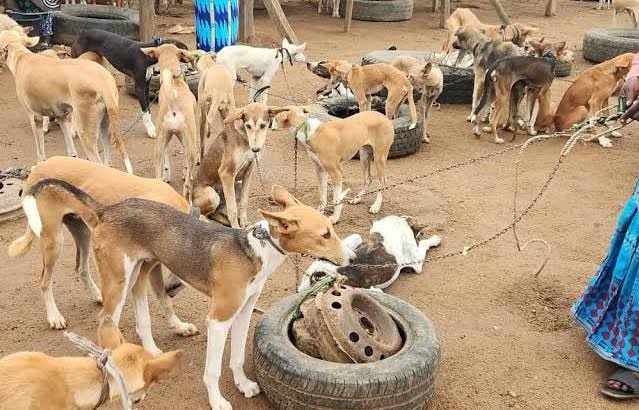
The Federal Government says it will commence free anti-rabies vaccination of dogs in Gwagwalada, Kubwa and other parts of the country on Saturday, Sept. 26.
Dr Samuel Anzaku, Chief Veterinary Officer of Nigeria (CVON) and Director, Veterinary Public Health and Epidemiology, Federal Ministry of Livestock Development (FMLD), said this on Friday in Abuja.
Anzaku spoke during a road walk organised to commemorate the 2026 World Rabies Day (WRD), marked annually on Sept. 28.
He said the intervention would be implemented by the Federal and state governments in collaboration with development partners, veterinarians and other stakeholders.
Anzaku said the campaign aimed at reducing the burden of rabies and contributing to the global target of eliminating dog-mediated human rabies by 2030.
He urged dog owners to take their pets to designated veterinary clinics for the free vaccination.
He also announced plans to provide human pre-exposure prophylaxis to frontline workers who regularly come into contact with dogs.
“Veterinarians, paraprofessionals and hunters who are always in contact with these dogs will be given some pre-exposure prophylaxis against rabies, because you do not have to wait until this problem happens,” he said.
Anzaku said the government had lined up activities to translate the World Rabies Day commemoration into concrete actions, especially through mass dog vaccination.
“Through the mass vaccination we are targeting two or three area councils beginning from tomorrow,” he said.
He described rabies as a preventable viral disease affecting warm-blooded animals, including humans, and said it could be transmitted through the saliva of infected animals, usually following a bite.
“In Nigeria, dogs are the principal source of rabies infection in humans,” Anzaku said.
He said this year’s WRD theme, “Stronger Together”, underscored the need for collaboration among dog owners, government institutions and other stakeholders.
According to him, the One Health approach brings together the Ministries of Health, Environment and Livestock Development, the Nigeria Centre for Disease Control and Prevention (NCDC) and other stakeholders.
He said the ministry was collaborating with the health and environment ministries, NCDC and the World Against Rabies Foundation to raise awareness and strengthen preventive measures.
Anzaku also urged the Ministry of Environment to intensify efforts to control stray dogs, describing them as a major contributor to the spread of rabies.
He called for active community participation, including traditional rulers, local government chairmen, state governors, development partners and civil society organisations.
“It is only through collective effort that we will be able to overcome rabies. Prevention is better than cure. Take your dogs to the nearest veterinary clinic.
“Report any bite to the nearest hospital so that immediate action can be taken,” he said.
Dr George Onyemaowa, National Coordinator, Rabies Control and Eradication Programme, FMLD, said the road walk was organised to raise awareness about rabies prevention and the need for immediate treatment after a dog bite.
Onyemaowa, who is also National Coordinator, One Health Technical Working Group, urged members of the public to immediately wash dog-bite wounds with soap and water and proceed to the nearest hospital.
Speaking on the prevalence of rabies, he said reports were being received from between 18 and 20 states monthly.
“As it stands now, we have over 100 cases already between January and August. And almost every week we keep getting reports,” he said.
Onyemaowa identified Plateau, Bauchi and Gombe as among the states reporting high numbers of rabies cases.
He listed symptoms in humans as including fever, headache, pain or tingling around the bite, confusion, irritability, fear of water and paralysis, which could result in death.
Dr Moses Arokoyo, President, Nigerian Veterinary Medical Association (NVMA), said the association was committed to supporting efforts to eradicate rabies.
Arokoyo, represented by Dr Chinnaemeka Joe-Iruobe, Chairperson, FCT chapter of NVMA, said rabies deaths were distressing because the disease was preventable.
“I follow the fight against rabies with passion as a veterinarian. If we can eradicate rabies by 2030, I will be the happiest person in the world,” he said.
