


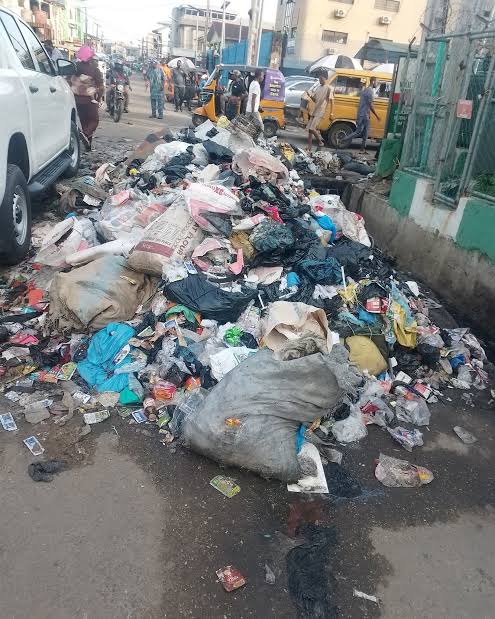
Residents in parts of Lagos have called for stricter enforcement of sanitation regulations and improved waste management to address indiscriminate dumping, blocked drains and inadequate disposal facilities.
They made the call in separate interviews with reporters on Saturday during the October environmental sanitation exercise.
Residents also identified poor public participation and irregular refuse collection as challenges undermining environmental cleanliness.
On Apapa Road, residents and traders cited rising waste collection costs, poor drainage and low public participation as major concerns.
Ms Yagazierem Igwe, a resident of Apapa Road, said occupants of her building contributed monthly to cleaning their surroundings.
She added that traders in a nearby market also funded regular sanitation exercises, which they conducted before starting business each month.
Igwe, however, expressed concern about rising waste collection charges and delays in refuse collection, which led to waste accumulation and unpleasant odours.
She said she had not seen Lagos State Waste Management Authority (LAWMA) Private Sector Participation (PSP) operators in her area for more than two years.
Igwe called for waste collection vehicles to be deployed during community sanitation exercises to ensure prompt removal of collected refuse.
Another Apapa Road resident, Mrs Kafayat Adeyemi, said residents took part in monthly sanitation exercises but needed more public waste bins around bus stops.
She said some commuters indiscriminately discarded empty containers and other waste along the roads.
A trader around Apapa Market, Mrs Aramide Adeniyi, said she cleaned the area around her shop daily and relied on LAWMA PSP operators to collect refuse.
She said the operators visited her area about twice a month, adding that she sometimes hired cart pushers when they failed to come.
Adeniyi expressed hope that more residents would participate in environmental sanitation exercises.
Similarly, Mrs Roseline Ogbuagu, a resident of Apapa Road, said occupants of her building organised monthly clean-ups and hired a cleaner twice a week.
Ogbuagu expressed concern about a blocked drainage channel outside her compound, blaming the blockage on the indiscriminate dumping of plastic cups and other refuse.
She said she spent more than two hours clearing the drain on Saturday, adding that nearby shop operators repeatedly declined invitations to help.
She also alleged that construction work had obstructed an earlier drainage channel, worsening the blockage and increasing the risk of flooding.
Ogbuagu urged authorities to engage shop operators in maintaining drainage channels and support communities in addressing wider sanitation challenges.
Mr Bayo Olowu of Jones Street, Apapa, said monthly sanitation activities took place between 6:30 a.m. and 8:30 a.m. on the last Saturday of each month.
Olowu said he encouraged residents to participate, while PSP operators collected the refuse gathered during the exercise.
He said refuse collection provided through the local government was free, adding that markets held separate sanitation exercises on Thursdays.
Olowu commended the council chairman for providing collection vehicles but called for stricter enforcement of sanitation regulations.
He said some residents continued moving around and engaging in other activities during sanitation hours, undermining collective efforts.
Reporters observed LAWMA personnel cleaning roads and clearing refuse, although moving vehicles hindered their work.
On Rasaki and Adeoye streets in Mushin, residents identified irregular waste collection, inadequate disposal facilities and poor drainage as major environmental concerns.
Mr Godwin Anyaka, a resident of Adeoye Street, said residents took part in weekly sanitation exercises between 6:30 a.m. and 8:00 a.m.
He estimated participation at 60 to 70 per cent, noting that some residents occasionally did not take part.
Anyaka identified irregular sewage and refuse disposal as major challenges, saying some households had their waste collected only once every three months.
He called for government intervention to improve drainage channels and sewage systems, warning that indiscriminate waste disposal could worsen flooding.
Mr Oluchi Ubai, a resident of Rasaki Street, said occupants of his compound worked together to keep the area clean.
Ubai said they cleaned their surroundings every Saturday, regardless of government-designated sanitation periods.
Another Rasaki Street resident, Mr Tochukwu Onyiuke, said residents took part in monthly, government-directed sanitation exercises. He added that they also cleaned their surroundings every Thursday and Saturday.
Onyiuke identified inadequate waste disposal facilities as a major challenge, saying designated collection points filled up quickly without regular collection.
He said overflowing refuse encouraged indiscriminate dumping, while dirty, waterlogged streets affected businesses and attracted flies and mosquitoes.
Onyiuke urged the government to provide larger waste containers at commercial junctions and ensure regular refuse collection.
He also called for major drainage channels to be reconstructed and widened to improve water flow and reduce flooding.
Meanwhile, on College Road in Ogba, reporters observed limited outdoor activity during the exercise, with few vehicles passing along the relatively quiet road.
Mr Akala Anaba, who was walking near Estate Bus Stop, attributed residents’ apparent reluctance to take part in manual sanitation partly to the heat.
He said the weather made outdoor cleaning uncomfortable, particularly without electricity to power fans.
“I cannot imagine myself cleaning gutters and the surroundings while sweating, only to return home and continue suffering from the heat.
“There is no electricity to power a fan and provide some relief. The weather is just not favourable for this exercise,” he said.
Anaba expressed hope that better weather would encourage greater participation in sanitation activities.
Across the locations, reporters observed varying levels of participation, with sanitation officers monitoring compliance and encouraging residents and traders to take part.
The observations highlighted persistent challenges with public participation, refuse collection and drainage maintenance, despite ongoing community sanitation efforts.
