


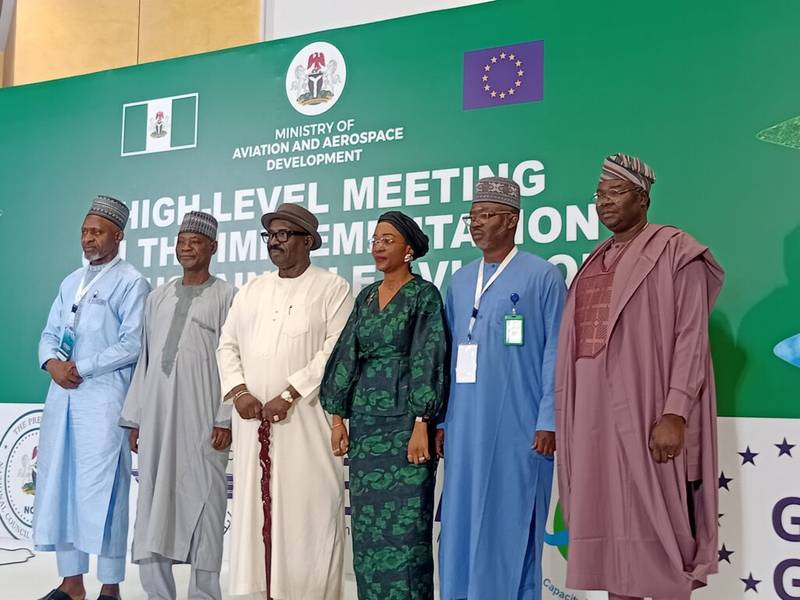
The Minister of Aviation and Aerospace Development, Festus Keyamo, has pledged the Federal Government’s support in providing policy direction, regulatory clarity, and the enabling environment required for Sustainable Aviation Fuel (SAF) initiatives.
Keyamo made the commitment in Abuja on Monday during a high-level meeting on the implementation of SAF in Nigeria and the inauguration of the SAF Steering Committee.
The Nigeria SAF Feasibility Study and the International Civil Aviation Organisation (ICAO)-supported SAF Business Implementation Study were presented at the meeting.
Represented by the Director of Air Transport Management in the ministry, Mr. Mohammed Tijani, the minister reaffirmed the Federal Government’s commitment to the initiative to reduce carbon emissions, strengthen energy security, and drive economic growth.
He said the initiative marked another milestone in Nigeria’s efforts to build a resilient, innovative, and environmentally sustainable aviation sector.
According to him, while aviation remains critical to economic growth, trade, and connectivity, the sector must also contribute meaningfully to global efforts to address climate change.
“Sustainable Aviation Fuel presents one of the most practical and impactful pathways towards achieving this objective.
“It offers an opportunity not only to decarbonise aviation but also to stimulate industrial development, create jobs, strengthen energy security, and promote growth across the agricultural, energy, and industrial value chains.”
The minister said Nigeria possessed enormous potential to produce SAF because of its abundant biomass resources, including agricultural residues, and its strategic position in Africa.
He commended President Bola Tinubu for supporting the initiative and thanked ICAO, the European Union, the European Union Aviation Safety Agency (EASA), and members of the technical working group for their contributions.
He described the newly inaugurated committee as the national governance platform that would coordinate the implementation of Nigeria’s Sustainable Aviation Fuel Programme and promote collaboration among government agencies, industry players, academia, development partners, and the private sector.
The minister said the implementation roadmap unveiled at the event identified priority actions, institutional responsibilities, and pathways to guide the country’s transition to sustainable aviation fuel.
Keyamo also reaffirmed Nigeria’s commitment to international carbon reduction goals in aviation, adding that the country would continue to align its aviation sector with global climate and sustainable development objectives.
On his part, the Director-General of the Nigeria Civil Aviation Authority (NCAA), Capt. Chris Najoma, described SAF as not only an “environmental initiative but also a strategic economic opportunity” capable of driving industrial growth, creating jobs, and enhancing energy security.
According to him, Nigeria’s vast agricultural resources, expanding refining capacity, and entrepreneurial workforce provide a strong foundation for developing a viable SAF industry.
The NCAA boss said the feasibility study was conducted under ICAO’s Capacity Building and Training for Sustainable Aviation Fuels Programme, with support from the European Union (EU) and EASA.
He added that the study would provide the evidence base for future investments in the aviation sector.
He said the next phase — the Business Implementation Study — would translate the findings into commercially viable projects and support the implementation of Nigeria’s Sustainable Aviation Fuel Programme.
“SAF holds the promise of new industries, new jobs, greater energy security, and a position of leadership for Nigeria in the major African SAF market.
“The feasibility study being handed over today provides a credible, evidence-based foundation upon which the opportunity can be built,” he said.
Also speaking, the Managing Director of NNPC New Energy Ltd., Mr. Haruna Abdurrahman, described the feasibility study as a major milestone that would pave the way for site-specific investment opportunities.
Abdurrahman said the global SAF market was projected to expand significantly over the coming decades, presenting Nigeria with opportunities for economic diversification, job creation, and energy transition.
The Director-General of the National Council on Climate Change (NCCC), Dr. Omotenioye Majekodunmi, said sustainable aviation fuel aligned with Nigeria’s climate commitments and economic transformation agenda.
Majekodunmi said the council would provide the policy, regulatory, and carbon market framework required to ensure environmental integrity, attract investment, and enable Nigeria to participate competitively in international carbon markets.
“Nigeria’s aviation sector stands at a defining moment. As global demand for air travel continues to rise, so does the responsibility to decarbonise one of the world’s most difficult-to-decarbonise sectors.
“Sustainable Aviation Fuel is not simply an environmental imperative; it is an economic opportunity.
“It presents Nigeria with the chance to diversify its economy, optimise value chains, attract investments, strengthen energy security, and position itself as a regional leader in sustainable aviation.
“The NCCC is not simply a stakeholder in this agenda. We are one of the world’s architects,” she said.
The EU Ambassador to Nigeria, Gautier Mignot, said the EU had supported Nigeria since 2020 through EASA in implementing international aviation emissions reduction programmes and strengthening capacity for sustainable aviation fuel development.
Mignot said the feasibility study demonstrated Nigeria’s strong potential to produce sustainable aviation fuel locally and urged stakeholders to support the implementation programme.
He added that SAF would not only reduce aviation emissions but also create new value chains, support the circular economy, and enhance Nigeria’s competitiveness in the global aviation industry.
