


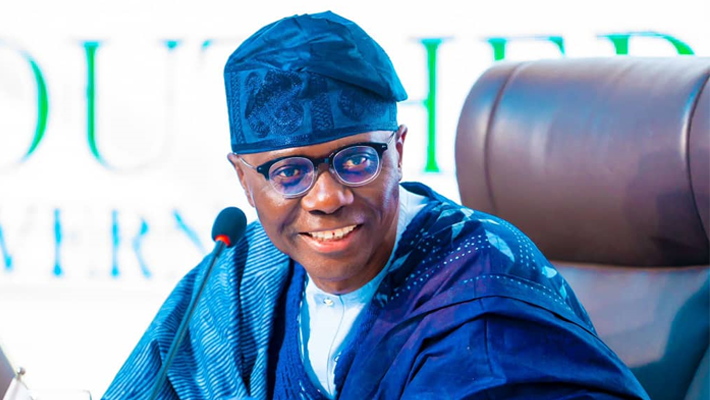
Lagos State Gov. Babajide Sanwo-Olu on Thursday unveiled the state’s Industrial Policy 2025–2030, outlining strategic reforms to reposition its industrial sector for sustainable growth and global competitiveness.
Sanwo-Olu said at the event in Lagos that the policy was designed as a framework to reform, rebuild, and reposition the state for long-term growth.
The governor was represented by the Secretary to the State Government, Mrs Abimbola Saliu-Hundeyin.
The event was attended by members of the diplomatic corps, Lagos State Government officials, and private sector players.
According to him, the policy reflects deliberate consultation, executive scrutiny, and professional input at the highest level, following months of technical work and stakeholder engagements.
He said the initiative marks a new phase in the state’s industrial development, driven by strategic actions to strengthen competitiveness.
“The global industrial landscape is evolving rapidly, with supply chains shifting and competitiveness now defined by innovation, resilience, and adaptability,” he said.
He added that the policy would address structural constraints, unlock growth opportunities, and position the industrial sector as a key driver of inclusive economic development.
“It aligns with our long-term vision of building a globally competitive mega city driven by productivity, innovation, and industrial exports,” he said.
The governor said the framework supports Nigeria’s commitments under the African Continental Free Trade Area, positioning Lagos as a hub for regional and global trade.
“By prioritizing key sectors, the policy will accelerate industrial productivity and strengthen Lagos as a gateway for participation in global markets,” he said.
Sanwo-Olu said the government would prioritize regulatory reforms to improve the ease of doing business and ensure a predictable operating environment.
“We are committed to creating an environment where businesses can operate efficiently and are supported by clear regulations and consistent policy direction,” he said.
On financing, he said the state was working with financial institutions and development partners to unlock capital for industrial investments.
“We are expanding investment promotion efforts and de-risking opportunities to attract funding that will support industrial growth and enterprise development,” the governor said.
He identified workforce development as a critical pillar of the policy.
“We are advancing skills development to ensure our workforce is prepared for the demands of a modern and competitive industrial economy,” he said.
Sanwo-Olu added that innovation, technology adoption, and sustainability would drive implementation.
“The future of industry lies in smart, green, and competitive production systems,” he said.
It was reported that the policy is expected to strengthen industrial capacity, attract investment, and generate employment across key sectors of the state’s economy.
In a goodwill message, the Minister of State for Commerce and Industry, Mr John Owan-Enoh, represented by Mr Temitope Osinowo, described Lagos as the commercial heartbeat of Nigeria.
Owan-Enoh commended the Sanwo-Olu-led administration for the initiative, which he said aligns with the domestication of the National Industrial Policy.
Earlier, Mrs Folashade Ambrose-Medebem, Lagos State Commissioner for Commerce, Cooperatives, Trade and Investment, said the policy reflects the state’s resolve to position itself among competitive global economies.
She said the state is doing so through disciplined planning, execution, and industrialization tailored to local realities and long-term development priorities.
“Africa’s industrial future is being shaped by economies with the courage to plan and the discipline to execute. Lagos must be one of them,” she said.
She described the policy as a covenant between the government and over 25 million Lagos residents.
She added that it aims to expand opportunities from small enterprises to large corporations across both formal and informal sectors.
Ambrose-Medebem said the economic scale, maritime assets, and youthful population of Lagos State position it as a sub-national economy of global relevance, with the capacity to drive industrial growth across West Africa and beyond.
“Our gross domestic product rivals several countries, while our ports handle significant regional trade.
“Our people remain innovative, entrepreneurial, and central to sustaining industrial expansion across sectors,” she said.
She said the policy outlines clear timelines, responsibilities, and measurable outcomes to ensure that Lagos’ industrial potential is translated into tangible benefits for residents and businesses across the state.
According to her, the document prioritizes local production, value chain development, and the integration of informal enterprises into structured economic systems supported by finance, regulation, and infrastructure.
“It commits Lagos to deepening production, strengthening domestic value chains, and ensuring that wealth created within the state remains and grows within the state’s economy,” she said.
Mr Abiodun Tobun, Chairman of the Lagos State House of Assembly Committee on Commerce, Cooperatives, Trade and Investment Portfolio, said the legislature would support the implementation of the policy to ensure economic growth, investor confidence, and employment generation.
“With this policy, we expect enhanced prosperity for investors, economic growth for the state, and job creation for youths to strengthen Lagos as a secure and competitive economy,” he said.
