


The opportunities discussed so far are significant. But investors do not invest in population size or transport demand alone. They invest where demand can be converted into predictable cash flows, manageable risks and acceptable returns on capital.
That distinction is important for Nigeria.
The country has enormous mobility demand, but several structural constraints continue to increase operating costs and weaken investment confidence.
Constraint 1: Poor Roads and Severe Urban Congestion
Road transport carries more than 90% of passenger and freight movements in Nigeria, making road quality a fundamental economic issue rather than merely an infrastructure problem (World Bank, 2024).
Yet the World Bank estimated in late 2024 that approximately 80% of Nigeria’s road network was in poor condition. In response, it approved US$500 million in concessional financing for the Rural Access Agricultural Marketing Project Scale-Up, alongside US$100 million expected from the Nigerian government (World Bank, 2024).
Poor roads translate directly into commercial costs: damaged tyres, suspension failures, higher fuel consumption, longer turnaround times, accelerated vehicle depreciation and lower fleet utilisation.
Congestion adds another layer.
In Lagos, Nigeria’s largest urban mobility market, the average commuter can spend up to four hours daily commuting (Duhaut et al., World Bank, 2025).
For a commercial vehicle, those hours represent underutilised capital.
A ₦30 million (22,600 USD) bus trapped in traffic is still depreciating. The driver is still working. Fuel or energy is still being consumed. But the asset is carrying fewer revenue-generating passengers per day.
For investors, congestion therefore needs to be incorporated into financial modelling as a productivity cost.
Here are the recommended solutions:
- Prioritise maintenance and transport corridors over isolated road projects.
Government investment should increasingly focus on maintaining economically important urban and intercity corridors, with measurable service-level standards.
- Expand high-capacity public transportation.
Lagos demonstrates the potential. World Bank-supported BRT infrastructure reduced public transport costs by approximately 30% for about 200,000 daily passengers during the project period (World Bank, 2024).
BRT, rail and organised high-capacity buses should become the backbone of large-city mobility, complemented by smaller vehicles which provide first- and last-mile connections.
- Deploy intelligent traffic management.
Traffic-light coordination, digital traffic monitoring, incident-response systems, parking management and real-time passenger information can improve existing road capacity without waiting for entirely new infrastructure.
Constraint 2: Fragmented Regulation and Weak Institutional Coordination
Transportation crosses multiple jurisdictions.
Federal agencies regulate aspects of vehicles, roads and safety. States regulate urban transport. Local governments influence terminals, parking and local operations. Transport unions and associations also exercise considerable practical influence.
For an investor, this can translate into uncertainty over permits, levies, routes, operating requirements and enforcement.
The World Bank’s current work on a National Urban Mobility Programme identifies precisely this institutional weakness. It notes that most Nigerian states outside Lagos lack dedicated transport authorities or sufficient planning capacity to develop investment-ready sustainable mobility programmes (World Bank, 2026).
This matters because infrastructure capital typically has a long investment horizon.
An investor financing buses, charging infrastructure or CNG stations needs reasonable confidence about the regulatory environment five or ten years ahead, not merely next month.
Here are what to do:
- Establish integrated metropolitan transport authorities.
Major cities should gradually adopt institutional structures similar to LAMATA, bringing transport planning, regulation, data and investment coordination under stronger metropolitan frameworks.
- Develop a harmonised commercial-transport regulatory framework.
Government should reduce overlapping permits, levies and administrative requirements while clearly defining responsibilities across federal, state and local authorities.
- Introduce regulatory investment agreements for major mobility projects.
Large fleet, BRT, CNG and EV projects should have clearly documented tariff principles, operating rights, performance requirements and dispute-resolution mechanisms.
Investors can manage commercial risk. What they find more difficult to price is unpredictable regulatory risk.
Constraint 3: Safety, Security and Passenger Confidence
Mobility investment cannot be separated from safety.
Globally, road crashes claim approximately 1.19 million lives annually, with low- and middle-income countries accounting for around 92% of fatalities despite having about 60% of the world’s vehicles (World Bank, 2025).
Nigeria’s road-safety challenge affects passengers, drivers, insurers, fleet owners, financiers and ultimately investors.
There is also a broader personal-security dimension.
Ride-hailing platforms introduced useful mechanisms including driver identification, digital trip records and GPS tracking. Similar safeguards remain much less developed across large parts of informal transportation.
This creates another investment opportunity.
Safety itself can become part of the mobility product.
Three recommended solutions
- Make telematics standard for financed commercial fleets.
GPS tracking, speed monitoring, driver-behaviour analytics and emergency-response functions should increasingly be requirements for institutionally financed commercial vehicles.
- Strengthen driver and vehicle certification.
Commercial driver training, periodic vehicle inspection and safety scoring should be linked to licensing, insurance and access to financing.
- Build safety into mobility platforms.
Verified identities, trip sharing, emergency buttons, route monitoring, passenger feedback and digital transaction records should become standard across organised mobility services, not just conventional ride-hailing.
Investors should also know what to approach cautiously.
- A business model based solely on acquiring vehicles without controlling utilisation, maintenance and revenue collection carries substantial risk.
- An EV charging station without sufficient captive demand may struggle with utilisation.
- A CNG station located away from commercially viable transport corridors may face similar problems.
- And another ride-hailing application offering discounts without solving driver economics may simply reproduce existing weaknesses.
The strongest opportunities are therefore likely to be integrated models.
Imagine a company that acquires 1,000 CNG buses through blended financing, deploys them along defined corridors, uses digital ticketing, maintains the vehicles centrally, tracks them through telematics and secures corporate or commuter demand before deployment.
That is substantially different from simply purchasing 1,000 buses and hoping passengers arrive.
It is the difference between owning transportation assets and building an investable mobility system.
Beyond Uber: What Should Nigeria Learn?
Uber’s exit should neither be celebrated nor interpreted as proof that Nigeria is commercially unattractive.
It should be studied.
A market can have enormous demand and still be difficult to monetise profitably.
Nigeria’s challenge is therefore not simply attracting another global ride-hailing company.
The bigger task is building an ecosystem where drivers can earn sustainably, passengers can afford mobility, financiers can recover capital, operators can make acceptable returns and governments can achieve safer and more efficient cities.
That requires policy reform, infrastructure and private investment to move together.
It also requires recognising that the future of Nigerian transportation will probably not be entirely formal or informal, public or private, petrol or electric, digital or conventional.
It will be multimodal.
- Danfo may feed passengers into BRT and rail corridors.
- Keke and motorcycles may continue solving first- and last-mile problems.
- CNG buses may become increasingly important for high-utilisation commercial transport.
- Electric motorcycles, tricycles and buses may gain ground where their operating economics are compelling.
- Ride-hailing platforms will continue serving customers who value convenience and point-to-point mobility.
- Private pick-and-drop operators, staff buses and school transportation will remain relevant.
The investment opportunity lies in connecting these pieces.
The Road Ahead
Nigeria does not have a transportation-demand problem.
It has an organisation, infrastructure, financing and productivity problem within a very large transportation market.
That difference matters.
- For policymakers, the priority should be creating predictable regulation, better infrastructure, integrated transport planning and an environment in which private capital can participate profitably.
- For development partners, the opportunity lies in de-risking commercially promising projects, strengthening institutions, supporting inclusive mobility and helping Nigeria transition towards cleaner transportation.
- For the private sector, opportunities extend far beyond operating vehicles. They exist in financing, leasing, fleet management, CNG, electric mobility, charging and battery infrastructure, insurance, maintenance, digital payments, telematics, ticketing, terminals and mobility data.
For investors, however, the central lesson is more disciplined:
Do not invest simply because more than 200 million Nigerians need to move.
Invest where there is demonstrable passenger demand, controllable operating costs, strong asset utilisation, predictable regulation and a credible path to positive cash flow.
Uber may have left Nigeria.
Nigeria has not stopped moving.
The more important question is who will build the systems, infrastructure and businesses that will move the country next.
For investors prepared to answer that question carefully, Nigeria’s land transportation ecosystem may still represent one of the country’s most significant long-term infrastructure and service opportunities.
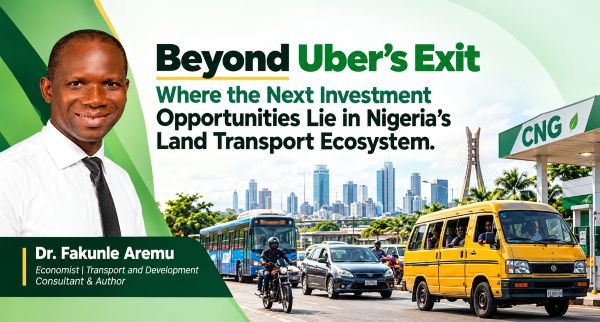
Dr. Fakunle Aremu is a Nigerian economist, management consultant and trade and investment expert with experience in private-sector development, policy advisory, market systems and investment facilitation. He holds a Ph.D. in Agricultural Economics and serves as Nigeria Country Director of the U.S.-Africa Trade Commission and the Managing Director of Cedro Royal Multiventures Limited. His work focuses on identifying commercially viable opportunities across trade, infrastructure, clean energy, agribusiness and emerging investment ecosystems. He works with businesses, investors, governments and development institutions to translate market opportunities and economic challenges into practical strategies for sustainable investment and development in Nigeria and Africa.
