


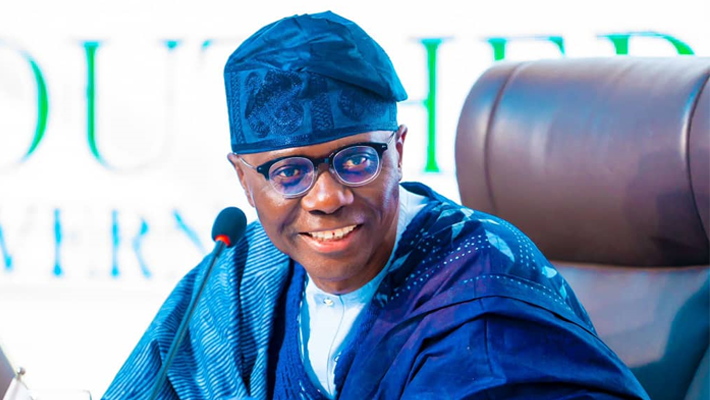
Lagos State Governor Babajide Sanwo-Olu on Friday urged Nigerians to embrace unity of purpose, warning that the nation’s greatest setback remains disunity and a lack of shared responsibility among citizens.
Sanwo-Olu spoke at a special Juma’at service and prayers held to commemorate Nigeria’s 66th Independence Day. The event was organised by the Lagos State Ministry of Home Affairs at the Secretariat Community Central Mosque, Alausa, Ikeja. The governor was represented by his deputy, Dr Obafemi Hamzat.
Sanwo-Olu said Nigeria’s abundant human and material resources could only translate into meaningful development if citizens and leaders worked together with a common sense of purpose and national identity.
Reflecting on Nigeria’s journey since independence, he said the country’s persistent challenges were not due to a lack of talent, but to the absence of unity and collective responsibility.
“We often see ourselves differently, and that creates division rather than shared purpose.
However, if we are united, come together and work as one, we already have the talent, the ability and the resources to move this country forward,” he said.
The governor noted that disunity had remained a recurring factor in Nigeria’s historical and contemporary struggles, pointing out that even past conflicts, including the civil war, underscored the dangers of division.
“Many of the issues we face today stem from a lack of unity; even the civil war we experienced is an example of what division can cause,” he added.
He stressed that national development could not be left to government alone and called for stronger collaboration among religious institutions, traditional rulers, the private sector and citizens.
“It is not just government alone; it is all of us. This includes the religious institutions, traditional institutions, the private sector and citizens.
We have seen it happen before, like during COVID-19, when everyone came together,” he said.
Sanwo-Olu said such collective spirit must be sustained beyond emergencies and integrated into everyday national life. According to him, countries that have recorded significant progress often share strong internal cohesion and a sense of direction.
“Countries like Saudi Arabia, the UAE, the United States and China, despite their differences, have something binding them together — a shared language, a shared direction, a shared purpose,” he said.
He also cited Singapore as an example of a nation that achieved development through unity of purpose rather than natural resources.
“I recall a powerful example from a visit to Singapore. With virtually no natural resources, they made deliberate choices.
Today, they stand as one of the most developed nations in the world,” he noted.
He added that Nigeria’s challenge was not a lack of talent, citing the global success of Nigerians in various fields.
“Everywhere you go in the world, Nigerians excel. So clearly, capacity is not our weakness. Our real challenge is division,” he said.
The governor further emphasised the need for responsible family values, warning that national progress would remain elusive without discipline and accountability at the household level.
“Family is the foundation of any nation. If the family fails, the nation cannot succeed,” he said.
He urged Nigerians to prioritise accountability, discipline and proper child upbringing as part of efforts to rebuild national values. He also called on Nigerians to see gratitude and faith as essential pillars for national stability and progress.
“We must unite. We must take responsibility, and we must understand that gratitude and reflection are part of national rebuilding,” he said.
Earlier, in his admonition, the Chairman of the Imams of the Lagos Secretariat Community Central Mosque, Dr Saaid Ahmad, called on Nigerians to engage in deep reflection and honesty. He anchored this on three key themes — retrospection, gratitude and prayer — in assessing the nation’s journey since independence.
He noted that while Nigeria was richly blessed with resources and human capital, it risked underdevelopment if it failed to translate its advantages into purposeful national development. The cleric emphasised gratitude and warned against ingratitude and complacency.
He noted that in spite of Nigeria’s challenges, its people continued to excel globally, stressing that “capacity is not our weakness.” He, however, warned that too many competing centres of interest and divisions pulling in different directions remained a major obstacle to national growth.
Ahmad also stressed the importance of responsibility, noting that population growth without corresponding discipline and planning could become a burden rather than a blessing. He called for renewed commitment to discipline, accountability, family values and national unity, adding that gratitude, introspection and prayer were key to national renewal.
In his sermon, the Chief Imam, Yunus Al-Imam, urged Nigerians to actively contribute to community development rather than leaving governance responsibilities solely to government. He called for unity, peaceful coexistence and the rejection of tribalism and religious intolerance, stressing that no tribe is superior to another.
“True distinction lies in living according to the will of God and demonstrating good character,” he said.
The Chief Imam also urged Nigerians to remain grateful to God for the peace and freedom enjoyed in the country despite global crises. He called on citizens to sustain gratitude, peace and mutual respect for continued national stability.
