


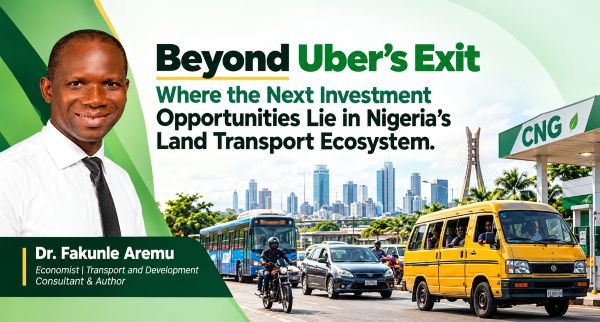
Uber’s departure from Nigeria should not be read simply as another multinational company leaving an African market. It should prompt a much bigger question:
How commercially sustainable is Nigeria’s land transportation ecosystem, and where are the opportunities for investors that are willing to understand it properly?
On 2 September 2026, Uber ceased ride-hailing operations in Nigeria after approximately 12 years in the market. The company described the decision as part of its evolving business priorities and investment focus in Africa. Its departure comes against a difficult operating environment characterised by fuel costs, inflation, currency volatility and increasing pressure on the economics of both drivers and digital mobility platforms (Reuters, 2026).
But Uber’s departure does not mean Nigerians have stopped moving.
Quite the opposite.
Nigeria’s cities continue to expand. Millions of workers, traders, students, entrepreneurs, and households must travel every day, regardless of inflation, fuel prices, or the presence of any particular mobility platform.
The real Nigerian transportation story therefore extends far beyond Uber.
It includes Bolt and inDrive, conventional taxis, danfo and other minibuses, keke NAPEP, okada, private pick-and-drop operators, staff buses, school transportation, interstate buses, Bus Rapid Transit (BRT) systems, government-supported mass transit and an emerging ecosystem around vehicle leasing, fleet management, digital payments, CNG, electric mobility and transport technology.
Understanding this wider ecosystem is essential for investors, development partners, policymakers and private-sector operators who are seeking opportunities in one of Africa’s largest mobility markets.
Transportation: A multifaceted market
One mistake that investors can make is to treat Nigerian land transportation as a single industry.
It is better understood as an interconnected mobility value chain.
At one end are the assets: cars, buses, minibuses, motorcycles and three-wheelers.
Around these assets are vehicle dealers, assemblers, financiers, leasing companies, insurers, mechanics, spare-parts suppliers, fuel stations, CNG infrastructure and increasingly EV charging and battery businesses.
Then come the operators: individual drivers, transport unions, fleet owners, corporate transport providers, informal bus operators and technology-enabled platforms.
At the customer end are millions of passengers whose priorities are surprisingly straightforward: affordability, availability, safety, reliability and journey time.
This structure explains why the departure of one major platform does not eliminate the underlying market.
Bolt and inDrive have already indicated that they intend to remain in Nigeria and compete for the market space created by Uber’s withdrawal. inDrive described Nigeria as an important African market where its active user base has continued to grow year-on-year (TheCable, 2026).
The critical distinction for investors is therefore between mobility demand and the business model used to serve that demand.
Nigeria has substantial mobility demand. The more difficult question is which business models can serve it profitably and sustainably.
The informal sector is actually at the centre of the market
Anyone attempting to understand Nigerian mobility solely through ride-hailing applications will substantially underestimate the market.
The danfo, keke NAPEP and okada are not peripheral components of the transportation system. In many communities, they constitute the basic infrastructure through which people access markets, workplaces, schools, healthcare facilities and major transport corridors.
Research published by the World Bank in 2025 illustrates the scale of this reality. Private minibuses were estimated to serve approximately 62% of trips in Lagos (Björkegren et al., 2025).
That statistic has major implications.
It means that the largest mobility opportunities may not necessarily lie in creating another conventional ride-hailing application. They may lie in improving the efficiency, financing, safety, technology and asset quality of the transportation systems Nigerians already use.
Imagine, for example, the investment potential associated with organised minibus fleets, vehicle leasing, driver financing, digital fare collection, route optimisation, fleet tracking, vehicle maintenance networks, passenger insurance and CNG conversion.
The opportunity is not simply to replace informal transportation.
The bigger opportunity may be to modernise it.
Experience from Lagos demonstrates what better organised public transport can achieve. World Bank-supported Bus Rapid Transit infrastructure reduced public transport costs by approximately 30% for about 200,000 daily passengers during the implementation period as reviewed by the Bank (World Bank, 2024).
For development finance institutions and impact investors, this intersection between commercial mobility and public value deserves particular attention.
The economics are attractive, but increasingly difficult
Nigeria’s transportation sector demonstrates an important paradox: enormous demand does not automatically translate into attractive returns.
The National Bureau of Statistics reported that Transportation and Storage grew by 14.08% in real terms in Q1 2025, compared with the corresponding period of the previous year. Its nominal growth was considerably higher at 53.56% (NBS, 2025).
Yet operators face an increasingly demanding cost structure.
Fuel provides one example. The average retail price of Premium Motor Spirit was ₦1,051.47 (0.79 USD) per litre in February 2026, according to the National Bureau of Statistics. Although this represented a 15.60% reduction from ₦1,245.80 (0.94 USD) recorded in February 2025, the figure still illustrates how substantial fuel expenditure has become within transport economics (NBS, 2026).
For a commercial driver, fuel is only one component.
Vehicle acquisition, financing costs, tyres, lubricants, maintenance, insurance, platform commissions, regulatory charges, security risks, depreciation and the opportunity cost of hours spent in traffic all affect profitability.
This leads to the first major constraint in the ecosystem: deteriorating unit economics for transport operators.
Constraint 1: High Operating Costs and Weak Driver Economics
The economics of mobility ultimately depend on a simple equation:
Revenue per productive kilometre must exceed the total cost per kilometre by a sufficient margin to compensate the asset owner, driver, financier and platform.
When vehicle and operating costs increase faster than passengers’ ability to pay, that equation becomes difficult to sustain.
The tension is already visible in Nigeria’s e-hailing segment. In 2026, app-based drivers raised concerns about earnings, fare structures, commissions and working conditions, with their union calling for stronger regulatory intervention (AUATON, 2026).
For investors, this is not merely a labour-relations issue. It is a warning about the sustainability of the underlying business model.
Three solutions to address this are:
1. Shift from fuel-dependent mobility towards CNG, hybrid and electric fleets where commercially viable.
Nigeria should treat lower-cost vehicle energy as an economic competitiveness strategy, not simply an environmental policy. Fleet-based operators are particularly suitable for CNG because predictable routes and centralised refuelling can improve infrastructure utilisation and investment economics.
2. Develop structured vehicle-financing and leasing models.
Commercial drivers frequently struggle with the upfront cost of vehicles. Banks, leasing companies, OEMs, development finance institutions and mobility platforms can develop lease-to-own and revenue-based financing structures where repayments are linked to verified transport earnings.
Technology can improve underwriting by using trip history, vehicle utilisation and digital-payment records as alternative credit data.
3. Move from fare competition to operational-efficiency competition.
Mobility platforms and fleet operators cannot sustainably compete only by reducing passenger fares.
Investment should increasingly target route optimisation, shared mobility, predictive maintenance, driver productivity, fuel management, digital payments and reduced empty kilometres.
The winner in Nigeria’s next mobility phase may therefore not be the company that offers the cheapest trip.
It may be the company that is capable of delivering the lowest sustainable cost per passenger-kilometre.
And that distinction is fundamental to understanding where the next generation of Nigerian transportation investments should go.
Dr. Fakunle Aremu is a Nigerian economist, management consultant and trade and investment expert with experience in private-sector development, policy advisory, market systems and investment facilitation. He holds a Ph.D. in Agricultural Economics and serves as Nigeria Country Director of the U.S.-Africa Trade Commission and the Managing Director of Cedro Royal Multiventures Limited. His work focuses on identifying commercially viable opportunities across trade, infrastructure, clean energy, agribusiness and emerging investment ecosystems. He works with businesses, investors, governments and development institutions to translate market opportunities and economic challenges into practical strategies for sustainable investment and development in Nigeria and Africa.
