



Across Africa, conversations about economic development often revolve around attracting multinational corporations, building industrial parks, expanding infrastructure and increasing foreign direct investment. While these priorities remain important, they frequently overshadow the largest productive segment of the continent’s economy, the informal economy.
Recent public discussions in Nigeria over government support for food vendors, roadside entrepreneurs and microenterprises have sparked diverse opinions. Some have questioned whether scarce public resources should be directed towards businesses that they consider too small to make a meaningful economic impact. Others argue that such interventions merely sustain subsistence rather than promote real economic transformation.
Both perspectives, however, miss a far more important point.
The true question is not whether a roadside cassava snack producer, a tailor, a welder or a market trader deserves support. The real question is whether Africa is prepared to recognize that millions of these entrepreneurs collectively constitute one of the world’s largest productive economic systems.
When viewed individually, these enterprises may appear insignificant. When viewed together, they represent one of the continent’s greatest investment opportunities.
That distinction changes everything.
Looking beyond the business you see
Imagine buying a packet of locally produced cassava chips from a roadside vendor in Abuja, Ibadan or Enugu.
To many consumers, the transaction appears simple. A customer pays for a snack and walks away.
In reality, that single purchase activates an extensive network of economic activities.
Behind that packet of cassava chips is a farmer cultivating improved cassava varieties. There are input suppliers providing fertilizers, herbicides and improved planting materials. Mechanization service providers prepare farmland while transport operators move fresh roots from farms to processing centres.
Processors convert fresh cassava into flour, starch or other intermediate products before manufacturers transform them into marketable snacks. Packaging companies produce branded sachets while printing firms design labels that attract consumers. Equipment manufacturers supply processing machines, fryers, sealers and dryers. Energy providers supply electricity, diesel or cooking gas that keep production lines running.
Wholesalers distribute finished products across cities while retailers sell directly to consumers. Digital payment providers process electronic transactions. Logistics companies deliver products to supermarkets and neighbourhood stores. Marketing agencies promote brands, while waste recycling businesses recover packaging materials after consumption.
One seemingly simple snack, therefore, supports farmers, processors, transporters, engineers, marketers, financiers, retailers and numerous service providers.
This is not merely a food business.
It is an economic ecosystem.
The same principle applies across thousands of informal enterprises operating throughout Africa.
Africa’s informal economy is larger than many realize
For decades, the phrase “informal economy” has often been associated with street trading or businesses that are operating outside government regulation. This narrow understanding has prevented policymakers, investors and financial institutions from appreciating its true economic significance.
The informal economy extends far beyond roadside commerce.
It includes smallholder agriculture, livestock production, fisheries, food processing, tailoring, furniture production, metal fabrication, transportation services, construction artisans, mobile phone repairs, beauty services, hospitality businesses, digital freelancers, renewable energy technicians, waste recycling enterprises and countless home-based manufacturers.
According to the International Labour Organization (ILO), more than 80 percent of employment in Sub-Saharan Africa is generated by the informal economy (ILO, 2023). In Nigeria, several studies estimate that informal economic activities contribute between 57 and 65 percent of the national Gross Domestic Product, depending on the methodology applied.
These figures reveal an important reality.
Africa’s informal economy is not a marginal sector operating alongside the formal economy.
In many countries, it is the real economy.
It feeds millions of households, creates employment where formal jobs do not exist and supplies essential goods and services to growing urban and rural populations.
Ignoring this sector is no longer economically defensible.
Why informality is not disappearing
For many years, economists assumed that informal businesses would naturally disappear as countries became more industrialized.
That prediction has not materialized across much of Africa.
Instead, informality has evolved.
Today’s informal entrepreneur increasingly accepts mobile payments, advertises products through social media, keeps digital business records, receives customer orders via WhatsApp Business and delivers products using digital logistics platforms.
Many businesses that remain technically informal are already participating in sophisticated digital commercial ecosystems.
This evolution is creating entirely new opportunities.
Every mobile payment generates transaction data.
Every digital order builds customer history.
Every electronic invoice strengthens business credibility.
These digital footprints can eventually become alternative indicators of creditworthiness, which can allow financial institutions to assess such businesses by using cash flow patterns rather than relying exclusively on collateral or formal financial statements.
Technology is therefore narrowing the gap between informal and formal enterprises without forcing businesses to abandon the flexibility that makes them resilient.
Nigeria’s competitive advantage
Among African countries, Nigeria occupies a unique position.
With an estimated population exceeding 220 million people, Africa’s largest consumer market, one of the continent’s youngest populations and one of its fastest-growing digital payment ecosystems, Nigeria offers exceptional opportunities for developing innovative informal economy financing models.
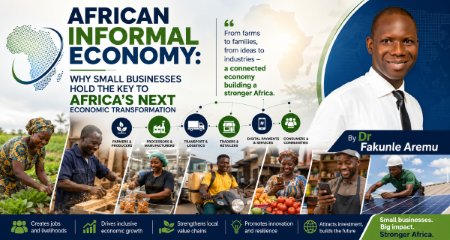
Every day, millions of Nigerians create businesses because formal employment opportunities remain insufficient to absorb the country’s rapidly expanding labour force.
Rather than waiting for jobs to emerge, entrepreneurs establish restaurants, food processing businesses, logistics services, fashion enterprises, renewable energy companies, construction services and digital businesses.
Many begin with modest capital.
Some eventually become nationally recognized enterprises.
Several of Nigeria’s leading companies started as small family businesses before expanding into regional and international markets.
The challenge, therefore, is not the absence of entrepreneurial talent.
The challenge is the absence of financing systems specifically designed for businesses that operate outside conventional banking requirements.
Investors may be looking in the wrong direction
Traditional investment models often prioritize large corporations because they appear easier to evaluate.
Yet concentrating enormous capital in a small number of businesses also creates concentration risk.
An alternative approach deserves greater attention.
Instead of financing one company with US$100 million, imagine supporting 100,000 productive enterprises with US$1,000 each through carefully designed value chain financing programmes.
The total investment remains the same.
The economic impact becomes exponentially larger.
Risk is diversified across sectors, geographic locations and business types while employment generation expands significantly.
This philosophy has already demonstrated success through microfinance, agricultural value chain financing, digital lending platforms and cooperative finance in several emerging economies.
Africa now has an opportunity to scale these models further by combining technology, blended finance, public policy and private investment.
The continent’s future prosperity may not be built solely by creating more multinational corporations.
It may equally depend on strengthening millions of existing entrepreneurs who already produce goods, create jobs and drive domestic commerce every single day.
Every Sector Has an Informal Economy
One of the biggest misconceptions about Africa’s informal economy is that it consists mainly of roadside trading and petty commerce. This perception has shaped public policy, influenced investment decisions and limited access to finance for millions of productive businesses.
The reality is far different.
The informal economy cuts across virtually every productive sector of the African economy. Whether one examines agriculture, manufacturing, construction, transportation, healthcare, renewable energy or technology, informal enterprises remain central to production, employment and service delivery.
In agriculture, millions of smallholder farmers produce the food consumed across the continent. Around them exists an extensive network of seed multipliers, agro-input dealers, irrigation service providers, mechanization operators, commodity aggregators, warehouse operators, food processors and market traders.
Manufacturing tells a similar story.
Across cities such as Aba, Kano, Nnewi, Onitsha, Kumasi, Nairobi and Kigali, thousands of small workshops manufacture furniture, garments, leather products, cosmetics, household chemicals, metal products, building materials and processed foods.
Many of these enterprises operate outside formal industrial estates, yet collectively they produce goods worth billions of dollars annually.
Construction provides another illustration.
Africa’s housing deficit cannot be addressed without artisans, brick moulders, welders, plumbers, electricians, painters, carpenters and block manufacturers. These businesses remain largely informal despite supplying essential services that sustain urban expansion.
The same applies to transportation.
Commercial motorcycles, tricycles, minibuses, haulage operators, dispatch riders and logistics providers move millions of people and goods every day. They form the backbone of domestic commerce, especially in rapidly growing cities where efficient mobility determines business productivity.
The healthcare sector is no exception.
Community pharmacies, medical laboratories, diagnostic centres, traditional medicine producers and home healthcare providers complement formal healthcare systems by extending access to underserved communities.
Africa’s energy transition is also increasingly being driven by small enterprises.
Thousands of independent solar technicians now design, install and maintain renewable energy systems for households, schools, hospitals and businesses. These technicians are helping bridge Africa’s electricity gap while creating employment in one of the continent’s fastest-growing industries.
This diversity demonstrates a simple truth.
The informal economy is not a sector.
It is an ecosystem that supports almost every aspect of economic life.
The Financing Gap That Holds Businesses Back
Despite their importance, millions of African entrepreneurs remain excluded from formal financial systems.
This exclusion is rarely because their businesses lack customers or generate insufficient income.
Rather, many fail to satisfy traditional banking requirements.
Commercial banks often require audited financial statements, registered businesses, collateral, tax histories and lengthy credit records before approving loans.
Most informal businesses possess none of these documents.
Yet they often demonstrate something equally important.
They have loyal customers.
They generate daily cash flow.
They maintain supplier relationships.
They possess practical business experience developed over many years.
Unfortunately, these strengths are seldom recognised within conventional lending models.
The International Finance Corporation estimates that micro, small and medium enterprises across developing countries face a financing gap exceeding US$5 trillion annually (IFC, 2017). Sub-Saharan Africa accounts for a significant share of this unmet demand.
This financing gap should concern investors.
Not because it reflects market failure.
But it represents one of Africa’s largest untapped investment opportunities.
Every business denied productive financing is also a missed opportunity to create jobs, increase household income and strengthen domestic production.
Rethinking Investment Risk
Investors naturally seek to minimise risk.
However, conventional definitions of risk deserve reconsideration.
Many assume that small businesses are inherently more risky than large corporations.
Experience increasingly suggests otherwise.
A single large investment concentrates exposure within one company, one management team and one market.
Should that business fail, substantial capital may be lost.
Conversely, financing thousands of productive enterprises across agriculture, manufacturing, retail, logistics and services distributes investment across multiple sectors, locations and customer bases.
Portfolio diversification has long been recognised as a fundamental principle of investment management.
The same principle applies to financing informal enterprises.
Rather than evaluating one business in isolation, investors should evaluate entire economic ecosystems.
This approach underpins successful agricultural value chain finance, cooperative lending, inventory financing and digital microcredit programmes operating across Africa and Asia.
Future investment success will increasingly depend upon financing interconnected value chains rather than isolated enterprises.
From Cash Lending to Value Chain Financing
Africa’s financial sector must also rethink how capital is delivered.
Traditional loans often place unrestricted cash into businesses without addressing the operational constraints limiting growth.
Alternative financing models offer greater potential.
Inventory financing allows businesses to receive productive stock rather than unrestricted cash. Retailers receive goods, processors receive raw materials, and manufacturers receive production inputs. Repayment occurs as inventory is converted into sales.
Equipment leasing enables businesses to access machinery without making substantial upfront capital investments.
A food processor can lease processing equipment.
A welder can lease fabrication machinery.
A solar installer can lease specialised tools.
Productivity increases while financial pressure declines.
Revenue-based financing provides another innovative solution.
Instead of fixed monthly repayments, businesses repay investors according to actual sales performance.
During seasonal downturns, repayments fall.
During stronger trading periods, repayments increase.
This approach reflects the realities of African markets where income frequently fluctuates throughout the year.
Cooperative financing models offer additional advantages.
Groups of producers can jointly access finance while sharing processing facilities, transportation, warehousing, packaging and marketing infrastructure.
This reduces operating costs while increasing competitiveness.
These financing approaches shift attention away from collateral and towards productive capacity.
That represents a significant change in thinking.
Technology Is Changing Everything
Perhaps the greatest transformation occurring within Africa’s informal economy is digitalisation.
Only a decade ago, many informal businesses operated almost entirely in cash.
Today, digital technologies have become essential business tools.
Entrepreneurs receive payments through mobile banking platforms.
Customers place orders through WhatsApp.
Retailers advertise products using Facebook, Instagram and TikTok.
Delivery services use GPS-enabled logistics systems.
Businesses increasingly maintain digital customer records and electronic payment histories.
Every transaction generates data.
For financial institutions, these digital records offer powerful alternatives to traditional credit assessment.
Rather than asking whether an entrepreneur owns land as collateral, lenders can evaluate sales frequency, transaction values, inventory turnover, customer retention and repayment behaviour.
Digital finance is therefore making millions of previously invisible businesses more visible to investors.
This transition could fundamentally reshape SME financing across Africa during the coming decade.
Women and Young Entrepreneurs Represent Africa’s Greatest Investment Opportunity
Across much of Africa, women dominate food processing, retail trade, hospitality, tailoring, beauty services and cross-border commerce.
Young entrepreneurs increasingly lead innovation within renewable energy, digital services, logistics, agritech and creative industries.
Supporting these entrepreneurs is not merely a social intervention.
It is a sound economic strategy.
Research consistently demonstrates that investments in women-owned businesses improve household welfare, education outcomes, food security and community resilience (World Bank, 2023).
Similarly, youth entrepreneurship reduces unemployment while accelerating innovation and productivity.
Africa’s demographic advantage will only translate into economic growth if millions of young entrepreneurs gain access to finance, technology, skills and markets.
The continent’s future prosperity depends not simply on creating more jobs.
It depends on creating more successful entrepreneurs.
Building a New Investment Architecture for Africa
If Africa is serious about creating sustainable jobs, reducing poverty and accelerating industrial development, the continent cannot continue financing its economy using systems designed primarily for large corporations.
The majority of African businesses are small, informal and deeply embedded within local value chains. Yet, most financial institutions continue to evaluate them using lending models developed for established companies with audited accounts, substantial collateral and long credit histories.
That disconnect has created one of the largest financing gaps in the developing world.
The solution is not simply to increase the volume of loans available to small businesses.
Africa needs an entirely new investment architecture, one that recognises how informal enterprises operate and finances them accordingly.
Instead of asking entrepreneurs to fit into outdated financial systems, financial systems must evolve to support the realities of African enterprise.
This requires collaboration among governments, commercial banks, development finance institutions, pension funds, private equity firms, impact investors and technology companies.
No single institution can transform the informal economy alone.
Collectively, however, they can unlock one of the world’s most significant investment frontiers.
Governments Must Shift from Regulation to Productivity
For decades, many governments have viewed the informal economy primarily through the lens of taxation and regulation.
Business registration campaigns, tax enforcement and compliance programmes have often dominated policy discussions.
While regulation remains necessary, productivity should become the primary objective.
The question should no longer be, “How do we tax more informal businesses?”
The better question is, “How do we help these businesses to become more productive, competitive and profitable?”
That shift changes policy priorities completely.
Governments should focus on improving market infrastructure, rural roads, electricity, broadband connectivity, irrigation systems, industrial clusters, storage facilities and logistics networks.
These investments increase productivity far more effectively than aggressive enforcement campaigns.
Business registration should become simpler, faster and cheaper.
Digital identity systems should be expanded to make financial inclusion easier.
Vocational education should be aligned with labour market demand, particularly in agribusiness, manufacturing, construction, renewable energy and digital services.
Public procurement also offers enormous opportunities. Governments spend billions of dollars annually purchasing goods and services; a greater proportion of these contracts should be accessible to qualified micro, small and medium enterprises.
Doing so would stimulate domestic production while strengthening local industries.
Commercial Banks Must Reinvent SME Banking
Commercial banks remain essential to Africa’s economic future.
However, traditional banking models have excluded millions of productive entrepreneurs.
The next generation of SME banking should rely less on collateral and more on business performance.
Alternative credit scoring can assess transaction histories, inventory turnover, supplier relationships, digital payment records and customer behaviour.
Agency banking can extend financial services into underserved communities.
Digital onboarding can dramatically reduce the cost of serving small businesses.
Sector-specific lending products can better address the unique financing needs of agriculture, manufacturing, renewable energy, healthcare and creative industries.
Banks should increasingly view themselves as long-term business partners rather than simply lenders.
When entrepreneurs succeed, banks also succeed.
Development Finance Institutions Can Catalyse Private Capital
Development finance institutions have an important role beyond providing concessional funding.
Their greatest contribution may be reducing investment risk for commercial investors.
Blended finance models allow development agencies to absorb a portion of potential losses while encouraging commercial banks and institutional investors to finance businesses they might otherwise avoid.
Guarantee schemes, first-loss facilities, technical assistance grants and enterprise acceleration programmes have already demonstrated success across several African countries.
These instruments should now be expanded significantly.
Rather than replacing private investment, development finance should mobilise it.
Every dollar of public or donor funding should aim to attract multiple dollars of private capital into productive enterprises.
That approach delivers greater long-term impact while strengthening local financial markets.
The African Continental Free Trade Area Changes Everything
The implementation of the African Continental Free Trade Area (AfCFTA) represents one of the most important economic developments in Africa’s modern history.
For decades, many African microenterprises remained confined to local markets.
Exporting products across borders was often too expensive, administratively complex and commercially risky.
AfCFTA is gradually changing that reality.
Today, a cassava processor in Nigeria can aspire to supply supermarkets in Ghana.
A leather manufacturer in Kano can target buyers in Kenya.
A furniture producer in Aba can serve regional construction companies across West Africa.
A solar equipment distributor can expand operations into neighbouring countries.
Regional integration increases market size.
Larger markets justify greater investment.
Greater investment improves productivity.
Improved productivity strengthens competitiveness.
This virtuous cycle can accelerate industrialisation across the continent.
However, businesses must receive adequate support to satisfy regional quality standards, improve packaging, strengthen branding and achieve export readiness.
Market access alone is not enough. Competitiveness must accompany opportunity.
Measuring Success Beyond Financial Returns
Traditional investment evaluation focuses primarily on profit.
While financial returns remain important, investments in Africa’s informal economy generate additional forms of value that deserve equal attention.
Governments, investors and development partners should monitor indicators such as employment generation, household income growth, women’s economic empowerment, youth entrepreneurship, food security, export expansion, business survival rates, local manufacturing capacity, financial inclusion and environmental sustainability.
These broader indicators provide a more complete picture of economic transformation.
They also demonstrate why investments in informal enterprises often generate substantial social returns alongside commercial returns.
This dual value proposition increasingly attracts impact investors, development finance institutions and socially responsible investment funds.
Nigeria Can Lead Africa’s Next Economic Revolution
Nigeria possesses many of the ingredients required to pioneer a new model of inclusive economic development.
It has Africa’s largest consumer market.
It possesses one of the continent’s strongest entrepreneurial cultures.
Its fintech ecosystem ranks among the most innovative in the developing world.
Its youthful population continues creating businesses despite significant economic challenges.
Its agricultural resources remain vast.
Its creative industries influence audiences across Africa and beyond.
If these strengths are combined with innovative financing, supportive public policy, improved infrastructure and stronger regional trade integration, Nigeria can become the continent’s leading laboratory for informal economy transformation.
The lessons learned can then be replicated across West Africa and eventually throughout the continent.
Africa does not lack entrepreneurs.
Africa does not lack markets.
Africa does not lack ideas.
What has been missing is an investment ecosystem that is capable of unlocking the productive capacity that already exists.
That opportunity remains within reach.
Conclusion: Investing in Africa’s Real Economy
Africa’s future will not be determined solely by the number of multinational corporations operating within its borders.
Nor will it depend exclusively on attracting large infrastructure projects or foreign investment.
Those investments matter.
But they represent only part of the story.
The greater story lies in the millions of entrepreneurs who wake each morning to cultivate farms, process food, manufacture products, repair equipment, transport goods, install solar systems, develop software, provide healthcare, construct buildings and create employment for themselves and others.
Collectively, these businesses form the productive engine of Africa’s economy.
They deserve more than admiration.
They deserve investment.
They deserve financial systems designed around their realities.
They deserve policies that improve productivity rather than merely enforce compliance.
Most importantly, they deserve recognition as contributors to economic growth rather than participants in the margins of development.
Africa’s informal economy is not waiting to disappear.
It is already evolving.
Technology is modernising it.
Regional integration is expanding its markets.
Young entrepreneurs are reshaping it.
Women are strengthening it.
Private investment can accelerate it.
The continent now stands at an important crossroads.
One path continues to treat the informal economy as a temporary challenge to be managed.
The other recognises it as one of Africa’s greatest competitive advantages.
History suggests that nations prosper when they invest in the productive capacity of their people.
Africa already possesses that productive capacity.
The next step is to unlock it.
