


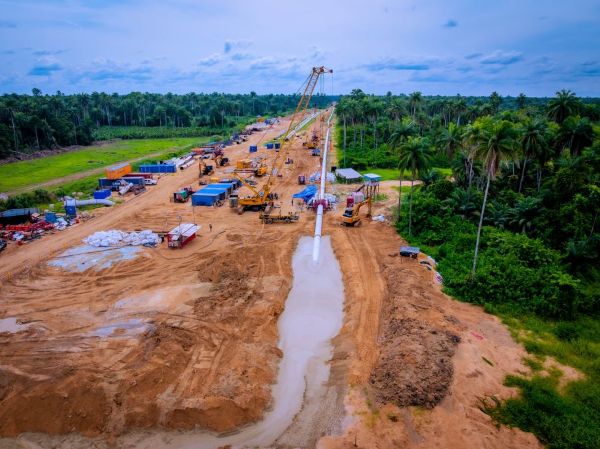
Nigeria’s state oil firm, NNPC Limited, has recorded a major milestone in its gas infrastructure drive with the successful completion of the River Niger crossing on the 130-kilometre Obiafu-Obrikom-Oben (OB3) Gas Pipeline.
The project, executed by the NNPC Gas Infrastructure Company, marks a critical breakthrough in the expansion of Nigeria’s national gas transmission network, effectively unlocking the full capacity of the OB3 pipeline to transport up to 2 billion standard cubic feet of gas per day.
The technically complex crossing—drilled approximately two kilometres beneath the River Niger riverbed—was delivered using advanced horizontal directional drilling (HDD) technology by the NNPC project team in collaboration with PCE Nig. Limited.
Group Chief Executive Officer of NNPC Limited, Bashir Bayo Ojulari, described the achievement as a defining moment for Nigeria’s energy infrastructure, noting that it would significantly enhance gas supply reliability and drive economic growth.
“The completion of the OB3 River Niger Crossing is a defining milestone for Nigeria’s gas infrastructure and a clear demonstration of what disciplined execution and sustained commitment to excellence can deliver,” Ojulari said.
He added that successfully navigating one of the most challenging sections of the pipeline would deepen domestic gas utilisation and support power generation and industrial expansion nationwide.
Ojulari noted that the milestone builds on previous engineering successes, including the completion of the AKK River Niger crossing in 2025, underscoring the company’s growing technical and execution capabilities in complex terrain, such as the Niger Delta.
He attributed the success to rigorous project governance, innovative engineering solutions, and the commitment of both NNPC teams and contractors, describing the OB3 pipeline as central to building an integrated and resilient national gas network.
The NNPC boss also acknowledged the support of the Federal Government under President Bola Ahmed Tinubu, citing the administration’s Gas-to-Prosperity agenda as instrumental in enabling the project.
According to him, the successful crossing ensures that Nigeria’s gas-producing regions are now physically interconnected with the rest of the country, strengthening supply networks and market access.
With a capacity of 2 billion standard cubic feet per day, the OB3 pipeline serves as a strategic backbone linking the Eastern and Western gas networks, while also extending supply to the Northern corridor through the AKK pipeline.
In the near term, the development is expected to unlock over 500 million standard cubic feet of additional gas supply for the domestic market, boosting electricity generation, industrial activity, and exports to the West African sub-region.
Ojulari reaffirmed NNPC Limited’s commitment to leveraging Nigeria’s oil and gas resources to improve living standards, while commending host communities, NGIC staff, and contractors for their roles in delivering the project.
