


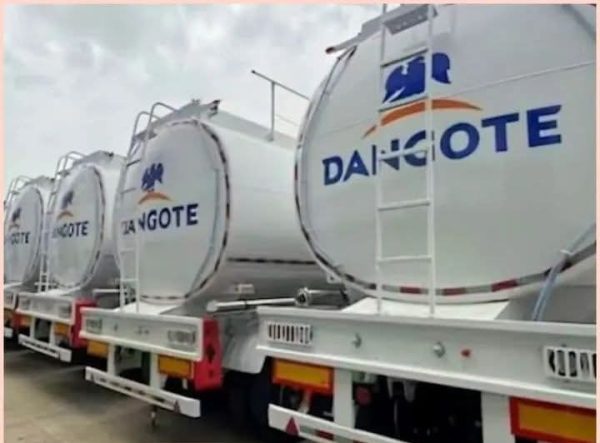
Nigeria’s oil refining industry posted its strongest quarterly performance in recent years in the second quarter of 2026, with output growth accelerating to 43.94 per cent year-on-year, as increased activity at the Dangote Petroleum Refinery boosted domestic refining.
The latest figures were contained in the National Bureau of Statistics’ Q2 2026 Gross Domestic Product report released on Monday.
The performance represents a significant acceleration in the refining industry, which recorded growth of 16.67 per cent for the full year 2024 under the rebased GDP series.
The Dangote refinery, located in the Lekki Free Trade Zone, has emerged as a major driver of the expansion following the completion of maintenance and expansion work in February 2026.
The facility’s crude distillation capacity was raised from 650,000 barrels per day to 700,000 barrels per day, allowing it to process larger volumes of crude and increase petroleum product output.
The increase in refining activity has also coincided with stronger crude supplies to domestic refineries.
Data from the Nigerian Upstream Petroleum Regulatory Commission showed that 53.7 million barrels were supplied to local refineries between April and June, representing 97.4 per cent of domestic crude and condensate supply during the quarter.
The Dangote refinery accounted for the bulk of the crude supplied to domestic refiners, accepting 52.6 million barrels out of the 68.1 million barrels offered by producers.
The stronger refining performance is increasingly changing Nigeria’s position in the petroleum products market, with the country moving beyond simply reducing its dependence on imported refined products to supplying overseas markets.
According to the US Energy Information Administration, Nigeria’s seaborne petroleum product exports averaged about 350,000 barrels per day in the second quarter of 2026, compared with an annual average of 46,000 barrels per day in 2023.
Europe accounted for about 130,000 barrels per day, while other African markets received nearly 120,000 barrels per day. A further 110,000 barrels per day went to markets in Asia and Oceania.
The refining expansion also coincided with broader improvement in the petroleum sector. Nigeria’s crude oil production averaged 1.72 million barrels per day in Q2 2026, while the oil sector grew by 7.31 per cent year-on-year.
The development comes as Nigeria’s overall economy expanded by 4.43 per cent during the quarter, according to the NBS report.
